Showing posts with label Christianity. Show all posts

Wednesday, May 30, 2012

Women that Rock My World: Two Book Reviews


Neither Anne Rice nor Sara Miles would be obvious choices to represent Christianity in American Culture. Rice is the renowned author of vampire novels and an erotic romance trilogy; Miles is a feminist lesbian former war-correspondent and chef. Both have walked difficult roads, far outside of, and often strongly critical of, the Church in America. And yet both experienced a conversion in their lives, not unlike Paul on the road to Damascus. While running from God, both were met by God and began new journeys as Christ-followers.

Miles told the story of her conversion in her previous book, Eat this Bread (read my review here). Out of that encounter came a passion to serve the people of her inner-city San Francisco neighborhood. She began a food ministry which has since grown to a city-wide endeavor. In Jesus Freak, Miles tells of the ongoing work of that ministry, and of her life, to feed the hungry, love the broken, heal the sick, provide for the destitute, offer friendship to the desperately lonely; to be the hands and feet of Jesus in the sharp brokenness of people's lives. This is a ministry to the immigrant, to the schizophrenic, to the addict, and to those who work amongst them. In beautiful prose, with humor and candor, Miles introduces us to the people of her world, tying them into the larger vision of the Kingdom of God. The parables of Jesus come to life in her community, and by revealing them to us, Miles challenges the rest of us to be about the work of God in our own world. This is raw, gritty stuff; often uncomfortable and painful, but it is the real stuff of life, and a prophetic message to the Church in America today.

Rice comes at it from a different angle; she is one who was raised in the church, but wandered away for many years. Only after decades of literary success and acclaim did she return to a faith she was convinced was dead. Whereas Miles came face-to-face with God in one completely unexpected moment, Rice came to a slowly dawning awareness that God had been pursuing her ever since she left. In her words, she was "Christ haunted." Drawn in by sacred images, by statues and paintings and the holiness of small South American sanctuaries, she felt her resistance fading, and finally stepped back into the embrace of God.

Both Miles and Rice offer the interesting perspective of newcomers, those looking at Christianity with fresh eyes. Both struggled (and continue to struggle) with the cultural and social trappings of the Church. Both describe the power of meeting Christ in the Lord's Supper, both speak of the impact of liturgy and art and language and song. Both have had difficulty bridging their progressive, liberal, left-leaning beliefs and ideologies with the conservate, fundamentalist, right-leaning American church. In fact, Rice would famously later 'quit the church in the name of Christ.' Miles, on the other hand, speaks regularly of her begrudging acceptance of the fact that, in the name of Christ, she willingly shares in the Kingdom of God with many who would cast her out, who disagree with fundamental issues of her life. In the words of one of the characters gracing the pages of Jesus Freak, "Since Jesus loves the knuckleheads who are running things I must try to, also, but I don't have to agree with them."

Rice reminds us of the beauty of God's presence in creation, in liturgy, in the soul's hunger for transcendence. Her descriptive passages of childhood memories of sanctuaries, flowering trees, and school gatherings remind us to open our own eyes to God's presence in the world around us. Miles reminds us of the image of God present in every human being, be they wealthy lawyer or tweaked-out crack-head. Her humor, and her obvious love for the outcasts and ragamuffins remind us to take people seriously - and not take ourselves so seriously. Both challenge the reader to take faith seriously; not as a hobby or accessory, but as the very thing that defines life.

Not that I don't find frustrations here, as well. Miles, in developing an earthy spirituality, grounded in the dust and grime of the Tenderloin, seems to miss out on the possibility of the supernatural showing up. Healing, to Miles, comes about when the soul is mended, when the heart is healed even if the sickness carries on. Comfort and hope are found in accepting the way life is and the way people are. Stories abound of people laughing in the face of death, or finding moments of grace in the midst of severe brokenness; on the other hand, the possibility that God might actually cure a disease seems missing. I agree that often-times the miraculous is hidden right there in the real stuff of life; sometimes, though, the miraculous blows us away and the lame do, in fact, walk again.

In Rice's case, the frustration comes in knowing the end of the story. Called Out ends so hopeful, with so much expectation; knowing that a decade later her frustrations overwhelmed that hope clouds the message. And yes, that frustration lies just as much with the Church as it does with Rice. We do lose sight of Christ in our debates over lesser things; we do focus too much on people's supposed sins, and don't care enough about their longings, their pains, their hopes and dreams. It's just sad that Rice felt the need to disassociate, giving up the possibility of engagement.

Near the end of Called Out, Rice writes, "The Lord Jesus Christ is where my focus belongs. And my commitment to Christ must remain unchanged." Near the end of Jesus Freak, Miles writes, "But Jesus is real, and so, praise God, are we." In the end, that's what is important in these two books. They are the autobiographical struggles of women trying to follow Jesus in the midst of a fractured world. Through fits and starts, failures and glorious successes, they continue on that journey. Through it all, they keep Jesus at center, and challenge the rest of us to do so. Neither is a sinless Saint, but both responded to the Call, and both are witnesses to the power of God's Spirit to change lives. They are, in many ways, examples of 21st century saints, following Christ in spite of long odds, and inviting us to do the same.

Wednesday, May 16, 2012

Book Review: One.Life


Are you a young person, trying to make sense of where your life fits into the larger scheme of this world? Are you out of college, hoping your life will mean something, and not just disappear into the haze of meaningless that is our culture? Have you hit middle age, and find yourself feeling like "there must be more to life than this?"

If so, then Scot McKnight's One.Life is the book for you.

It is McKnight's intention that life is supposed to be more than the humdrum of mindless entertainment, empty pleasure, vacuous reality-show stories, accumulation of stuff, boredom, disappointment, silly fights with friends, and all those other things we fill our lives with. Instead, we are given one life to live, and called into a glorious adventure of love, service, compassion, meaning, and world-changing work.

However, that can only happen when people truly and fully give their lives over to Jesus, letting Jesus lead, following his dreams, surrendering everything to his lordship. In McKnight's words,

Christianity isn't enough. Religion isn't enough. Being accepted in a church isn't enough. Climbing the corporate ladder isn't enough. Solving intellectual problems isn't enough. Chasing the American dream isn't enough. Friends aren't enough. Science isn't enough. Food and drink aren't enough. Fame isn't enough. Nothing's enough. The only thing that is enough is Jesus, and the only way to get to Jesus is to follow him, and that means one thing: giving your One.Life to him and following his dream.

McKnight makes clear that he is redefining a common misunderstanding of Christianity; namely, that following Christ is about making a one-time decision, and then spending the rest of our lives trying to follow a bunch of rules. Instead, the author slowly builds up his central theme, which is that followers of Jesus follow Jesus, devoting their lives to the Kingdom vision of Jesus.

The earlier part of One.Life is spent sketching this vision of discipleship even as he defines what, exactly, the Kingdom Vision of Jesus is (think peace, compassion, justice, and wisdom). In the latter chapters of the book, McKnight addresses some of the specific issues and contexts with which people struggle - why is the Church important? What does the Kingdom have to do with sex? How do I follow Jesus in a 'secular' job? Finally, the last few chapters are given to exploring God's Kingdom in light of eternity, God's nature, and the work of Jesus at the cross.

One.Life is a powerful book that is also accessible, fairly easy to read yet full of profound insight. There is so much confusion in the world about what it means to be a Christian (and let's be honest: to many, 'Christian' is not a good word). McKnight has offered a positive, hopeful, meaningful vision for what life can and should be, a life that finds its meaning simply by following Christ through the ordinary moments as they come.

Thanks to Zondervan for offering One.Life as a free gift to Ministers in the Evangelical Covenant Church at our Midwinter Conference.

Tuesday, December 06, 2011

Book Review: Reaching Out


Loneliness, hostility, illusion - these things mark the lives of so many humans, wandering through life trying to survive, trying to find meaning, trying to make sense of it all. Broken by a sinful world, we find ourselves isolated and angry, living in illusions of our own making that cover over the reality of our pain.

Rather than avoiding all three, Henri Nouwen sees each as a starting place toward wholeness, as we realize each has something to teach us, and each can lead us deeper into the heart of God. In Reaching Out, Nouwen explains how our loneliness, painful and frightening as it is, can be transformed into solitude, the quiet place where we can know ourselves better, and the place where we can finally rest in the comforting presence of God's Spirit. "Instead of running away from our loneliness and trying to forget or deny it, we have to protect it and turn it into a fruitful solitude." The Christian life needs its time in the desert; by developing hearts that are comfortable with solitude, we can find again what it means to commune with God, and thus be better equipped to live with our neighbors.

This leads to the second movement - from hostility to hospitality. Because we are lonely we are protective of our space, and we often use others to fill up the empty spaces in our lives. "When hostility is converted into hospitality then fearful strangers can become guests revealing to their hosts the promises they are carrying with them." Hospitality, according to Nouwen, is "the creation of a free space where  the stranger can enter and become a friend instead of an enemy." Hospitality is a ministry in which the host creates space for the guest to come as they are and find themselves. Nouwen sketches this out in the context of the teacher/student, parent/child, and healer/patient relationships. In each of these, says Nouwen, "Affirmation, encouragement and support are often much more important than criticism. The good host is the one who not only helps the guests to see that they have hidden talents, but who is able to help them develop and deepen these talents so that they can continue their way on their own with a renewed self-confidence."

Unfortunately, our loneliness and hostility is often hidden behind a veneer of illusion. We have such a hard time getting to the heart of our brokenness. We live as if we are immortal. We cover over our hostility with sentimentality. We make idols of our dreams, thinking ourselves much greater and of more importance than we really are. The answer is found only in prayer - not the pious platitudes of religion, but open, honest communication before the God who knows us better than we know ourselves. "When, however, prayer makes us reach out to God, not on our own but on his terms, then prayer pulls us away from self-preoccupations, encourages us to leave familiar ground, and challenges us to enter into a new world which cannot be contained within the narrow boundaries of our mind or heart."

Like all of Nouwen's writings, this book is deceptively simple. It is a short and easy read, yet so rich and deep that it requires time to ponder, contemplate, and re-read. Even more, it requires action - not programs or plans, but action of the soul, as we seek to reorient our lives back into line with God's loving desires for us. It is an extremely helpful book for people whose lives have settled into religious routine, who feel stifled, who feel like it's time for something new but are uncertain where to turn. It's a book that requires a little maturity, but will lead to so much more.

Friday, October 28, 2011

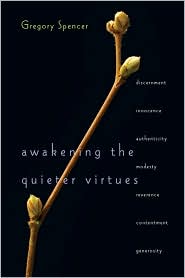
Book Review: awakening the quieter virtues


We often define our faith by a big list of things we should do, and things we shouldn't do. Most of the items on those list also fall into the category of obvious and important things we should do (like go to church, love our mother, behave respectfully) and, more explicitly, the Big Sins we should avoid (murder, lust, pornography, addictions, voting for a Democrat, and stealing).

Gregory Spencer has written Awakening the Quieter Virtues, a very helpful book calling our attention to the fact that more often it's the little things that really count, the quieter virtues that really make a difference. It's the unseen practices that mold us and shape us as Christ-followers, and that slowly change the world around us. Much like yeast working through the dough, the quieter virtues act from deep within us, not calling attention to themselves yet all the while forming us and assisting us as we seek to be like Christ.

Not only does he point out this often-overlooked point; Spencer spends the bulk of the book working through these quieter virtues, explaining what they may look like in our 21st-Century lives. He peppers his work with stories from his own life and the lives of his friends and students (he teaches at Westmont College). The book is not an esoteric description of spiritual disciplines unattainable by normal, non-spiritual folks. He proves that with a little effort, anybody can put these virtues into practice and slowly see their spirit drawn closer to the Spirit who gives life.

Certainly these are important virtues for our world today, and if the church were to put these into practice, we would begin to shine a brighter light into a dark world. Virtues Spencer explores include discernment, innocence, modesty, reverence, contentment, and generosity. Each virtue is paired with a spiritual discipline that is useful to form that virtue in the reader's heart. However, I must say again that Spencer is not working toward a pious, self-righteous unearthly spirituality. He labors to plant these virtues firmly into the soil of our postmodern lives.

This certainly isn't a theological tome, and the fact that Spencer teaches college students shows up in his writing. Some may be put off by his attempts to be catchy, but in the end I appreciated his efforts to contextualize this work, making sense of it for our time and place. It reads lighter than Nouwen or Merton, but to that end would be especially useful for people without much (if any) experience with the concept of spiritual disciplines.

Awakening the Quieter Virtues was a gift given to Covenant pastors at last year's Midwinter conference. I appreciate that people within our denomination are generous in their gifts, and thoughtful in the books they send out way.

Wednesday, January 07, 2009

Book Review: A Faith And Culture Devotional


Kelly Munroe Kullberg and Lael Arrington want to stretch your brain. They want you to think broadly about the intersection between faith and the world in which we live. To that end, they've delivered the Faith and Culture Devotional: Daily Readings in Art, Science, and Life.

The premise is simple enough. Kelly and Lael have searched the archives of Christian thinking , and have pulled out writings of note, organizing them into seven different categories: Bible and Theology, History, Philosophy, Science, Literature, Arts, and Contemporary culture. These are then presented in the devotional, complete with questions for reflection and discussion, and biblical references to shed further light on the topic.

The devotional is set up up to last 15 weeks, with readings from a different category for each day of the week. Thus, on Monday you'll have a reading from Bible and Theology, on Tuesday a reading from History, on Wednesday you get Philosophy, etc.

The authors whose works are used rum the gamut of popular writers, scientists, theologians, pastors, professors, researchers, and musicians. Some are familiar, others are relatively obscure outside of their fields. You get best-selling author John Eldridge, you get Walter Kaiser, Professor of Old Testament at Gordon Conwell Theological Seminary, you get Hugh Ross, astronomer and astrophysicist, you get Guillermo Gonzalez, professor of physics at Grove City College, you get J.P. Moreland, professor of philosophy at Talbot School of Theology, you get John Stott and Lee Strobel and Randy Alcorn and R.C. Sproul and Michael Card. You even get Covenanter Scot McKnight. And, just to be honest, you get a healthy dose of Kelly Kullberg and Lael Arrington, the editors of the devotional.

The topics range across a wide spectrum. Some of the daily titles include:
- Sex, intimacy, and worship
- The Bible and its Influence of Literary Arts
- DNA: The Beauty and Intelligence of the Designer
- The Strange Small World of Quantum Mechanics
- Jesus' Resurrection: When Truth Confronts our Worst Suffering
- The Secret Gospels
- The Small and the Big Gospel
- The Council of Nicaea: The Voice Beneath the Altar
- Ziegenbalg: India's First Missionary
- Belief, Knowledge, and Truth
- Moral and Ethical Relativism
- Theodicy
- The Periodic Table of the Elements
- Vincent Van Gogh and Seeing
- The Impressionists
- Postmodern Architecture
- U2
- Bob Dylan: Slow Train Coming
- Burning Man
- AIDS

Get the idea? There's something in here to stretch everybody.

The strength of this devotional is in that breadth - every day, you ought to be challenged with something new. Yet each topic is confined to a mere few pages, thus the reader isn't overwhelmed with reams of information on the topic - just enough to get you thinking. The editors have helpfully suggested scriptures that speak to the topic, thus tying everything back to the Word. The questions at the end of each day would be suitible for mulling over on your commute, or sitting in a small group and discussing into the night.

As to weaknesses? Some might point out that "devotional" usually means The Word - beginning with the Bible and moving outward, rather than beginning "out there" and then eventually getting around to scripture. If this book is meant to be primary material for time spent with God, I would have hoped the Scriptures led the discussion, rather than coming in at the very last moment. And, of course, in a book with as many sources as this, there are bound to be authors who the reader isn't going to enjoy. Scanning the list, I quickly found a few on who've been taken off my "people I want to read" list. The premise of this book is "Deep thinking by great minds." Quite often, I don't equate "best-selling Christian author" with "Great Mind." Perhaps the editors relied just a little too much on the shelves of the Christian bookstore for their ideas.

But. . .I plan on continuing to work my way through this book, and would gladly recommend it to anybody and everybody looking for some new spice to throw into the stew. If your reading list has become a little one-dimensional, if your intellectual life has grown stagnant, then please, do pick up A Faith and Culture Devotional and allow your mind and soul to be stretched anew.

Wednesday, September 03, 2008

Book Reports

Just before heading off to family camp, I finally finished Shane Claiborne and Chris Haw's Jesus for President.


If you spend any time searching internet discussion boards for opinions about this book, you'll realize it's struck a chord. People either love it, believing it's the answer to the malaise facing the 21st Century church, or they'll hate it, believing it twists and distorts scripture to promote a pacifist, communist, anti-american agenda. Like a Rorschach test, reactions to this book probably say as much about the reader as they do the content of the book itself.

I should begin by saying the book isn't saying anything all that original. In other words, Claiborne and Haw aren't promoting anything they've discovered for themselves. Instead, they have ingested the work of people like Wendell Berry, Gregory Boyd, John Howard Yoder, Marva Dawn, and Walter Wink, they have listened carefully to the anabaptist voice within Christianity, they have synthesized the work of those thinkers and writers and theologians and peacemakers, and they have published a manifesto to the 21st Century Church - a call to the church to return to its roots as an alternative community, a seperate, holy people, called apart from the kingdoms of earth to live as the Kingdom of God on earth.

Two quick strenghts of the book:
1) This is biblical theology as opposed to systematic theology. In other words, the book focuses on the broad sweep of Judeo-Christian history, beginning in the garden and carrying on through Abraham, Israel, Jesus, the Church, up to the images of victory in Revelation. They then take the large sweep of biblical history to paint the full picture of rebellion and redemption in which we find ourselves. Thus, rather than nit-picking what "this verse over here" means up against "that verse over there," they instead ask "what has been God's plan all along?" This, to me, is the healthiest way to let the Scriptures speak into our lives.
2) It's a beautiful book. Literally. Shane and Chris employed the work of artists to craft a book that is fascinating to look at. Every page is a painting, a photo, a stitch-work, a challenge, a delight. Thus, the book challenges not just the intellectual side, but the artistic side, as well. Sometimes the pictures, the questions, the images speak even louder than the text on the page. This is obviously a labor of love for the authors.

My take on the book: For the most part, I think Shane and Chris are dead-on. Their critique of the 21st-Century American Church nails us all. They rightfully see the ways in which The Church has sold out to a culture of shopping, a culture of idolatry, a culture of power-play, and how the church has abandoned the call to "take up our cross" and follow Christ. At the same time, they don't stop at critique. In fact, most of the book is given to suggestions on how to move forward, and examples of communities of faith who come close to reflecting Christ in their lives. So they challenge the Church, but they challenge the individual Christian as well. How, exactly, do we follow in the pattern of Christ who had no home when we spend massive amounts of money on plasma televisions and name-brand sneakers? How exactly do we claim to follow the Prince of Peace when we so enjoy violence, when we so quickly call for retribution upon our enemies? How do we show love to our brothers and sisters when we participate in an economy that is so unequitable? How do we worship both the Father of All Nations and at the same time worship the country in which we live?

To read this book is to read a call to live a different kind of life. It challenges, it exhorts, it pushes on some tight spots. But I think it's a necessary read by any who would claim Jesus as Lord. So go read it. Then let's talk some more.

______

So this is what came out of the Amazon box last week, and now is on top of my reading stack:

Saturday, August 23, 2008

At the risk of offending everybody

Like most pastors in North America, I've been asked about Todd Bentley and the revival with which he was a part in Florida. And while I had some concerns, I didn't want to deny the possibility that God was truly up to something down there. Now that Todd has fallen, and fallen hard, people are trying to figure out what it all means.

1. Does this just prove it was false to begin with?
2. Does this just prove that Satan has attacked the Lord's anointed?
3. Does this just prove that everybody is fallible, even God's servant?
4. Does this just prove Todd was a sham and his work a put-on?
5. Is God still causing revival, even with Todd no longer a part?

I'll tell you a little of my starting position: historically, true revival has always been marked by repentance more than healing. Changed lives, more than fixed bodies. And, from the little I paid attention to this one, I can't say I saw much of a spirit of repentance. It seemed more about "getting the goods" (be it healing or "an anointing") and less about deep, Spirit-led repentance with a parallel commitment to mission and ministry. So I wasn't completely sold.

But tonight as I read a few of the news reports related to Todd's, ahem, indiscretion, as I sifted through some "comments" pages and some blogs related to the issue, it began to dawn on me that I'd been looking at it all wrong.

What we have here is the latest in a series of "revivals" - Toronto, Modesto, Brownsville, and more. All have drawn a lot of attention, all were marked by healings (or, at least, rumors of healings). And while most made extravagant claims to "commitments to Christ," the numbers never played out. For instance, in Modesto they proudly tell of the 70,000 people who accepted Jesus there. Unfortunately, church attendence in the area didn't grow by 70,000 people. It didn't even grow by 10,000 people. If I remember correctly, church attendence didn't grow AT ALL following the event. (Well, the church hosting it grew; most of the other churches in the area lost attendence; iow, it was simply church-hopping, not conversion growth).

Yet the hosts of these revivals proclaimed loudly that God was pouring out his blessings, and tens of thousands of people flew into town, or drove in in their motorhomes; the revivals saw packed-out buildings for weeks on end as Christians showed up to take part. I know of people here in Washington who flew all the way to Florida to take part in Bentley's "anointing."

But the sad truth is, there is no long-term appreciable difference in the Church today. Those who go to these revivals have a powerful experience, they meet God in new ways. Supposedly some are healed (although it would be nice to see some hard, fast evidence, like doctors going on Nightline saying "20 of my patients came back to see me, and I can say the blind can now see, the deaf can now hear, the lame can now walk."). But when all is said and done, the Church is no different.

So here's my question: Is this not the exact same thing as when Catholics claim a vision of the Virgin Mary, and suddenly tens of thousands of people descend on some poor town, hoping to see the Virgin themselves? They believe it passionately, they claim a deep spiritual experience, they dismiss any negative voice in their midst. And we laugh at them with their silly superstition. How crazy, that they would believe Mary is there and wants to show herself to them.

But yet isn't this talk of revivalism the same? It has more to do with the "faith" of the people than any tangeable evidence or report. Any Christian who questions the authenticity is accused of "quenching the Spirit" or denying the power of God. Even when things fall apart, when healing doesn't happen, when conversion growth doesn't appear, the emotion of the moment carries everything on of its own accord.

I'm not saying God can't work through Todd Bentley. I'm not saying God doesn't show up when people seek him. I am saying I'm concerned that often we mistake our emotions, and the emotions of those around us, for a movement of God. Most Protestants would scoff at the Catholic who runs to Omaha to see Mary (or Jesus) in a piece of toast. Should we not apply the same standard to Christians who need to run off to Florida to see Jesus in a questionable servant?

I'm just asking. Feel free to disagree.

Friday, December 21, 2007

And one more inspiring story

Last Sunday I announced that this coming Sunday's offering would be given, in its entirety, to a disaster relief fund at a sister church in Aberdeen, to help people who have suffered so much since the storms hit Washington a few weeks ago. After the service Sarah W and Sarah T, two of our more energetic and precocious junior high girls, came up to me and told me they wanted to do a fundraiser to collect money for disaster relief.

If you spend any time in ministry leadership, you get these all the time. People come with great ideas (usually when you're really busy) and expect you to jump on in and make their ideas happen. So most pastors learn the art of reflection: "That's a great idea. Why don't you make it happen and keep me informed." 90% of the time nothing ever comes of it (until they decide to fire you, claiming that you "never listen to our ideas!", but that's another story).

So imagine my surprise when Sarah and Sarah told me Wednesday night that they were doing a bake sale at the Peninsula Market, and could they borrow a table and coffee pot to heat up water for hot chocolate?

I stopped by and saw them on Thursday, following the men's breakfast, and there they were, miserably cold but laughing and goofing off as only Junior High girls can do. They had a table full of cookies they had made the night before. They had a huge poster announcing that this was a Disaster Relief Bake Sale. And they already had a bucket-full of money. Even local politician Al Yanity stopped by and donated to the cause.

This morning, Sara W.'s mom stopped in with the money they raised, which amounted to a little over $200. And they did it all of their own initiative. They did all the work. And I think they even enjoyed themselves.

That is the spirit of Christmas. Even more, that is the Spirit of Christ at work among His Children. Sarah and Sarah have been an inspiration to me this year, reminding me of all that is good about God's people and this community. So this is a public Shout-Out to the Sarahs (squared). You are wonderful, amazing young ladies who God has used to bless people who are suffering. I am proud of you, more proud than I can say.

Now, can I clone you two? With a few more like you, we could change the world.

Wednesday, November 14, 2007

Absolutely Tasteless

You know, there are a lot of things out there that are sold in the name of Christianity that I wish would just go away. Why Christians go for the cheese factor I'll never know. I'm thinking of things like my Jesus Nightlight ("Let His Light Light Your Way"), Testamints, christian T-shirts, and Carman. And everything sold by the Oriental Trading Company.

When I worked for a christian bookstore I was continually amazed at the stuff that we had to sell in the name of Christianity. It seems you can slap the name "Jesus" on anything, and that makes it good for Christian Consumption. And if you can come up with a catchy phrase like "Jesus Makes Me Beary Happy," then you truly have a winner.

But I saw this yesterday, and this. . .this beats them all. I have labeled this the Absolutely Worst Idea Ever:


They are little mints, shaped like crosses, in a little tin can made to look like a Bible. I can hear the promo now: "The Cross: instrument of terror, the most devious torture device ever invented, and now it freshens your breath, too!" Or "The Cross: It saved the world, and now it saves you from bad breath!" Or perhaps you could get really creative: "Bothered by the demons of bad breath? Frightened by the evil forces of foul smells emanating from your mouth? Then use the power of the Cross to be cleansed and protected again! Cross Mints - Your Salvation from Social Anxiety!"

I mean, really. Who thinks up these things? Who decides this is a good idea? And who actually buys this crap?*

Remember - the cross was not cute. It was terrible. Death by crucifixion was not clean and quick. It was by all definitions cruel and unusual. Those crucified peed and pooped on themselves, they bled for days. They felt the pain of nails hammered through their hands and feet, they hung under the sun all day, they felt the humiliation of hanging naked for the world to see. And the Romans did this to people over and over and over again to make the point: don't mess with us, or this is what you'll get. Nails through your wrists and ankles, legs broken with 2x4s, and one long, slow, excruciating death.**

The cross then became the instrument of the salvation of the world. All our hope goes back to the cross and resurrection. The cross is the singularly most important moment in human history. The cross is at the center of all we say and do and believe as the people of God. The cross ought to be approached with wonder, awe, terror, and joy at God's love portrayed there.

But, no. We're going to turn all that into a mint and sell it to unsuspecting Sunday School teachers to give to their classes. The word "desecration" comes to mind. It certainly is utterly demeaning to Christ's Victory won there. And it sure confuses the little kids who eat these things - how ever will they take the cross seriously when we treat it with such superficiality?

So there you have it. #1 on my list of "Worst Ideas Ever." It would be funny if it weren't so supremely sad.

____________
* I realize that the usage of the word "crap" may offend some of my more sensitive readers. However, in this context, the word is not used flippantly, but is the best word to describe the utter nonsense of turning crosses into mints. Strong situations call for strong language.

** For a more culturally relevant feel for this, imagine if they made mints that looked like trees with nooses thrown over the branches. Or mints that looked like electric chairs. Or mints that looked like concentration camp gas chambers. Imagine the outrage if that happened.

Thursday, August 30, 2007

Yes, I'm Glad

I am rejoicing that all remaining Korean hostages have been freed. This is a moment to celebrate. It is an answer to prayer. This could have turned out much worse. At moments, I expected to turn on the news and hear they had all been killed. I am sure the relief felt by them and their families is overwhelming. Praise the Lord.

However,

what troubles me is this line:

"Seoul also said it would prevent South Korean Christian missionaries from working in the staunchly Muslim country, something it had already promised to do."

I'm wondering how the Korean Church feels about this pledge. On the one hand, it got their friends and family home. On the other hand, it effectively removes any possibility of being God's ambassador in that land that so desperately needs God. Could the Church ever agree to a deal that stands in the way of doing Kingdom work anywhere in the world?

Gospel work is never safe. When God calls, he doesn't promise health and freedom from harm. Sometimes God calls Christians to very dangerous places. Many Christians pay the ultimate price. I'm sure the Korean missionaries and their families are thrilled that this incident is over. But will the price paid for their freedom be worth it?

We'll have to wait and see.

Friday, May 11, 2007

Study Time


I'm going to learn how the Mennonites are speaking to the issue of homosexuality and the Church. Should be an interesting read, since they always come at these issues from angles other than the normal ones.

From the intro:
"What this issue should be about is discernment: trying to discern the will and way of God on this matter at the threshold of the third millennium of the Christian Era. I know, others will disagree with this premise. For some, the issue is standing up for an oppressed minority; for others, it is standing up for the truth as they know it. (Is there any other?) But if we can't step back from our own positions long enough to hear the perspectives of others, then dialogue, if not discernment, is foiled.

In many such cases, the schismatics are putting their own convictions, ideas, and religious experiences - egos, too - ahead of the unity of the body and this treasure we call peoplehood. Whereas I am not comfortable with the current struggle over the 'H-issue,' as one chapter in this book calls it, I am even more discontented with the flight option [running away from each other and the debate].

What I plead for, instead, is a commitment to the common struggle of discovering God's will for us. To do this, we need at least the following: confession, empathy, humility, patience, and prayer."

Whenever I read stuff like that, I'm convinced that the Mennonites and Covenanters are cut out of much the same cloth. So I think I'm going to get a lot of good from this book. I'll let you know.