

This post may be a little late to the party, but it's been on my mind for a little while. It's genesis was in the infamous Ham/Nye debate regarding Young Earth Creationism, but found more traction following last week's World Vision fiasco surrounding their decision to hire people in same-sex marriages, a decision that was quickly rescinded in the firestorm of backlash that ensued.
But this isn't really about either of those particular instances, so much as the way we all behaved in the midst of the storm.
For the most part, Christians behaved rather badly.
A few years ago, we here at Lakebay Community Church adopted a Relational Covenant; a document that spoke to our way of living together. Recognizing that people have differing thoughts, beliefs, opinions, and values, we committed ourselves to function together in a way that will allow us to stay focused on the greater values of loving God, loving each other, and loving the world, and (hopefully) not become fractured over secondary issues.
This is what we committed ourselves to be:
- Friendly
By which we mean we approach each other with an attitude of good will, of basic trust, of seeing and hoping the best, rather than suspicion, doubt, fear, and judgment. We begin with the premise that the other is a good person acting out of good motives, having good reason for what they do and believe.
- Listening
Before ever casting judgment or thinking we understand another, we take time to ask good questions, to get to know them, to do our best to really get the fullest picture of why another acts the way they do, believes what they do, says what they say, fights for what they fight for. We listen before we speak.
- Accepting
The Covenant Church bases much of its ecclesiology (the way we do church) around Psalm 119:63 - "I am a friend of all who fear Thee." We find we disagree with people, but we accept them anyway because we see the Image of God in them. Rather than draw dividing lines, we stay in relationship with people, even people who hold to different ideas/political persuasions/theological understandings.
- Compassionate
And thus, rather than living in suspicion or hostility or division, we are able to live out lives of compassion, because we understand and accept people with whom we disagree. We carry out the greater commandments of loving God by loving our neighbor, even when it's not easy.
Now, if you look closely, you'll see there's a fun little acronym there, if you take the first letter of each of those four points: FLAC.
And so I told the church we all need to work hard at giving each other more FLAC. It's something I remind myself of time and again, when I'm growing tired or frustrated or antagonized over disagreements and misunderstandings. Just when I'm tempted to dismiss or lash out, I hear that voice saying "Give 'em some FLAC, Dan." And on my better days, I do just that.
So it was last week when the internet erupted over World Vision's decision, when Christians were casting WV out of evangelicalism (there was more than one "Goodbye, World Vision" tweet), when my own faith was being questioned by people who knew me, when I saw nothing but anger and judgment and condemnation and outrage, I found myself thinking of how much better this would all be, had people known about the concept of giving people FLAC.*
I wasn't in on the inner workings of it all, but I wonder if Franklin Graham called up World Vision and said "so tell me about this - why did you make this decision" before posting his scathing rebuttal? If Al Mohler had his people contact the people at WV and say "could we meet? I'd like to understand what you're doing." If the leadership at the Assemblies of God (who encouraged their membership to slowly stop supporting WV) made any attempts to listen to the leadership at WV? If any of the 2,000 people (or was it 4,000? Or 5,000? I've heard various reports)** who instantly called and cancelled their support made any attempt to really listen and understand why WV did what they did?
The response I saw certainly couldn't be categorized as "approaching one another with an attitude of good will." Instead it was more akin to "this is the end of Western Civilization and WV has just sounded the death knell of all things Christian."
I know there are Big Issues that need to be worked through, but I find more often than not my concern isn't so much the issue, but how we work through these issues. After all, Jesus said the world would know we were his disciples by the love we have for one another. Instead, so many jumped on Facebook and Twitter to denounce, condemn, pounce, and judge, and the world just laughed at us (or shook their heads in disbelief and said "see - that's why I'm not a Christian.")
Here's my little part of trying to make the Church healthier. Can we please learn to give each other some FLAC, and stop with the judgment and condemnation already? The hysteria isn't good for the Kingdom, and will never help resolve any of these issues. Please. Let's learn to give each other some FLAC, living as Christ commanded as we love our God and love our neighbor.
_____________________________
*The sad thing is that, while I wouldn't expect any of these Christian leaders/spokespeople to know anything about Lakebay's relational covenant, the principles are right there in scripture. Maybe Al and Franklin didn't know about giving people FLAC, but they certainly know the words of Jesus and Paul, which encourage us time and again to act in love and compassion and understanding and unity, and to "judge with right judgement," which doesn't include press releases denouncing decisions we have yet to fully understand.
** Update: Various sources are reporting today (4/3/14) that it was actually closer to 10,000 kids who've lost their sponsors. I can't imagine Jesus being proud of all those people who displayed their offense by abandoning hungry children.
Showing posts with label church. Show all posts
Showing posts with label church. Show all posts
Thursday, April 03, 2014


Friday, February 01, 2013
Shopping at Wal Mars
Note: This is not a post about Wal-Mart
I generally avoid shopping at Wal Mart. I just don't think it's a healthy practice to spend my money there.
That's not to say I'm judging people who shop at Wal Mart. That's their choice. Although, if given the chance, I would encourage them to shop elsewhere. I just don't think that Wal Mart is good for the world.
But let's be clear: it is possible to be a good person and still shop at Wal Mart. I can imagine a father or mother shopping for groceries at Wal Mart, and taking those groceries home and cooking up a nice meal for their family, all out of love for their family and the desire to share a meal together. And the family will eat and be filled, which is a good thing. I can also imagine a man or woman picking up a copy of It's a Wonderful Life and some popcorn at Wal Mart, taking them home, and enjoying a wonderful family night building up a sense of tradition and love of the season. In fact, I can imagine a person picking up a book at Wal Mart, taking it home and reading it, and thus learning something and being a better person. To that end, good can come from shopping at Wal Mart.
But this isn't a post about Wal Mart.
There are tens of thousands of people who go to work at Wal Mart every day, people who put in their eight hours and go back to hearth and home; the paycheck they are paid by Wal Mart puts a roof over their head and food on their table and medicine in their children and perhaps covers a family vacation to the coast. And you know that gentleman who stands at the door of Wal Mart, saying "hello" to all who enter? I happen to believe he's a genuinely nice man who genuinely cares about people and really does want them to have a nice shopping experience. So it's not as if I think everything about Wal Mart is bad. There is much good there.
(remember, this isn't really about Wal Mart)
On the whole, however, I believe Wal Mart does more harm than good. It puts too many local shops out of business. Causes too many empty or struggling downtowns and main streets in small towns from Iowa to California. It sells cheap junk made by struggling people in dirty factories too far away for us to care. While the food bought there may fill the body tonight, over the long-term all the additives and high-fructose corn syrup and highly-processed food substances are not healthy. The food they are selling is literally killing us in the form of obesity, diabetes, cancer, and the like. Not to mention the local farmers driven out of business by the corporate factory farm system that allows Wal Mart to sell food cheaply.
"But they're just giving the customer what they want," some will argue. And that's probably true. But it doesn't wash the blood off their hands. Wal Mart takes money from local economies and sends it away to corporate coffers and the accounts of shareholders in cities far away. The world would be a better place if filled with local shops who knew their customers, who sold local products, who took their profits and reinvested in the local economy.
So yes, you can shop at Wal Mart and have a richer life. You can work at Wal Mart and be a good person. But the entity that is Wal Mart still does more damage than good. So I choose not to shop there, and whenever possible, I encourage people to shop locally, to buy organic, to support the mom-and-pop store down the street.
But, this isn't really about Wal Mart. I just wanted to show that it is possible to think about things in a way that isn't exactly black and white, good vs. evil. It's a bit more complicated than that. But I also wanted to make the case that, while a thing might create space for individual good, it can, on the whole, still be less-than-good.
What this was going to be about: a particular church across the water from us over there in Seattle. But then I realized, it applies to a lot more than just that one church over there. In fact, I could think of a few more churches to which it applies. Plus. . .if I name that one church, we'll never get to the issues at hand. My former pastor Gary once (wisely) told me "you can talk issues and theology all day, but once you name names, you'll lose the discussion because it becomes personal." So I'm taking this a slightly different direction than I planned at the start.
Still. . .in thinking about those churches, be they in Seattle or Federal Way or Tacoma or Redding or Tulsa or Orange County, the principle is the same.
I know a young man whose life was probably saved through the ministry of that church. This man was walking down some dark roads, engaging in self-destructive behaviors, falling deeper into depression, and then found Jesus in that church. It turned his life around.
I have friends who attend those churches. Some who have done ministry trips with those churches. I know young men who are passionate about studying the Bible and living lives of righteousness, abandoning the pleasures of the world in pursuit of Christ. I know young people who engage in theological discussion, who serve the poor and weak, who act kindly and with compassion, who desire nothing more than to serve God with their lives. And they worship at one of those churches, and it has been good for them.
It's just that, on the whole, I don't think those churches are good for the Kingdom of God. I think, like Wal Mart, they deal well in volume and sales, but the country isn't better off for it. A few people may be better off, but the rest of the world is all the poorer. I think that, like Wal Mart, sometimes the brand becomes the thing, and the celebrity pastor takes on the mythical character of Sam Wal (he's such a down-to-earth guy; he's so genuine, he just wants to do what's right). A lot of work goes into defining and defending the brand. Consumer market forces take over - evangelism turns into marketing.
It gets difficult, of course, because whenever somebody tries to criticize one of those churches, or point out the many ways they fall short of true biblical health, then somebody will say "but it's been good for me!" and you can't argue with that. Or when one of their pastors sends out an offensive tweet criticizing, say, the President of the United States, and calling into question his very faith, everybody defends said pastor either because a) they've been suckered into thinking this pastor always does what's right, or b) they'll excuse that behavior in light of all the good he's done.
Okay, forget that part about not naming names. Can you go to Mars Hill and be a good Christian? Absolutely. But would the world be better if, instead of a few Mars Hills, there were hundreds of small, healthy missional churches scattered throughout the city? Yes. Can you go to Christian Faith Center and be a good Christian? I suppose it's possible. But, overall, is the world healthier because of the size and influence of Christian Faith Center, and the particular theology it espouses? I don't think so. And do these churches do more harm than good? Overall, you can be the judge. But I think so.
Pastor Driscoll, Pastor Treat, and so many others might mean well. They might be decent people. They might have started with a healthy idea of building a church. But somewhere along the way, what had been a nice little communitystore church turned into a cultural behemoth that cheapens society and undermines the fabric of our culture. I can point to individuals who have had a positive experience at Mars Hill. But we can also point to the consistent stream of bullying, insults, petty attacks, and manipulative techniques coming out of those churches. We can talk about the caustic atmosphere they bring to Christianity, in which each and every question and critique is treated as a direct challenge that needs to be crushed. We can talk about the men being taught to control their wives, and the women being taught that subservience is their greatest good in life.
We can talk about the bad theology, be it the particular neo-calvinism of Mars Hill or the Prosperity Gospel at Christian Faith Center, and the way it seeks to control the gospel and those who profess to follow it. We can talk about the horror stories coming out about *alleged exorcisms in Driscoll's office, the shunning of those who dare challenge authority, the blaming of women when their husbands stray, the judgment and condemnation of those who hold to different doctrinal understandings. The appearance of pride and arrogance rather than humility and service. The gospel that seeks to define boundaries rather than cross those boundaries in love. Silly but offensive tweets on inauguration day.
Can you go to Mars Hill or Christian Faith Center or Bethel Church and be a good Christian? Absolutely. Can you grow in your faith and experience Christ there? I know you can. Have those churches done good in the name of Jesus? Yes, they have.
But would the world be a better place if more people found healthier local churches in which to grow and serve? Would I recommend people find someplace else to worship and serve? Yes. Yes, I would.
I generally avoid shopping at Wal Mart. I just don't think it's a healthy practice to spend my money there.
That's not to say I'm judging people who shop at Wal Mart. That's their choice. Although, if given the chance, I would encourage them to shop elsewhere. I just don't think that Wal Mart is good for the world.
But let's be clear: it is possible to be a good person and still shop at Wal Mart. I can imagine a father or mother shopping for groceries at Wal Mart, and taking those groceries home and cooking up a nice meal for their family, all out of love for their family and the desire to share a meal together. And the family will eat and be filled, which is a good thing. I can also imagine a man or woman picking up a copy of It's a Wonderful Life and some popcorn at Wal Mart, taking them home, and enjoying a wonderful family night building up a sense of tradition and love of the season. In fact, I can imagine a person picking up a book at Wal Mart, taking it home and reading it, and thus learning something and being a better person. To that end, good can come from shopping at Wal Mart.
But this isn't a post about Wal Mart.
There are tens of thousands of people who go to work at Wal Mart every day, people who put in their eight hours and go back to hearth and home; the paycheck they are paid by Wal Mart puts a roof over their head and food on their table and medicine in their children and perhaps covers a family vacation to the coast. And you know that gentleman who stands at the door of Wal Mart, saying "hello" to all who enter? I happen to believe he's a genuinely nice man who genuinely cares about people and really does want them to have a nice shopping experience. So it's not as if I think everything about Wal Mart is bad. There is much good there.
(remember, this isn't really about Wal Mart)
On the whole, however, I believe Wal Mart does more harm than good. It puts too many local shops out of business. Causes too many empty or struggling downtowns and main streets in small towns from Iowa to California. It sells cheap junk made by struggling people in dirty factories too far away for us to care. While the food bought there may fill the body tonight, over the long-term all the additives and high-fructose corn syrup and highly-processed food substances are not healthy. The food they are selling is literally killing us in the form of obesity, diabetes, cancer, and the like. Not to mention the local farmers driven out of business by the corporate factory farm system that allows Wal Mart to sell food cheaply.
"But they're just giving the customer what they want," some will argue. And that's probably true. But it doesn't wash the blood off their hands. Wal Mart takes money from local economies and sends it away to corporate coffers and the accounts of shareholders in cities far away. The world would be a better place if filled with local shops who knew their customers, who sold local products, who took their profits and reinvested in the local economy.
So yes, you can shop at Wal Mart and have a richer life. You can work at Wal Mart and be a good person. But the entity that is Wal Mart still does more damage than good. So I choose not to shop there, and whenever possible, I encourage people to shop locally, to buy organic, to support the mom-and-pop store down the street.
But, this isn't really about Wal Mart. I just wanted to show that it is possible to think about things in a way that isn't exactly black and white, good vs. evil. It's a bit more complicated than that. But I also wanted to make the case that, while a thing might create space for individual good, it can, on the whole, still be less-than-good.
What this was going to be about: a particular church across the water from us over there in Seattle. But then I realized, it applies to a lot more than just that one church over there. In fact, I could think of a few more churches to which it applies. Plus. . .if I name that one church, we'll never get to the issues at hand. My former pastor Gary once (wisely) told me "you can talk issues and theology all day, but once you name names, you'll lose the discussion because it becomes personal." So I'm taking this a slightly different direction than I planned at the start.
Still. . .in thinking about those churches, be they in Seattle or Federal Way or Tacoma or Redding or Tulsa or Orange County, the principle is the same.
I know a young man whose life was probably saved through the ministry of that church. This man was walking down some dark roads, engaging in self-destructive behaviors, falling deeper into depression, and then found Jesus in that church. It turned his life around.
I have friends who attend those churches. Some who have done ministry trips with those churches. I know young men who are passionate about studying the Bible and living lives of righteousness, abandoning the pleasures of the world in pursuit of Christ. I know young people who engage in theological discussion, who serve the poor and weak, who act kindly and with compassion, who desire nothing more than to serve God with their lives. And they worship at one of those churches, and it has been good for them.
It's just that, on the whole, I don't think those churches are good for the Kingdom of God. I think, like Wal Mart, they deal well in volume and sales, but the country isn't better off for it. A few people may be better off, but the rest of the world is all the poorer. I think that, like Wal Mart, sometimes the brand becomes the thing, and the celebrity pastor takes on the mythical character of Sam Wal (he's such a down-to-earth guy; he's so genuine, he just wants to do what's right). A lot of work goes into defining and defending the brand. Consumer market forces take over - evangelism turns into marketing.
It gets difficult, of course, because whenever somebody tries to criticize one of those churches, or point out the many ways they fall short of true biblical health, then somebody will say "but it's been good for me!" and you can't argue with that. Or when one of their pastors sends out an offensive tweet criticizing, say, the President of the United States, and calling into question his very faith, everybody defends said pastor either because a) they've been suckered into thinking this pastor always does what's right, or b) they'll excuse that behavior in light of all the good he's done.
Okay, forget that part about not naming names. Can you go to Mars Hill and be a good Christian? Absolutely. But would the world be better if, instead of a few Mars Hills, there were hundreds of small, healthy missional churches scattered throughout the city? Yes. Can you go to Christian Faith Center and be a good Christian? I suppose it's possible. But, overall, is the world healthier because of the size and influence of Christian Faith Center, and the particular theology it espouses? I don't think so. And do these churches do more harm than good? Overall, you can be the judge. But I think so.
Pastor Driscoll, Pastor Treat, and so many others might mean well. They might be decent people. They might have started with a healthy idea of building a church. But somewhere along the way, what had been a nice little community
We can talk about the bad theology, be it the particular neo-calvinism of Mars Hill or the Prosperity Gospel at Christian Faith Center, and the way it seeks to control the gospel and those who profess to follow it. We can talk about the horror stories coming out about *alleged exorcisms in Driscoll's office, the shunning of those who dare challenge authority, the blaming of women when their husbands stray, the judgment and condemnation of those who hold to different doctrinal understandings. The appearance of pride and arrogance rather than humility and service. The gospel that seeks to define boundaries rather than cross those boundaries in love. Silly but offensive tweets on inauguration day.
Can you go to Mars Hill or Christian Faith Center or Bethel Church and be a good Christian? Absolutely. Can you grow in your faith and experience Christ there? I know you can. Have those churches done good in the name of Jesus? Yes, they have.
But would the world be a better place if more people found healthier local churches in which to grow and serve? Would I recommend people find someplace else to worship and serve? Yes. Yes, I would.
Tuesday, November 13, 2012
A couple of book reviews about books about church leadership
Over the last few weeks I've finished two different books related to church leadership.
The first was Simple Church, which we read as a group project for the Lakebay Church board.

Based on an extensive research project, Simple Church argues that churches are weighted down by complexity, busy-ness, and too many ministries and programs; at the same time, they lack clear vision, focus, and direction. The most important task of the church - building disciples - is lost in the chaos of events and programs and structure.
Simple Church calls churches to refocus, to reclaim their vision, to find their one true calling, and to reorganize around that task. Beyond simply sharing the facts deduced from their research (which are impressive and comprehensive enough to prove their point), the authors describe how to begin to reclaim a simplicity of style and structure, in order that churches would become more effective at living out the gospel.
There were parts of the book I found aggravating - too much statistical information interrupting the flow, attempts at light-heartedness that seemed forced, illustrations that didn't exactly track with the central point - but the overall premise is worth reading and understanding. Rainer and Geiger make clear that Simple Church isn't a program to adopt, but a philosophy to guide and direct whatever program a church decided to pursue.
It is also an easy read, not requiring a college degree to understand, and sincerely lacking in seminary-level words, which the Lakebay board very much appreciated.
The other book, which I mostly read while relaxing in my hammock during the last sunny days of Fall, was How Your Church Family Works by Peter Steinke.

HYCFW is a slightly older book (first published in '93), but I found it one of the most useful ministry-related books I've read. Steinke takes Family Systems Theory and applies it to church. His premise is that we too often fail to see the forest for the trees - when looking at churches, we look at individuals and how they behave, but we forget to look at the whole, at the overarching system. But Family Systems Theory tells us we are all interconnected, and the organism is much more than the sum of its part, for better or for worse.
Specifically, Steinke writes about the process anxiety plays in the system - the things that make us anxious, and how that anxiety plays out across the group. Because, quite often systems will behave in predictable, if somewhat unexpected ways. Or to put that another way, people respond in systems differently than you would expect them to as individuals. Sometimes the nicest, kindest, gentlest folks react in surprising ways when the system is infected with anxiety.
This book is filled with theory and research, but also with case studies and stories to flesh out the concepts. It deals with the direct conflict that often happens between people in systems, but also spends considerable time working through the triangles we create to ease our anxiety. Finally, it gives helpful ideas and tools that can be implemented to manage anxiety, whether we seek to ease it or use it to spur healthy decision-making.
HYCFW is both diagnostic and prescriptive; it gives language to the issues that happen all around us; it also gives us tools to move ahead into health and vitality. It isn't a program or study for the whole church to digest and implement, but it does give healthy language to understand the reality that is all around us, helping leaders name the issues that they face, and decide how to move ahead even in the midst of those issues.
Over the years I've read a number of books on church leadership; this one ranks up there with the most important of them. Many times I've found myself in confusing situations, wherein people were reacting in odd and unexpected ways. Steinke's work on anxiety and the different ways it pushes people has been very helpful. More importantly, it helps me understand better my own tendencies within systems - how I respond to anxiety, how my fears and doubts and natural patterns sometimes aren't the healthiest response.
As a side note . . . a friend of mine had loaned me his copy of HYCFW, and after I returned it I decided I needed my own. So it was sitting in my Amazon shopping cart, when, much to my joy and surprise, I was given a copy at last week's Navigate Conference in Minnesota. So thank you, Covenant Church, for also recognizing the importance of this book, and for passing it along to us pastors.
The first was Simple Church, which we read as a group project for the Lakebay Church board.

Based on an extensive research project, Simple Church argues that churches are weighted down by complexity, busy-ness, and too many ministries and programs; at the same time, they lack clear vision, focus, and direction. The most important task of the church - building disciples - is lost in the chaos of events and programs and structure.
Simple Church calls churches to refocus, to reclaim their vision, to find their one true calling, and to reorganize around that task. Beyond simply sharing the facts deduced from their research (which are impressive and comprehensive enough to prove their point), the authors describe how to begin to reclaim a simplicity of style and structure, in order that churches would become more effective at living out the gospel.
There were parts of the book I found aggravating - too much statistical information interrupting the flow, attempts at light-heartedness that seemed forced, illustrations that didn't exactly track with the central point - but the overall premise is worth reading and understanding. Rainer and Geiger make clear that Simple Church isn't a program to adopt, but a philosophy to guide and direct whatever program a church decided to pursue.
It is also an easy read, not requiring a college degree to understand, and sincerely lacking in seminary-level words, which the Lakebay board very much appreciated.
The other book, which I mostly read while relaxing in my hammock during the last sunny days of Fall, was How Your Church Family Works by Peter Steinke.

HYCFW is a slightly older book (first published in '93), but I found it one of the most useful ministry-related books I've read. Steinke takes Family Systems Theory and applies it to church. His premise is that we too often fail to see the forest for the trees - when looking at churches, we look at individuals and how they behave, but we forget to look at the whole, at the overarching system. But Family Systems Theory tells us we are all interconnected, and the organism is much more than the sum of its part, for better or for worse.
Specifically, Steinke writes about the process anxiety plays in the system - the things that make us anxious, and how that anxiety plays out across the group. Because, quite often systems will behave in predictable, if somewhat unexpected ways. Or to put that another way, people respond in systems differently than you would expect them to as individuals. Sometimes the nicest, kindest, gentlest folks react in surprising ways when the system is infected with anxiety.
This book is filled with theory and research, but also with case studies and stories to flesh out the concepts. It deals with the direct conflict that often happens between people in systems, but also spends considerable time working through the triangles we create to ease our anxiety. Finally, it gives helpful ideas and tools that can be implemented to manage anxiety, whether we seek to ease it or use it to spur healthy decision-making.
HYCFW is both diagnostic and prescriptive; it gives language to the issues that happen all around us; it also gives us tools to move ahead into health and vitality. It isn't a program or study for the whole church to digest and implement, but it does give healthy language to understand the reality that is all around us, helping leaders name the issues that they face, and decide how to move ahead even in the midst of those issues.
Over the years I've read a number of books on church leadership; this one ranks up there with the most important of them. Many times I've found myself in confusing situations, wherein people were reacting in odd and unexpected ways. Steinke's work on anxiety and the different ways it pushes people has been very helpful. More importantly, it helps me understand better my own tendencies within systems - how I respond to anxiety, how my fears and doubts and natural patterns sometimes aren't the healthiest response.
As a side note . . . a friend of mine had loaned me his copy of HYCFW, and after I returned it I decided I needed my own. So it was sitting in my Amazon shopping cart, when, much to my joy and surprise, I was given a copy at last week's Navigate Conference in Minnesota. So thank you, Covenant Church, for also recognizing the importance of this book, and for passing it along to us pastors.
Wednesday, April 18, 2012
More Thoughts on Dead Bunnies

I promise this will be shorter than the last. But one more thought has been gnawing at me since last week's screed against unhealthy marketing techniques employed by churches in their desire to get people in their doors.
Think about the language employed in that postcard - "Bunnies stay dead. Jesus didn't." Those are fighting words. Those are combative words. Those aren't hopeful words, but judgmental words. They point fingers at all those families out there who think Easter is about bunnies and candy and egg hunts, and they say "you're wrong! Easter is about Jesus!"
Now, don't freak out on me. I firmly, 100% believe that Easter is about the resurrection of Jesus of Nazareth, late of the grave but now residing enthroned in heaven, awaiting the day of his return to earth. Bunnies and eggs and candy can be, and often are, a distraction from the more important message of Jesus.
But that's insider language. That's language we use when the Church gathers; we remind ourselves that our hope lies in the fact that "He is Risen!" And yes, the message of resurrection can and should enter into friendly conversations when the opportunity arises. This is not a message Christians should keep to themselves.
In other words, I believe when we are gathered, we can challenge each other to keep Jesus first and foremost. And when we're in the company of no-church-goers, if the opportunity presents itself, it can be appropriate to share our hope in the resurrection of Jesus.
But that's not what's going on here. "Bunnies stay dead. Jesus didn't" is just another way of saying "We're right and you're wrong!" This isn't an invitation to anything so much as a criticism of those families and their silly Easter bunny traditions. It's too easy to read this as "We know the truth about Jesus, but you only have your bunnies, so neener neener."
By criticizing the (mostly harmless) celebrations of the people in the community, the church is actually building walls, drawing lines in the sand, creating division where it ought to be building bridges.
I'm reminded of a quote by John Fischer, in his book What on Earth are we Doing?
"Non-Christians today think that many Christians are out to get them, not because they are lost and need to be found, not because they are lonely and need a friend, not because they are dying in their trespasses and sins and need to be saved, but because they are wrong and need to be either set straight or defeated."
There are a lot of families out there just struggling to get by. Families desperate for traditions and moments of togetherness. I know a couple of single moms who are working incredibly hard to build memories for their kids; often, those involve longstanding family traditions like coloring eggs and going on Easter egg hunts. Moments of joy are few and far between; Easter bunnies and Easter eggs are one of the rare moments of frivolity in their otherwise difficult lives.
And suddenly, in the mail one day, out of the blue, comes a postcard saying "You're doing it all wrong! You're a failure for playing with bunnies, when Jesus is the real reason for Easter!" Just what part of that is Good News?
I know, that "Jesus didn't" is supposed to be good news. But the best news, delivered in the wrong way, is still a bitter pill to swallow.
Thursday, April 12, 2012
When Youth Pastors Grow Up (?)
About 10 years ago, there was a youth pastor holed up in his office, trying to think of a creative way to get kids in the door so he could tell them about Jesus. This was a significant part of his job. Yes, actually telling kids about Jesus was important, but getting them in the door occupied most of his energy. Kids were busy with school and family and Halo, kids weren't interested in church, and the kids who were interested were mostly heading to the bigger church down the street, the church with the bigger budget and the cooler toys. So our youth pastor friend here was desperate to come up with a new way to get kids into the door of his church.
On good days, most youth pastors would say their primary goal in life was to introduce kids to the gospel of Jesus Christ, and then to train them as followers of Christ. On more honest days, however. . .the unspoken truth was that their unspoken goal was just to get kids in the door. Yes, before you can tell kids about Jesus you need to meet them, so getting them in the door was a good goal. But in reality, one of the only measures of success that could be gauged was "how many kids are sitting in the seats?" Church members would look at the budget every year, and compare it to "how many kids are sitting in the seats?" Youth pastors would read books and go to conferences and the not-so-subtle message they heard was "effective youth ministries have lots of kids sitting in the seats." All the youth pastors in town would gather for lunch, and everybody knew who the superstars were, who the really important youth pastors were - the ones who had the most kids sitting in the seats. In fact, the really really important youth pastors didn't even come to the meetings, because they were so busy taking care of all those kids that were sitting in those seats.
And of course, they all knew that the way to get kids into those seats was to offer something really cool. Really radical. Really awesome. Really gross. Really relevant. Like a series called "Jesus and Sex and Dating." Or, more often, an event that was just awesome and super and gross. Like when the church across town held the Nickelodeon-style Slime Night, at which the youth pastor and his staff and some of the cool kids all got slimed, and it was gross and awesome and amazing, and all the kids in town were talking about how cool it was when the youth intern (the new hip one) had gotten slimed.
So our youth pastor, the one in our story, had to come up with something even more cool and gross and awesome than slime night. He didn't want to admit it, but he was in competition with all those other churches, so he had to out-cool, out-awesome, out-gross those others. He needed something more super-awesome than Slime Night.
So he sat there, with a couple of his volunteers, and the racked their brains, until an idea popped into his head.
"I know. . .let's have a toilet bowl night! That will be super-gross and funny. We can have toilet-themed games! Like, we could fill a (clean) toilet with Mountain Dew, and throw in some Tootsie Rolls, and make the kids get them out with their mouths - like bobbing for apples, only in a toilet!"
(note: this is an actual youth group event that has been tried in many youth ministries across America. I'm not making it up.)
And then his intern said "Yeah! We could even throw in some mustard, so it looks like diarrhea!" And they all laughed at that one for a good 5 minutes.
They spent the next hour coming up with slogans and toilet bowl relay races and toilet-paper games. The creative arts girl went to work putting together the graphic arts for the flyers. And they all went home that day, stoked at their creativity that was sure to bring in a big crowd to sit in those seats.
Now, the thing is, sometimes in youth ministry, this isn't all bad. Kids like gross and different and fun; they might invite their friends to toilet night, and they'd certainly talk about it for years to come. A steady diet of gross-out super radical youth ministry can be dangerous, but the occasional goofy game night can be a welcome moment of frivolity for stressed-out kids.
What I always wondered, though, was what would happen when all these youth pastors, whose primary giftings seemed to lie in creative ways to fill the seats, grew up and became senior pastors or church planters. There has often been, unfortunately, a correlation between a youth pastor's immaturity and their success, at least insofar as getting kids to sit in those seats. So what happens when that mentality of "immaturity + gross-out factor = more people in the seats" moves upward into the senior leadership in the church?
That question is now being answered. A few years ago a church in a Seattle suburb held a large promotional event, offering free tattoos during their morning worship service. This year's example was a church in South Carolina that mailed out thousands of mass-mail invitations to Easter worship; on the cover was a photograph of a dead rabbit on the road, obvious road-kill, surrounded by plastic Easter eggs.

Setting aside the fact that mass-mail invitations have been proven to be absolutely worthless in attracting people to church, these were sent out with the direct purpose of offending people. According to their pastor, "Are we willing to offend some to get the attention of other folks who have no regard for Jesus, the church, the gospel or Easter? That's a risk a we're always willing to take."
Listen, the gospel is offensive enough without us adding layers and layers of trumped-up offense. As the Rev. Don Robinson once said, "If we're going to offend people, let's make sure they're offended for the right reasons." Proclaiming the lordship of Jesus? Okay. Mailing out postcards with dead bunnies to unsuspecting families? Not so much.
By the way, that whole 'competing with the church across town' idea was certainly at play here. Because another church in the same town set this sign up to attract people:

If there was one thing lacking in many of the youth pastors I used to know, it was the filter that said "Just because it gets people's attention, it's not necessarily a good idea." And the subsidiary filter that said "Just because it's my idea, it's not necessarily a good idea."
Unfortunately, it seems that, just because these youth pastors grew up and became senior pastors and church planters, they didn't leave behind the "be super-shocking and amazing to get people in the seats" mentality.
Not to rant about this too long. . .but just imagine for a moment you're a frazzled single mom, barely making it through a long day of getting kids up and out the door to school, heading off to work, picking up the kids from day care, running them to soccer practice, heading home for dinner, and then little Susie picks up the mail and finds this picture of a dead rabbit. Exactly what part of that makes you say "Oh yes, I want to go to that church! That looks like a place where I'll find the love, mercy, grace, hope, and friendship I so desperately need! That looks like a place of hope and grace!" Really. . .what non-church attender is going to come to your church because of this? The only people you're really going to attract is people who are already attending other churches, but getting a little bored with the same-old same-old. So you're not spreading the gospel, you're really just stealing sheep with the help of cheap marketing tactics.
And that's not how you build a healthy church.
Addendum 1: Over the last few years I've hung out with many youth pastors who seem to be doing much better at the disciple-making thing, avoiding much of the gimmick-based ministry of earlier days. So don't read this as any kind of judgment against today's youth ministers. The ones I know are pretty cool people.
Addendum 2: I just noticed that Eugene Cho posted a blog about this same subject a few days ago. As usual, he says it a lot better than I did.
On good days, most youth pastors would say their primary goal in life was to introduce kids to the gospel of Jesus Christ, and then to train them as followers of Christ. On more honest days, however. . .the unspoken truth was that their unspoken goal was just to get kids in the door. Yes, before you can tell kids about Jesus you need to meet them, so getting them in the door was a good goal. But in reality, one of the only measures of success that could be gauged was "how many kids are sitting in the seats?" Church members would look at the budget every year, and compare it to "how many kids are sitting in the seats?" Youth pastors would read books and go to conferences and the not-so-subtle message they heard was "effective youth ministries have lots of kids sitting in the seats." All the youth pastors in town would gather for lunch, and everybody knew who the superstars were, who the really important youth pastors were - the ones who had the most kids sitting in the seats. In fact, the really really important youth pastors didn't even come to the meetings, because they were so busy taking care of all those kids that were sitting in those seats.
And of course, they all knew that the way to get kids into those seats was to offer something really cool. Really radical. Really awesome. Really gross. Really relevant. Like a series called "Jesus and Sex and Dating." Or, more often, an event that was just awesome and super and gross. Like when the church across town held the Nickelodeon-style Slime Night, at which the youth pastor and his staff and some of the cool kids all got slimed, and it was gross and awesome and amazing, and all the kids in town were talking about how cool it was when the youth intern (the new hip one) had gotten slimed.
So our youth pastor, the one in our story, had to come up with something even more cool and gross and awesome than slime night. He didn't want to admit it, but he was in competition with all those other churches, so he had to out-cool, out-awesome, out-gross those others. He needed something more super-awesome than Slime Night.
So he sat there, with a couple of his volunteers, and the racked their brains, until an idea popped into his head.
"I know. . .let's have a toilet bowl night! That will be super-gross and funny. We can have toilet-themed games! Like, we could fill a (clean) toilet with Mountain Dew, and throw in some Tootsie Rolls, and make the kids get them out with their mouths - like bobbing for apples, only in a toilet!"
(note: this is an actual youth group event that has been tried in many youth ministries across America. I'm not making it up.)
And then his intern said "Yeah! We could even throw in some mustard, so it looks like diarrhea!" And they all laughed at that one for a good 5 minutes.
They spent the next hour coming up with slogans and toilet bowl relay races and toilet-paper games. The creative arts girl went to work putting together the graphic arts for the flyers. And they all went home that day, stoked at their creativity that was sure to bring in a big crowd to sit in those seats.
Now, the thing is, sometimes in youth ministry, this isn't all bad. Kids like gross and different and fun; they might invite their friends to toilet night, and they'd certainly talk about it for years to come. A steady diet of gross-out super radical youth ministry can be dangerous, but the occasional goofy game night can be a welcome moment of frivolity for stressed-out kids.
What I always wondered, though, was what would happen when all these youth pastors, whose primary giftings seemed to lie in creative ways to fill the seats, grew up and became senior pastors or church planters. There has often been, unfortunately, a correlation between a youth pastor's immaturity and their success, at least insofar as getting kids to sit in those seats. So what happens when that mentality of "immaturity + gross-out factor = more people in the seats" moves upward into the senior leadership in the church?
That question is now being answered. A few years ago a church in a Seattle suburb held a large promotional event, offering free tattoos during their morning worship service. This year's example was a church in South Carolina that mailed out thousands of mass-mail invitations to Easter worship; on the cover was a photograph of a dead rabbit on the road, obvious road-kill, surrounded by plastic Easter eggs.

Setting aside the fact that mass-mail invitations have been proven to be absolutely worthless in attracting people to church, these were sent out with the direct purpose of offending people. According to their pastor, "Are we willing to offend some to get the attention of other folks who have no regard for Jesus, the church, the gospel or Easter? That's a risk a we're always willing to take."
Listen, the gospel is offensive enough without us adding layers and layers of trumped-up offense. As the Rev. Don Robinson once said, "If we're going to offend people, let's make sure they're offended for the right reasons." Proclaiming the lordship of Jesus? Okay. Mailing out postcards with dead bunnies to unsuspecting families? Not so much.
By the way, that whole 'competing with the church across town' idea was certainly at play here. Because another church in the same town set this sign up to attract people:

If there was one thing lacking in many of the youth pastors I used to know, it was the filter that said "Just because it gets people's attention, it's not necessarily a good idea." And the subsidiary filter that said "Just because it's my idea, it's not necessarily a good idea."
Unfortunately, it seems that, just because these youth pastors grew up and became senior pastors and church planters, they didn't leave behind the "be super-shocking and amazing to get people in the seats" mentality.
Not to rant about this too long. . .but just imagine for a moment you're a frazzled single mom, barely making it through a long day of getting kids up and out the door to school, heading off to work, picking up the kids from day care, running them to soccer practice, heading home for dinner, and then little Susie picks up the mail and finds this picture of a dead rabbit. Exactly what part of that makes you say "Oh yes, I want to go to that church! That looks like a place where I'll find the love, mercy, grace, hope, and friendship I so desperately need! That looks like a place of hope and grace!" Really. . .what non-church attender is going to come to your church because of this? The only people you're really going to attract is people who are already attending other churches, but getting a little bored with the same-old same-old. So you're not spreading the gospel, you're really just stealing sheep with the help of cheap marketing tactics.
And that's not how you build a healthy church.
Addendum 1: Over the last few years I've hung out with many youth pastors who seem to be doing much better at the disciple-making thing, avoiding much of the gimmick-based ministry of earlier days. So don't read this as any kind of judgment against today's youth ministers. The ones I know are pretty cool people.
Addendum 2: I just noticed that Eugene Cho posted a blog about this same subject a few days ago. As usual, he says it a lot better than I did.
Friday, September 02, 2011
changes in the air
In a Bible study a few weeks ago, we talked about how people react to change. Specifically, that many people don't react well. Their status quo is threatened, so they push back. They fight. They belittle the other. Rather than receive the possibility of something new, they prefer to stay in their comfortable little world, and thus become bullies toward anybody who threatens their world. This goes a long way in explaining the Taliban and Muslim terrorists. It explains the passion and vitriol of certain young Calvinists who post on internet message boards. It explains so-called Christian extremists who go on shooting rampages. It explains kids on the schoolyard.
note: I know in some of those cases, it goes beyond simple self-protection. Some form of mental illness is often necessary before people go on shooting rampages. But that's beside the point for now.
I pointed out that this is more true of the rest of us than we'd like to admit. It's true of Christians in America, and it's true of people here in our own church. The root of the decades-old worship war isn't really about what kind of music is best-suited to praise God, it's really more a territorial battle over who gets their preference when it comes to music. Many in the church today are nervous, worried, and angst-ridden at all the 'change' in the church; they do their best to push back and return us to a more traditional Christianity in the name of restoring something good and holy; in reality, they just don't like it that some emerging trends in the church threaten their worldview, their sense of well-being (Brannon Howse over at Worldview Weekend is a great example). Change in practice, or questions to traditional theological (or social, or political) positions is taken as a threat (after all, if those people are right, it would force me to change my belief system, which would cause me to change my lifestyle, which would just make me uncomfortable).
So the question was asked, why are people grieving this change? What have we lost that is causing us to fight back, to feel all this tension and anger and worry?
Two articles came to mind.
First, there was the church in Olympia that was told by the state they couldn't hold their baptism at a local state park. A picnic and barbecue was okay, but not a baptism, because, according to the state's General Administration office, a baptism is a religious activity, and the state constitution doesn't allow for state property to be used for religious activities. (Side point A: actually, a picnic is a religious activity, too, since fellowship is a central core of Christian practice.) (Side point B: this article stuck out to me, since we do a baptism service at our local state park every year, we just don't get a permit).
The church, after looking at all their options, decided being good neighbors was important, so has chosen not to sue, even though it would seem they have a good case.
Then there was the article my friend Stan wrote for the Covenant News website, which talked about a recent court decision in New York forbidding schools from renting their facilities to churches during non-school seasons. The court decision said it is "reasonable for the board to fear that allowing schools to be converted into churches might foster an excessive government entanglement with religion that advances religion."
It's those words "fear" and "entanglement" that jumped out.
So this is what I pointed out in our Bible Study. The wind has shifted. Back in the day, being a Christian was respectable. Sometimes it was necessary, if you wanted to be part of the social and business societies in town (one could argue that that was unhealthy in its own way). Being a minister was respectable. The church held pride of place in society. And some of us still remember those days.
But things have changed. The church is being shoved aside. Christians are to be feared (just go read the comments section in this recent article about Mark Driscoll and Mars Hill Church. But put on your flak jacket first).
I know this isn't news to many of you. But for some who've been in the Church for a long time, who don't really pay attention to popular culture, all they sense is that something has changed, and it doesn't feel good. So some fight back, be it politically (see Dobson, James) or theologically (see MacArthur, John). Many others fight back in their local churches whenever and wherever the younger people try to make adjustments befitting the times (and no, I'm not saying every change those youngsters make is good). The landscape is littered with pastors who have made missional moves to better reach the world, only to be attacked by people more interested in maintaining a comfortable status quo.
It's a complicated situation, but we have to face the reality that, while the Church is eternal, the age of respect for the Church in the U.S. has passed us by. And we need to name it and grieve it, but then move on. God still has a work to be done in and through us. The playing field may have changed, but the Spirit is as powerful as ever.
Oh, and this. The discussion we were having was around the church in the 1st Century, the church in Jerusalem. God was doing an amazing new thing, but it was happening within the world of Judaism and synagogue. Most chose to reject this new movement, kicking these upstart Jesus-followers out of their world. And the church split from its historic Jewish roots, and the two have been uneasy with each other ever since. And, at the risk of sounding a little offensive, Judaism lost the chance to experience this amazing new Messianic wind. Imagine if rather than rejecting God's work, they had embraced it with open arms? History would be different.
God is still at work around us, but it looks different than before. Are we going to shut ourselves off to it, and lose the chance to be part of this Spirit Work? Or are we willing to be a little uncomfortable, to try some new things, to accept a different landscape, and to carry forth with God's mission? Are we going to keep fighting to keep things as they are, or, in fact, to push things back to 'the good old days'? Or are we willing to be like Peter, and realize the landscape has changed, and all that's left is to trust the Spirit and ride this train wherever it goes?
I'm no fan of those who ridicule the church; I'm not happy with court decisions marginalizing the church and Christianity. But it is what it is. At some point, we just have to stop worrying about all that, and instead look around to see what God is doing anyway, climbing on board and being part of his work. Because he's not going to be held up by court decisions or public opinion. He's just going to keep at his work of saving this world, whether we want to join him or not.
note: I know in some of those cases, it goes beyond simple self-protection. Some form of mental illness is often necessary before people go on shooting rampages. But that's beside the point for now.
I pointed out that this is more true of the rest of us than we'd like to admit. It's true of Christians in America, and it's true of people here in our own church. The root of the decades-old worship war isn't really about what kind of music is best-suited to praise God, it's really more a territorial battle over who gets their preference when it comes to music. Many in the church today are nervous, worried, and angst-ridden at all the 'change' in the church; they do their best to push back and return us to a more traditional Christianity in the name of restoring something good and holy; in reality, they just don't like it that some emerging trends in the church threaten their worldview, their sense of well-being (Brannon Howse over at Worldview Weekend is a great example). Change in practice, or questions to traditional theological (or social, or political) positions is taken as a threat (after all, if those people are right, it would force me to change my belief system, which would cause me to change my lifestyle, which would just make me uncomfortable).
So the question was asked, why are people grieving this change? What have we lost that is causing us to fight back, to feel all this tension and anger and worry?
Two articles came to mind.
First, there was the church in Olympia that was told by the state they couldn't hold their baptism at a local state park. A picnic and barbecue was okay, but not a baptism, because, according to the state's General Administration office, a baptism is a religious activity, and the state constitution doesn't allow for state property to be used for religious activities. (Side point A: actually, a picnic is a religious activity, too, since fellowship is a central core of Christian practice.) (Side point B: this article stuck out to me, since we do a baptism service at our local state park every year, we just don't get a permit).
The church, after looking at all their options, decided being good neighbors was important, so has chosen not to sue, even though it would seem they have a good case.
Then there was the article my friend Stan wrote for the Covenant News website, which talked about a recent court decision in New York forbidding schools from renting their facilities to churches during non-school seasons. The court decision said it is "reasonable for the board to fear that allowing schools to be converted into churches might foster an excessive government entanglement with religion that advances religion."
It's those words "fear" and "entanglement" that jumped out.
So this is what I pointed out in our Bible Study. The wind has shifted. Back in the day, being a Christian was respectable. Sometimes it was necessary, if you wanted to be part of the social and business societies in town (one could argue that that was unhealthy in its own way). Being a minister was respectable. The church held pride of place in society. And some of us still remember those days.
But things have changed. The church is being shoved aside. Christians are to be feared (just go read the comments section in this recent article about Mark Driscoll and Mars Hill Church. But put on your flak jacket first).
I know this isn't news to many of you. But for some who've been in the Church for a long time, who don't really pay attention to popular culture, all they sense is that something has changed, and it doesn't feel good. So some fight back, be it politically (see Dobson, James) or theologically (see MacArthur, John). Many others fight back in their local churches whenever and wherever the younger people try to make adjustments befitting the times (and no, I'm not saying every change those youngsters make is good). The landscape is littered with pastors who have made missional moves to better reach the world, only to be attacked by people more interested in maintaining a comfortable status quo.
It's a complicated situation, but we have to face the reality that, while the Church is eternal, the age of respect for the Church in the U.S. has passed us by. And we need to name it and grieve it, but then move on. God still has a work to be done in and through us. The playing field may have changed, but the Spirit is as powerful as ever.
Oh, and this. The discussion we were having was around the church in the 1st Century, the church in Jerusalem. God was doing an amazing new thing, but it was happening within the world of Judaism and synagogue. Most chose to reject this new movement, kicking these upstart Jesus-followers out of their world. And the church split from its historic Jewish roots, and the two have been uneasy with each other ever since. And, at the risk of sounding a little offensive, Judaism lost the chance to experience this amazing new Messianic wind. Imagine if rather than rejecting God's work, they had embraced it with open arms? History would be different.
God is still at work around us, but it looks different than before. Are we going to shut ourselves off to it, and lose the chance to be part of this Spirit Work? Or are we willing to be a little uncomfortable, to try some new things, to accept a different landscape, and to carry forth with God's mission? Are we going to keep fighting to keep things as they are, or, in fact, to push things back to 'the good old days'? Or are we willing to be like Peter, and realize the landscape has changed, and all that's left is to trust the Spirit and ride this train wherever it goes?
I'm no fan of those who ridicule the church; I'm not happy with court decisions marginalizing the church and Christianity. But it is what it is. At some point, we just have to stop worrying about all that, and instead look around to see what God is doing anyway, climbing on board and being part of his work. Because he's not going to be held up by court decisions or public opinion. He's just going to keep at his work of saving this world, whether we want to join him or not.
Tuesday, October 26, 2010
Practice What You Preach
Sunday's sermon was on hospitality. We spent some time in Matthew 25 - the judgment passage, wherein the nations are divided into sheep and goats based on how they treated their fellow man. "I was hungry, and you fed me; thirsty, and you gave me something to drink; I was in prison and you visited me; I was a stranger and you invited me in" and so on.
(Side note: is it sacrilegious that I think the Keith Green version is better than the original?)
Hospitality, as defined in the sermon, is simply creating a space into which broken people can enter and find healing; a place wherein lost people can come home, lonely people can find friendship, people hungry and thirsty can find their souls (and stomachs) filled. It is an invitation to share a moment and space together. Hospitality can be inviting someone over for dinner; it can also be sitting with a person at the bus stop and giving a piece of your life to them. And this is our calling: as Christ has invited us to join him in friendship, as the Lord creates green pastures in which he invites us to lie down, as God has become our safe harbor in the storm, so are we called to create safe, warm, inviting, comfortable spaces into which others can come and receive healing and solace in their weary lives.
That was the gyst of it anyway.
And then we finished; the kids headed downstairs for Sunday School, the adults adjourned to the fellowship hall for cake and cheese and coffee and a discussion about creating inviting, comfortable spaces.
An hour later, Mike walked in. We didn't see him at first, but Duncan happened to be walking through the foyer and saw draped over the couch there. It was obvious Mike wasn't doing well. Incoherant would be a good word. He was looking for his grandmother, Delores, or his aunt or sister. But he didn't know their names. They supposedly taught Sunday School at our church, but none of us knew them. He didn't know his phone number. He was pretty wet and disheveled. And as much as we tried to figure out who he belonged to, he couldn't really tell us. But still, we sat with him for a bit. He didn't smell like he'd been drinking, which is (unfortunately) always the first suspicion out here on the KP. So we assumed it was medical, and wouldn't you know it. . .Sean was still around. Sean who works with the fire department, who's used to situations like this. So he came and joined the conversation. About the time Mike mentioned he's diabetic, and hadn't taken his medication in 4 days, we decided it was time to call the paramedics.
Eventually he decided he didn't like all the attention, so he wandered to the cemetary next door. I followed him up there, where he lay down and began weeping next to his dad's grave. And he showed me his grandmother's grave (the same grandmother he'd come to the church hoping to find. . .). And there he lay, sobbing in the wet grass under a steady drizzle. And there I sat with him until the medic units showed up. Thankfully, the knew Mike. He's a regular, you might say. They got him into the ambulance and took care of him. Many of our children had come out to see the fire truck, and they prayed for Mike as he was loaded in.
"I was a stranger, and you invited me in." Maybe today, Jesus might add "I was messed up, and you got me medical help." Or "I was incoherant and raving and soaking wet, and you let me sit on your couch and showed me love." All I know is, the message of the sermon was put to the test, and it was an honor for me to see some good people live it out, just because that's who they are.
Well, what the hey. If you've still got 8 minutes, here's Keith.
(Side note: is it sacrilegious that I think the Keith Green version is better than the original?)
Hospitality, as defined in the sermon, is simply creating a space into which broken people can enter and find healing; a place wherein lost people can come home, lonely people can find friendship, people hungry and thirsty can find their souls (and stomachs) filled. It is an invitation to share a moment and space together. Hospitality can be inviting someone over for dinner; it can also be sitting with a person at the bus stop and giving a piece of your life to them. And this is our calling: as Christ has invited us to join him in friendship, as the Lord creates green pastures in which he invites us to lie down, as God has become our safe harbor in the storm, so are we called to create safe, warm, inviting, comfortable spaces into which others can come and receive healing and solace in their weary lives.
That was the gyst of it anyway.
And then we finished; the kids headed downstairs for Sunday School, the adults adjourned to the fellowship hall for cake and cheese and coffee and a discussion about creating inviting, comfortable spaces.
An hour later, Mike walked in. We didn't see him at first, but Duncan happened to be walking through the foyer and saw draped over the couch there. It was obvious Mike wasn't doing well. Incoherant would be a good word. He was looking for his grandmother, Delores, or his aunt or sister. But he didn't know their names. They supposedly taught Sunday School at our church, but none of us knew them. He didn't know his phone number. He was pretty wet and disheveled. And as much as we tried to figure out who he belonged to, he couldn't really tell us. But still, we sat with him for a bit. He didn't smell like he'd been drinking, which is (unfortunately) always the first suspicion out here on the KP. So we assumed it was medical, and wouldn't you know it. . .Sean was still around. Sean who works with the fire department, who's used to situations like this. So he came and joined the conversation. About the time Mike mentioned he's diabetic, and hadn't taken his medication in 4 days, we decided it was time to call the paramedics.
Eventually he decided he didn't like all the attention, so he wandered to the cemetary next door. I followed him up there, where he lay down and began weeping next to his dad's grave. And he showed me his grandmother's grave (the same grandmother he'd come to the church hoping to find. . .). And there he lay, sobbing in the wet grass under a steady drizzle. And there I sat with him until the medic units showed up. Thankfully, the knew Mike. He's a regular, you might say. They got him into the ambulance and took care of him. Many of our children had come out to see the fire truck, and they prayed for Mike as he was loaded in.
"I was a stranger, and you invited me in." Maybe today, Jesus might add "I was messed up, and you got me medical help." Or "I was incoherant and raving and soaking wet, and you let me sit on your couch and showed me love." All I know is, the message of the sermon was put to the test, and it was an honor for me to see some good people live it out, just because that's who they are.
Well, what the hey. If you've still got 8 minutes, here's Keith.
Wednesday, September 01, 2010
Church Reading
A couple of books I finished in the last month - David Olson's The American Church in Crisis, and David Gibbons' The Monkey and The Fish


Both books are by ministers/leaders in the Evangelical Covenant Church, the tribe to which I belong. Both books were gifts to Covenant Ministers at a previous Midwinter Conference, so thanks to Zondervan for your generosity.
Both books cover the same general ground: the world has changed, and continues to change. What was is slowly passing, what is is in flux, and what will be is anybody's guess. Regardless, the church finds itself in trouble - losing touch with society, losing members faster than we realized, losing influence in our world; and, where there is growth, often times it is shallow, narrow, lacking in the depth and breadth that ought to mark the Kingdom of God.
Olson's book is a statistical tour de force, based on substantial research into almost every nook and cranny of the American Church. The results of that survey are pretty disturbing. Church attendance overall is down; compared to population growth, the attendance figures are even worse. Almost every denomination is losing ground in every county in every state. Old churches are stagnating and dying off, and not nearly enough new churches are being planted to stem the tide. Too many churches are simply surfing on the final waves of Christendom, enjoying the remnants of the kingdom they used to control, even while ignoring the changing landscape around them.
Gibbons' book is more of a friendly chat, looking into the amazing cultural forces at work to chance the American (and world) landscape. Any semblance of a monolithic culture is quickly passing. Our neighborhoods are filling up with people from all over the world, and our young people are wired into the world even from their very bedrooms. The 'Seeker-Sensitive' church of the 80s and 90s, the church that tried to tap into singular cultures in order to draw like-minded people, can no longer be counted on to grow the Kingdom. In fact, Gibbons would argue, it's an unbiblical model in the first place. The Church is instead called to be cross-cultural in every way: crossing ethnic lines, social lines, and socio-economic lines. He says, "Here is the reality: if we really want to see our churches grow in the way Jesus would want us to grow, if we really want to see Christ revealed in our communities and through our lives and in this global world of ours, then we must focus our strategic initiatives of love on people who make us feel uncomfortable, who don't fit into our thinking and our conventions, who are marginalized and even considered misfits and outsiders."
He goes on to say, "When the world sees the church willing to forgo size and scale to love and embrace people who are not like us, treating them as neighbors, they can sense an expression of true and genuine love. It's a thing of miraculous beauty. And people know beauty when they see it."
Both books are realistic, but also hopeful. First of all, God is still at work in the Church, so we always have reason to hope in the future. Secondly, God seems to be raising up a new group of leaders, pastors, thinkers, and church planters who can help us all move into this new world. The challenges are real, and many will be tempted to bury their head in the sand. To those who are willing to take a risk, to be "liquid," as Gibbons says, to flow with the Spirit, to carry on conversations rather than making pronouncements, to listening and learning and loving and risking, these are great times. A new wave of the Spirit may be happening before our eyes.
The question is, are we willing to give up our false ideas of importance, our desire for comfort, our (false) belief that we have all the answers? Are we willing to give up the delusion that we can return to the 'good old days'? Or will we sit back, hide, and forgo our mission to the world?
Both Gibbons and Olson challenge the church to step out in faith, to learn anew what it means to minister in the world, and to be a part of this amazing work of God. We would do well to listen.
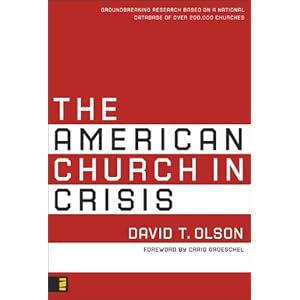

Both books are by ministers/leaders in the Evangelical Covenant Church, the tribe to which I belong. Both books were gifts to Covenant Ministers at a previous Midwinter Conference, so thanks to Zondervan for your generosity.
Both books cover the same general ground: the world has changed, and continues to change. What was is slowly passing, what is is in flux, and what will be is anybody's guess. Regardless, the church finds itself in trouble - losing touch with society, losing members faster than we realized, losing influence in our world; and, where there is growth, often times it is shallow, narrow, lacking in the depth and breadth that ought to mark the Kingdom of God.
Olson's book is a statistical tour de force, based on substantial research into almost every nook and cranny of the American Church. The results of that survey are pretty disturbing. Church attendance overall is down; compared to population growth, the attendance figures are even worse. Almost every denomination is losing ground in every county in every state. Old churches are stagnating and dying off, and not nearly enough new churches are being planted to stem the tide. Too many churches are simply surfing on the final waves of Christendom, enjoying the remnants of the kingdom they used to control, even while ignoring the changing landscape around them.
Gibbons' book is more of a friendly chat, looking into the amazing cultural forces at work to chance the American (and world) landscape. Any semblance of a monolithic culture is quickly passing. Our neighborhoods are filling up with people from all over the world, and our young people are wired into the world even from their very bedrooms. The 'Seeker-Sensitive' church of the 80s and 90s, the church that tried to tap into singular cultures in order to draw like-minded people, can no longer be counted on to grow the Kingdom. In fact, Gibbons would argue, it's an unbiblical model in the first place. The Church is instead called to be cross-cultural in every way: crossing ethnic lines, social lines, and socio-economic lines. He says, "Here is the reality: if we really want to see our churches grow in the way Jesus would want us to grow, if we really want to see Christ revealed in our communities and through our lives and in this global world of ours, then we must focus our strategic initiatives of love on people who make us feel uncomfortable, who don't fit into our thinking and our conventions, who are marginalized and even considered misfits and outsiders."
He goes on to say, "When the world sees the church willing to forgo size and scale to love and embrace people who are not like us, treating them as neighbors, they can sense an expression of true and genuine love. It's a thing of miraculous beauty. And people know beauty when they see it."
Both books are realistic, but also hopeful. First of all, God is still at work in the Church, so we always have reason to hope in the future. Secondly, God seems to be raising up a new group of leaders, pastors, thinkers, and church planters who can help us all move into this new world. The challenges are real, and many will be tempted to bury their head in the sand. To those who are willing to take a risk, to be "liquid," as Gibbons says, to flow with the Spirit, to carry on conversations rather than making pronouncements, to listening and learning and loving and risking, these are great times. A new wave of the Spirit may be happening before our eyes.
The question is, are we willing to give up our false ideas of importance, our desire for comfort, our (false) belief that we have all the answers? Are we willing to give up the delusion that we can return to the 'good old days'? Or will we sit back, hide, and forgo our mission to the world?
Both Gibbons and Olson challenge the church to step out in faith, to learn anew what it means to minister in the world, and to be a part of this amazing work of God. We would do well to listen.
Sunday, August 08, 2010
Turning Trials Into Joy
I received an email yesterday afternoon with some bad news. Longbranch Community Church, our brothers and sisters to the south, was the victim of a vicious vandalism attack Friday night. I threw on a coat and headed down to see if we could offer any assistance. It was worse than I imagined, worse than can be described. Most windows shattered, tables overturned, bookshelves thrown to the ground, fire extinguishers emptied in the office, broken glass everywhere, doors punched through, holes hammered into walls, "I Am the Devil" written in whipped cream on a table. Every room was affected. Broken glass was showered over the floors, and out into the parking lot. It was horrendous.
Lakebay had a similar experience a dozen or more years ago, a fact some of the Longbranch people remembered. We now had a story in common. Unfortunately.
But they had some people there just beginning the process of cleaning up. And I made a few phone calls, and they made some phone calls, and word got out, and a dozen of their people showed up, and 8-10 Lakebay people showed up with work gloves and willing hearts, and a local glass guy made an emergency visit, and the local diner (Lulu's Homeport) brought some soup and sandwiches. And the glass was cleared out, bookshelves were set back up, trash cans were run off to dumpsters in the area, floors were mopped and vacuumed, and I realized in the midst of it that people were having a good time. They were laughing. They were getting to know each other, and, this being a small community, everyone was figuring out all the connections they had with each other. Young people and old were on their hands and knees picking up glass shards and scrubbing tables. Men were up on ladders securing the broken windows with plywood.
Yes, more people came as they heard the news, and there were tears and cries of shock and anger. But a community developed. People gave up their Saturday evening to serve those who were in the midst of a tragedy. And before you knew it. . .we all shared dinner together in a cleaned-up fellowship hall. And prayers were said for victim and perpetrator alike. And love and service ruled the day. There weren't a group a churches gathered together; instead, the singular body of Christ showed up in sacrificial service. It was a beautiful sight to behold, and (I think even the Longbranch folks would agree) a marvelous blessing was borne out of a vicious attack.
A couple other items of interest:
- the vandals left the sanctuary untouched, which seems both a blessing and a little suspicious
- the vandals left some evidence behind. Perhaps enough to point a pretty sure finger at them.
- while we grieve for Longbranch Church, we also recognize the vandals hit the Longbranch Improvement Club first. They have their own pain and mess to deal with
- At least one Longbranch Church member pointed out to me, with a sure sense of irony, that the lectionary text for this morning from Luke 12 reads: "If the owner of the house had known at what hour the thief was coming, he would not have let his house be broken into."
Lakebay had a similar experience a dozen or more years ago, a fact some of the Longbranch people remembered. We now had a story in common. Unfortunately.
But they had some people there just beginning the process of cleaning up. And I made a few phone calls, and they made some phone calls, and word got out, and a dozen of their people showed up, and 8-10 Lakebay people showed up with work gloves and willing hearts, and a local glass guy made an emergency visit, and the local diner (Lulu's Homeport) brought some soup and sandwiches. And the glass was cleared out, bookshelves were set back up, trash cans were run off to dumpsters in the area, floors were mopped and vacuumed, and I realized in the midst of it that people were having a good time. They were laughing. They were getting to know each other, and, this being a small community, everyone was figuring out all the connections they had with each other. Young people and old were on their hands and knees picking up glass shards and scrubbing tables. Men were up on ladders securing the broken windows with plywood.
Yes, more people came as they heard the news, and there were tears and cries of shock and anger. But a community developed. People gave up their Saturday evening to serve those who were in the midst of a tragedy. And before you knew it. . .we all shared dinner together in a cleaned-up fellowship hall. And prayers were said for victim and perpetrator alike. And love and service ruled the day. There weren't a group a churches gathered together; instead, the singular body of Christ showed up in sacrificial service. It was a beautiful sight to behold, and (I think even the Longbranch folks would agree) a marvelous blessing was borne out of a vicious attack.
A couple other items of interest:
- the vandals left the sanctuary untouched, which seems both a blessing and a little suspicious
- the vandals left some evidence behind. Perhaps enough to point a pretty sure finger at them.
- while we grieve for Longbranch Church, we also recognize the vandals hit the Longbranch Improvement Club first. They have their own pain and mess to deal with
- At least one Longbranch Church member pointed out to me, with a sure sense of irony, that the lectionary text for this morning from Luke 12 reads: "If the owner of the house had known at what hour the thief was coming, he would not have let his house be broken into."
Tuesday, May 18, 2010
Change
We've been going through a fair amount of change over here at Lakebay Community Church. A few little things, a few bigger things, but enough that it all adds up. Last year we began a new ministry when we introduced the Alpha Course. At the beginning of this year we moved our church newsletter to an electronic format, and stopped mailing out 250 paper copies every month. Our Maundy Thursday service gave way to a Seder dinner this year. We produced a Stations of the Cross installation. We added a small orchestra to Christmas Eve and Easter.
This last Sunday brought about two large changes. First, we changed our schedule, moving everything up an hour. With Sunday School coming to a close, we decided to take advantage of these long summer day by holding morning worship at 9:30, instead of the usual 10:30. In addition, we stopped taking an offering. Not that we're no longer receiving people's tithes and offerings. We've just placed some donation boxes in the back of the sanctuary (we're calling them "Cheer Boxes," since 'the Lord loves a cheerful giver'), and are asking people to drop their tithes there, rather than passing a plate. And yes, we bit the bullet and are encouraging people to consider giving electronically, either through their own banks, or through www.networkforgood.org.
Change is hard a lot of the time. Even these changes haven't been completely smooth; a few people have been hurt, a few people have been scared, a few are worried that our church today isn't the same church we were a few years ago. Personally, I'm learning some lessons about leading through change, on listening to people who are uncertain, on hurting for people who are left out by new schedules, new technologies, on aching when change causes separation, and yet on leading through disruption, of following God's leading and trusting we're all in his hands. I'm naturally a peace-maker, one who wants to minimize stress and disruption so that all can live in peace and harmony. It's difficult to be one of the agents of stress and disruption causing stress and pain.
And yet I believe God is at work in our church, that he's leading us to days of expanded ministry and presence here on the Key Peninsula. I think we're digging up fallow ground, creating space and energy for new life ahead. I'm convinced God has had his hand on us up to this point, that we've been following faithfully, that these changes have been made with prayer and wise deliberation. And so we move ahead in faith and trust.
And if Sunday morning is any indication, the people of Lakebay have again proven their flexibility, their willingness to try something new, their willingness to follow the decisions of their leaders. Because by 8:45 people were pulling into the parking lot, by 9:30 the sanctuary was filling up, and instead of tired, grouchy faces I saw smiles and laughter and joy. I felt excitement. The singing was full and rich; I couldn't get them to sit down after releasing them for the morning greeting. It was good.
Oh, and for a moment I thought there was an additional blessing, that somebody had donated a $40,000 truck to our ministry. But no, it was simply a stolen truck somebody left in our parking lot Saturday night. Which gave us a wonderful opportunity to do the right thing and call the police, so it could be returned to its rightful owner.
This last Sunday brought about two large changes. First, we changed our schedule, moving everything up an hour. With Sunday School coming to a close, we decided to take advantage of these long summer day by holding morning worship at 9:30, instead of the usual 10:30. In addition, we stopped taking an offering. Not that we're no longer receiving people's tithes and offerings. We've just placed some donation boxes in the back of the sanctuary (we're calling them "Cheer Boxes," since 'the Lord loves a cheerful giver'), and are asking people to drop their tithes there, rather than passing a plate. And yes, we bit the bullet and are encouraging people to consider giving electronically, either through their own banks, or through www.networkforgood.org.
Change is hard a lot of the time. Even these changes haven't been completely smooth; a few people have been hurt, a few people have been scared, a few are worried that our church today isn't the same church we were a few years ago. Personally, I'm learning some lessons about leading through change, on listening to people who are uncertain, on hurting for people who are left out by new schedules, new technologies, on aching when change causes separation, and yet on leading through disruption, of following God's leading and trusting we're all in his hands. I'm naturally a peace-maker, one who wants to minimize stress and disruption so that all can live in peace and harmony. It's difficult to be one of the agents of stress and disruption causing stress and pain.
And yet I believe God is at work in our church, that he's leading us to days of expanded ministry and presence here on the Key Peninsula. I think we're digging up fallow ground, creating space and energy for new life ahead. I'm convinced God has had his hand on us up to this point, that we've been following faithfully, that these changes have been made with prayer and wise deliberation. And so we move ahead in faith and trust.
And if Sunday morning is any indication, the people of Lakebay have again proven their flexibility, their willingness to try something new, their willingness to follow the decisions of their leaders. Because by 8:45 people were pulling into the parking lot, by 9:30 the sanctuary was filling up, and instead of tired, grouchy faces I saw smiles and laughter and joy. I felt excitement. The singing was full and rich; I couldn't get them to sit down after releasing them for the morning greeting. It was good.
Oh, and for a moment I thought there was an additional blessing, that somebody had donated a $40,000 truck to our ministry. But no, it was simply a stolen truck somebody left in our parking lot Saturday night. Which gave us a wonderful opportunity to do the right thing and call the police, so it could be returned to its rightful owner.
Monday, March 22, 2010
The Church
From Bill Easum's blog:
However, I have a problem with all the words being battered around today to describe the church like organic, emergent, missional, incarnational, etc because none of them are necessary- the church is either the church or its not. There aren’t shades of gray. The church is always a “sending church” or it isnt the church. The church always lives to transform the world or its not the church. The church always is a witness to Jesus in Jerusalem, judea, samaria, and the ends of the earth or its not the church.
However, I have a problem with all the words being battered around today to describe the church like organic, emergent, missional, incarnational, etc because none of them are necessary- the church is either the church or its not. There aren’t shades of gray. The church is always a “sending church” or it isnt the church. The church always lives to transform the world or its not the church. The church always is a witness to Jesus in Jerusalem, judea, samaria, and the ends of the earth or its not the church.
A church doesn’t have members; it has missionaries. A church doesn’t have an evangelism committee; it is evangelism. The church doesn’t not a missions committee; the church is missions.
Period. All other forms of church are hospices and hospitals. Period.
Thursday, March 18, 2010
Out of the mouths of babes
I know there's nothing worse than parents who blog about 'My kid just said the cutest thing!' But seriously. Sometimes kids can be pretty funny.
Like today, after I picked Olivia up from school. We pulled through the church parking lot. She looked at the steeply-pitched roof of the church and said "we have a triangle church." But then she started to process. "Except at the bottom, where it's more rectangle. Hmmm."
Wait for it. Here it comes.
"I know, we have a tri-rectal church!"
"Um, what?" I asked, trying hard not to shriek.
"We have a tri-rectal church!"
I think that's my new motto for Lakebay. Lakebay Community Church - We're Tri-Rectal!
Like today, after I picked Olivia up from school. We pulled through the church parking lot. She looked at the steeply-pitched roof of the church and said "we have a triangle church." But then she started to process. "Except at the bottom, where it's more rectangle. Hmmm."
Wait for it. Here it comes.
"I know, we have a tri-rectal church!"
"Um, what?" I asked, trying hard not to shriek.
"We have a tri-rectal church!"
I think that's my new motto for Lakebay. Lakebay Community Church - We're Tri-Rectal!
Sunday, January 31, 2010
Godspeed, WayPoint!
Shortly after I arrived here on the Peninsula, one of the local churches lost their building to a fire. The former Vaughn Church has been somewhat homeless ever since.
Tonight, WayPoint Church officially dedicated their brand-spanking-new home, right alongside the highway out of town. It's a beautiful building, and a great platform for all sorts of future ministry. God has been good to them.
And they are in good hands. Pastor Tim is an excellent, compassionate, and fun pastor. Their youth pastor isn't such a bad guy, either. I think they are poised to do some powerful work for the Kingdom.
So congratulations Pastor Tim and all of WayPoint Church - on behalf of Lakebay Community Church, we're happy for you!
Tonight, WayPoint Church officially dedicated their brand-spanking-new home, right alongside the highway out of town. It's a beautiful building, and a great platform for all sorts of future ministry. God has been good to them.
And they are in good hands. Pastor Tim is an excellent, compassionate, and fun pastor. Their youth pastor isn't such a bad guy, either. I think they are poised to do some powerful work for the Kingdom.
So congratulations Pastor Tim and all of WayPoint Church - on behalf of Lakebay Community Church, we're happy for you!
Thursday, January 07, 2010
Book Review: Think Orange

Reggie Joiner is rightfully concerned that the Church, in general, isn't doing a very good job at family ministry. At youth ministry. At children's ministy. He's also rightfully concerned that families are struggling like never before, and that, in that struggle, our society is facing turmoil and upheaval at its core. Think Orange, the book and the philosophy, is his response, a challenge to the church to partner with the family in order to raise up generations who know what it is to walk "in the way," and in order to strengthen families in the here and now.
Joiner's primary image is this: The church is called to shine the Light of Christ in the world, illuminating the work of Christ and drawing people to Christ. (Hint: Light is represented by yellow). Families are the heart and soul of society, families are the primary location people learn of love, acceptance, sacrifice, and relationships. (Hint: Love is represented by red (think Valentine's Day)). When you mix red and yellow you get -what? Orange!
This is the heart of Think Orange - mixing red and yellow. The problem, according to Joiner, is that families are struggling to survive, parents are struggling to raise their children, young people are leaving the Church for the world in droves. . .and the Church is over in the corner, running programs that seem to have no effect in helping any of these problems. The Church, it seems, has developed a host of programs and ministries that help the individual groups: children, youth, and adult, but none of these maintain any synchronicity with a larger plan. The childrens' ministry does its thing, youth ministries do their thing, and adults go their way to study the theology of the minor prophets. Then families go home and struggle to make sense of it all in a confused and confusing world. As Joiner laments, "Most churches are characterized by random acts of ministry to the family." Parents have no idea how to impact the spiritual life of their children. Children don't know how to navigate the multiple messages that bombard them day in and out. Youth have no clue how all this 'church stuff' impacts their larger life.
The answer, says Joiner, is for the church and family to combine forces. "What we should really be concerned about is our collective ability to influence a generation to have a stronger, deeper, and more authentic relationship with God." All of this he summarizes with two important points:
1. Kids need parents who will help them advance in their relationship with God.
2. Parents need churches that will help them know how to be spiritual leaders.
Think Orange is not, then, another book on catchy childrens' ministry. It is, instead, a complete reworking of the junction where churches and families come together to disciple, raise, cherish, teach, and lead children and youth in their pursuit of Christ.
A couple of strengths of this book:
1) One of the earlier chapters lays out an impressive theology of family, something sorely lacking in the overall discussion.
2) The book is biblical - while it includes cultural references and sociological research, the ideas and plans are all soundly based within a biblical framework of ministry.
3) The book has lots of pictures and charts.
4) The book recognizes the reality that no family or church is perfect, that setting impossible standards only frustrates people; it is realistic in the goals it sets out, while still setting a high bar in pushing us toward excellence.
5) The book is a great place to even start the discussion. I bought a couple extra copies for a few people in our church, and hope this stimulates us toward new growth and a stronger overall sense of mission.
6) The book comes with a host of resources, and is backed up by Joiner's Orange Leaders website.
7) If anything, the book will challenge and stimulate your own thinking regarding how you go about your family ministry, the assumptions behind it, and why it may or may not be working very well.
A couple things about which I wasn't quite so impressed:
1) Honestly, at times the whole "orange" metaphor seemed a little stretched. By the time the metaphor was presented, I could have done without the multiple examples of Orange showing up in society. Perhaps, to this reader, it came too close to "cutesy" at that point. So what if somebody sells an orange amp? It doesn't seem to matter to the rest of the book.
2) There were other times when it seemed Joiner was writing primarily to large churches with multiple staff and large creativity budgets. The idea of regularly re-painting your children's area to go with that quarter's theme seems fun and exciting, but how many churches have the people and the finances to do that? Of course, the response would be that we all need to read with discerning ears and take away what we can, but I would have enjoyed some examples of how small churches with small budgets and small, over-committed volunteer staffs can bring these ideas to fruition.
Overall, I am glad somebody sent me a copy of Think Orange. I confess I probably wouldn't have picked it up myself, and I wasn't all that eager to dig into it, but once I did (mostly on a flight to Denver last November), I found myself drawn in, challenged, and encouraged by the vision it contains. As I said, I'm hoping it influences the vision and work of our church; I think it would be of value to any and all who are concerned about families and those who minister with and to them.
Monday, November 23, 2009
Anything to make a sale
A long time ago in a galaxy far, far away. . .
Evangelistic-minded youth ministries hit upon a genius idea. Create events that are cool, hip, attractive, amazing, get kids in the door, and then hit them with the gospel. Young Life is the master of this strategy, but it has impacted the entire world of youth ministry. In small ways, it looks like 'throw a pizza party, invite your friends, then we'll tell 'em about Jesus." In larger ways, it looks like "Hire a band, have some fireworks, break some bricks with your head, then tell 'em about Jesus." Either way, entertain 'em, entice 'em with coolness, then tell 'em about Jesus.
One problem: no matter what the Church does, the World does a better job of offering Cool options. While the Church was offering pizza and goofy games, the World invented Wiis and Hip-Hop. So the Church is always playing catch-up, trying to find ever hipper and cooler ways of enticing 'worldly youth' into our doors, so we can tell 'em about Jesus. Or, maybe just to keep our kids in the doors, trying to make it just cool enough that they won't run out there where the World offers all that other stuff.
So, to recap, the strategy is: do something fun/cool/outrageous to get people in the door, then tell 'em about Jesus.
Let's be clear about one thing: the motivation is great. Telling people about Jesus is our highest calling. Creating opportunities to tell people about Jesus is a wonderful task.
But there was a dark side that very few people really wanted to talk about: this 'wow 'em and tell 'em about Jesus' strategy doesn't do much in the way of creating disciples. Instead, it creates instant flash with no long-term impact. The fact that even 70-80% of Christian kids leave the church after high school ought to tell us we're doing something wrong. That we're not growing Followers, that we're not raising Disciples. Instead, we're creating Consumers who will always chase after the next big fix, wherever that comes from. We're not raising young people who understand such basic tenets of Christianity as sacrifice, service, humility, forgiveness, love, grace and mercy. We are, in fact, temporarily distracting young people with smoke and mirrors, sneaking the gospel in there, assuming that, since they 'said the prayer' following the pizza and root-beer gorge, they're 'in.'
And here's today's problem: those raised in this world are leaving their youth ministry days behind and moving into senior leadership in churches across America. . .and they're using the exact same strategies in the larger church.
Like the Church over in the Seattle area that decided to perform live tattooing during their worship service.
Again, the motivation is probably good: create some buzz (no pun intended. . .maybe), get some people in the door, tell 'em about Jesus. Young people are into tattoos. So, bring tattoos into the Church, get people interested, tell 'em about Jesus.
But is this anything more than the same strategy that has failed so miserably in our youth ministries over the last 60 years?
One might also spend a few minutes talking about the nature of worship itself - a holy people gathered to lift up the name of God in adoration and praise, to listen to (and apply) his Word in their lives.
It has always struck me as odd that we have to do all this in the first place. After all, the Church has the most amazing package ever to be offered - eternal life, hope, love, peace, joy, a relationship with the God who created the Universe, redemption, acceptance, friendship. . .For some reason, so many have decided that's not enough, so instead they re-package all that into pizza parties, goofy games, church coffee shops, the never-ending pursuit of 'relevance,' tattoo services.
My hope, as I've stated before, is that people will be drawn to Lakebay Community Church not because we're cool or hip or relevant or edgy, but because they've heard it's a place of hope, a place of joy, a place of acceptance, a place where Christ's light shines into the darkness of our lives. It makes you wonder what would happen if the Church across America would decide to give up this striving for relevance, and get back to the real work of the Church, which, as I pointed out in my sermon yesterday, comes down to two things:
1) being a community of grace and mercy and love
2) going out into all the world making disciples.
Something tells me we just might actually be healthier. We'd certainly be stronger. Promotional gimmicks might fill the pews, but they don't teach people to do justly, love mercy, and walk humbly with their God. Only the hard work of disciple-making does that.
Evangelistic-minded youth ministries hit upon a genius idea. Create events that are cool, hip, attractive, amazing, get kids in the door, and then hit them with the gospel. Young Life is the master of this strategy, but it has impacted the entire world of youth ministry. In small ways, it looks like 'throw a pizza party, invite your friends, then we'll tell 'em about Jesus." In larger ways, it looks like "Hire a band, have some fireworks, break some bricks with your head, then tell 'em about Jesus." Either way, entertain 'em, entice 'em with coolness, then tell 'em about Jesus.
One problem: no matter what the Church does, the World does a better job of offering Cool options. While the Church was offering pizza and goofy games, the World invented Wiis and Hip-Hop. So the Church is always playing catch-up, trying to find ever hipper and cooler ways of enticing 'worldly youth' into our doors, so we can tell 'em about Jesus. Or, maybe just to keep our kids in the doors, trying to make it just cool enough that they won't run out there where the World offers all that other stuff.
So, to recap, the strategy is: do something fun/cool/outrageous to get people in the door, then tell 'em about Jesus.
Let's be clear about one thing: the motivation is great. Telling people about Jesus is our highest calling. Creating opportunities to tell people about Jesus is a wonderful task.
But there was a dark side that very few people really wanted to talk about: this 'wow 'em and tell 'em about Jesus' strategy doesn't do much in the way of creating disciples. Instead, it creates instant flash with no long-term impact. The fact that even 70-80% of Christian kids leave the church after high school ought to tell us we're doing something wrong. That we're not growing Followers, that we're not raising Disciples. Instead, we're creating Consumers who will always chase after the next big fix, wherever that comes from. We're not raising young people who understand such basic tenets of Christianity as sacrifice, service, humility, forgiveness, love, grace and mercy. We are, in fact, temporarily distracting young people with smoke and mirrors, sneaking the gospel in there, assuming that, since they 'said the prayer' following the pizza and root-beer gorge, they're 'in.'
And here's today's problem: those raised in this world are leaving their youth ministry days behind and moving into senior leadership in churches across America. . .and they're using the exact same strategies in the larger church.
Like the Church over in the Seattle area that decided to perform live tattooing during their worship service.
Again, the motivation is probably good: create some buzz (no pun intended. . .maybe), get some people in the door, tell 'em about Jesus. Young people are into tattoos. So, bring tattoos into the Church, get people interested, tell 'em about Jesus.
But is this anything more than the same strategy that has failed so miserably in our youth ministries over the last 60 years?
One might also spend a few minutes talking about the nature of worship itself - a holy people gathered to lift up the name of God in adoration and praise, to listen to (and apply) his Word in their lives.
It has always struck me as odd that we have to do all this in the first place. After all, the Church has the most amazing package ever to be offered - eternal life, hope, love, peace, joy, a relationship with the God who created the Universe, redemption, acceptance, friendship. . .For some reason, so many have decided that's not enough, so instead they re-package all that into pizza parties, goofy games, church coffee shops, the never-ending pursuit of 'relevance,' tattoo services.
My hope, as I've stated before, is that people will be drawn to Lakebay Community Church not because we're cool or hip or relevant or edgy, but because they've heard it's a place of hope, a place of joy, a place of acceptance, a place where Christ's light shines into the darkness of our lives. It makes you wonder what would happen if the Church across America would decide to give up this striving for relevance, and get back to the real work of the Church, which, as I pointed out in my sermon yesterday, comes down to two things:
1) being a community of grace and mercy and love
2) going out into all the world making disciples.
Something tells me we just might actually be healthier. We'd certainly be stronger. Promotional gimmicks might fill the pews, but they don't teach people to do justly, love mercy, and walk humbly with their God. Only the hard work of disciple-making does that.
Monday, September 28, 2009
What does it all mean?
A week ago, some of the women from our church were away at the NPC Ladies' Retreat at Cascades Camp. In spite of that, Lakebay had one of the best-attended Sunday services in a few months.
Yesterday, some of the men were away at the NPC Men's Retreat at Cascades Camp. And yesterday we were off by almost 1/3 of our regular attendance.
So does that tell us anything? The women leave and the men still show up, but the men leave and everybody stays home?
I'm sure there's a brilliant insight in there somewhere. I just can't figure it out.
Yesterday, some of the men were away at the NPC Men's Retreat at Cascades Camp. And yesterday we were off by almost 1/3 of our regular attendance.
So does that tell us anything? The women leave and the men still show up, but the men leave and everybody stays home?
I'm sure there's a brilliant insight in there somewhere. I just can't figure it out.
Tuesday, August 11, 2009
Church Changes
I was updating our church website the other day - not any sort of major overhaul, just checking on some of the links, making sure they still work.
On the list of "area churches," I used to have quite a few. At last check, there were seven. But in this past month, Community Bible Fellowship moved their operations over to Gig Harbor, giving up on their plan to build their own meeting center up along the highway (ironically, directly across the street from where somebody just opened up one of "those kinds" of coffee places). And, in following links, I discovered the Presbyterian Church moved off the Peninsula and in to Gig Harbor, as well. In addition, one of the local churches down here in our area no longer seems to have a website; I'm not sure if that reflects on the state of their congregation or not.
So, as far as online presence goes, there seem to be only four of us here on the Peninsula. As far as 'real' presence, I know of a couple others (Lakebay Assembly and the Historic Vaughn Church), plus I hear stories of a number of little house churches out here. But it does change the tone of the conversation about ministry out here on the KP; fewer houses of worship, fewer Kingdom members rooted in this land doing the work of being salt and light. But I have this sneaking suspicion God hasn't up and left, even if the presence of his people is less visible.
On the list of "area churches," I used to have quite a few. At last check, there were seven. But in this past month, Community Bible Fellowship moved their operations over to Gig Harbor, giving up on their plan to build their own meeting center up along the highway (ironically, directly across the street from where somebody just opened up one of "those kinds" of coffee places). And, in following links, I discovered the Presbyterian Church moved off the Peninsula and in to Gig Harbor, as well. In addition, one of the local churches down here in our area no longer seems to have a website; I'm not sure if that reflects on the state of their congregation or not.
So, as far as online presence goes, there seem to be only four of us here on the Peninsula. As far as 'real' presence, I know of a couple others (Lakebay Assembly and the Historic Vaughn Church), plus I hear stories of a number of little house churches out here. But it does change the tone of the conversation about ministry out here on the KP; fewer houses of worship, fewer Kingdom members rooted in this land doing the work of being salt and light. But I have this sneaking suspicion God hasn't up and left, even if the presence of his people is less visible.
Tuesday, June 09, 2009
Book Review: Making a Meal of It

Making a Meal of It is the second of three books penned by Ben Witherington III looking at the most basic elements of the Christian life and faith: Baptism, the Lord's Supper, and the Bible. Dr. Witherington is Professor of New Testament at Asbury Theological Seminary, as well as a prolific author and blogger. His expertise in NT and early church history give him a solid background with which to explore this topic of the Lord's Supper.
He begins by working the connection between the original meal in the upper room and the Jewish Passover feast, pointing out that the Passover festival was both a remembrance of what had gone before, and an act of renewal of the community that continually celebrated it. "Thus anamnesis is more than remembering; it is a placing of the current Jews into the ancient story such that it is and becomes once again their own story, their own trial and triumph, which took place in the Exodus-Sinai events" (10).
This, then, becomes the context of the original Lord's Supper, as shared in the synoptic gospels. In that place Jesus gathered his disciples, shared this meal with them, even with the one who would betray him (a scandal in itself), but he broke up the usual liturgy by reinterpreting elements of that meal, using them to point to his own impending atoning death. "What we have here then in the Last Supper is an enacted parable, much like ancient, prophetic enacting parables or sign acts. . .There is nothing here about the transformation of the elements into something they were not before. . .But what is most telling about all this is that Jesus is in a sense symbolically distributing the benefits of his Passion before it happens! How confident he must have been that God would use his death for good to have at this juncture changed or added to the Passover liturgy and referred to himself and his coming death this way" (27).
The earliest church carried on with this tradition of bread-breaking and wine-drinking in remembrance of Christ. While it is true that the book of Acts doesn't explicitly speak of the Lord's Supper, ". . .a good case can be made that the 'breaking of the bread' was Luke's shorthand for the special Christian meal that came to be called the Lord's Supper by the time Paul wrote 1 Corinthians" (30). However, one important aspect of this meal that must be remembered is its communal nature. This was a meal that took place in a home (or homes), not in the temple, perhaps daily as believers gathered together to share in this new-found faith in Christ. It was also closely tied to the sacrificial nature of this community, in which all sold their possessions so that none would go hungry or homeless. Speaking of Acts 2:24, Witherington writes, ". . . Luke sees the Lord's Supper as a fellowship meal, a meal that has a horizontal dimension binding the disciples to one another and so should be partaken of with great regularity to reinforce that bond" (31).
In the longest chapter in the book, Dr. Witherington digs into the passage dealing with this meal in Paul's first letter to the church in Corinth - one of the only texts in the NT which explicitly deals with the Lord's Supper. Much of his work here is to set this meal in context, comparing it to similar meals in Corinthian culture of the same time - meals that would have influenced the early Corinthian believers. In quick summary, much of this community's social life revolved around dinner parties and symposiums held in local homes by the well-to-do. Generally, the elite would invite those they wanted to impress (and their families) for a meal. Following the meal, the men would 'retire' for a drinking party. "The drinking parties were generally all-male affairs. . .But entertainment might include dancing and flute-playing girls and companions (hetairai) - as well as prostitutes at less-refined meals. . ." (35) Included in this after-meal affair were conversations "of all sorts of subjects, including politics, philosophy, religion, economics, and of course gossip and personal matters" (36).
Thus, this is what you had: The families of the rich and elite would gather for a meal. As they sat around the table, the most important people sat closest to the host. Following the meal, the women and children would leave, while the real party was just beginning. The few women who did remain were assumed to be immoral and shameful. In some of these locations, there was a garden next to the dining room "where slaves and perhaps lesser-status guests could also participate in the family meal or at least wait for the leftovers and take them away" (37).
It seems, from a close reading of 1 Corinthians, that the church in Corinth was allowing these traditions to influence their taking of the Lord's Supper. And Paul would have none of it. "Paul does not want his converts to hold their fellowship meals . . . according to the rules of Greco-Roman dining, perhaps especially because the Lord's Supper was a part of this larger fellowship meal and occasion. Not surprisingly these strictures came as something of a surprise, a painful one, to more high-status Christians in Corinth who had only partially understood what the practical implications were of being a Christian" (38).
This meal, according to Paul, is so much more than another feast with partying and debate. "What believers are sharing in is not just one another, but some third thing to which the word koinonia refers. . .Apparently Paul thinks more than mere symbols are involved. There seems to be some real, spiritual communion with Christ and others at issue here. . .Paul then is talking about that which binds Christians together into one body of believers. It is not merely the physical sharing in the bread but also the more profound spiritual sharing and uniting that it signifies and facilitates" (44-5).
What our author is working toward here is the premise that many of our discussion regardin the Lord's Supper in 1 Corinthians have approached the text incorrectly. Reading phrases like "discern the body" and "examine themselves" have been read through a strongly sacramental lens, in which it is assumed the elements somehow contain the body and blood of Christ, and thus individual believers must examine themselves to make sure they are worthy of partaking. But that isn't what Paul had in mind here. "The examination referred to in verse 28 means that one must reflect on how one is partaking of the meal; it is not about introspection to determine if one is worthy. . .While ['the body'] might be a reference to remembering Christ's death when one eats, it seems more likely in the larger context to refer to the body of believers. One is to be cognizant that this is a group meal, a group-building ceremony. . .The Corinthians are eating in a selfish and self-centered manner without taking cognizance of their brothers and sisters present. They should be partaking with them as one body of Christ, rather than following pagan protocol that gives the elite better treatment and first dibs at the meal" (59).
Witherington then turns to the great feast in the gospel of John. This text has long given scholars trouble, in that it doesn't seem to fit in with the accounts of the last supper in the other gospel. For one, the timeline is wrong - the synoptics place the last supper at the Passover feast, whereas John seems to place it the day before the Passover feast. Much work has gone into synchronizing these accounts, with some saying John just got it wrong, and others saying John changed the story to fit his theological agenda. The author here builds the case that both of those assumptions get it wrong. Instead, he writes, "Firstly, the Fourth Evangelist is portraying the disciples' sharing a farewell dinner, which was actually a series of dinners, with Jesus. Secondly, the dinner is not portrayed as a Passover meal." In other words, John is condensing a series of talks Jesus gave in the week leading up to the Passion, but doesn't directly give us an account of the Passover supper itself.
Another important point to be noted from the Gospel of John is that, through this final discourse, Jesus is working toward the same aims as Paul in Corinth. "Here we note that Jesus, by the footwashing episode at the meal, coupled with his prayer for unity in John 17, is depicted as undertaking the same kind of social rearrangement of perceptions and practices" [that Paul worked on in Corinth] (65).
It is here that Dr. Witherington does some detective work and comes forth with a startling claim. I'll let you pick up the book and work through the details, but, based on a careful reading of the text, and its interplay with the other accounts as well as the intricate details of the last days of Jesus, the author builds the case that the Gospel of John was written by Lazarus - the close friend of Jesus, the one Jesus had raised from death, the brother of Mary and Martha. And, if this is true, then it is probable that the meals earlier in the week, the meals on which this gospel focuses, the meals before the Last Supper, were all held in the home of Lazarus - which is why more attention is given to these than to the Last Supper itself.
Now, lest this review become longer than the book itself. . .it is pointed out that there really isn't any more work dealing with the Lord's Supper to be found in the pages of the NT; we also have very little documentation among the writings of the early church explaining the practice or belief surrounding this meal. Dr. Witherington works briefly with pertinent passages from the Didiche, which all seem to point toward a celebration that was part of a regular meal as both a remembrance of Christ's death, and as a unifying moment within the body of believers. "There certainly is nothing here that suggest some sort of magical view of the elements, and we have no commentary at all about the words of institution that Jesus himself spoke" (94). The few conclusions we can make based on this material are that the Lord's Supper remained an in-home ceremony taken along with a fellowship meal, that there is no mention of an official priesthood overseeing the meal, that it was partaken at least weekly, and that it was partaken of by those who had repented of their sins.
The final chapters of the book are given to working through the historical development of this meal, a development which, on the whole, hasn't been helpful. By the second century Ignatius of Antioch was speaking of the necessity of the the presence of a bishop to hold a love feast. By the fourth century many churches were banning love feasts as they embraced the ascetic movement (this was also one of the moments in which women began to be excluded from many church activities). Greek philosophical concepts of substance slowly overran the Hebrew concepts of enacted ritual, and, "Here then is a cautionary reminder - the less Jewish the approach one takes to the Lord's Supper, the more likely one is to be wrong about one's assessment of what is the case about the elements" (110).
By the Middle Ages, of course, the concept of transubstantiation had taken hold - that the bread and wine magically and mystically became the true body and blood of Christ. "The idea of transubstantiation is that the substantia changed when consecrated, whereas the material accidentia remain the same. In A.D. 1215 the Fourth Lateran Council proclaimed, 'His body and blood are really contained in the Sacrament of the altar. . .'" Witherington goes on to explain, "It was left to the Council of Trent to boldly claim what was absolutely untrue - 'it has therefore always been held in the Church of God' that what Christ offered under the appearance of bread and wine was truly his body" (119).
The theological maelstrom that was the Reformation added to the debate and confusion surrounding the Lord's Supper. "Luther discarded the notion that of the sacrifice of the Mass, but he wanted to hold on to the real, even physical presence of Christ connected somehow with the sacrament. This led to the idea of consubstantiation, the presence of Christ somehow being attached to or under and with the sacramental elements" (122). "By 1525 [Zwingli] was prepared to deny the real physical presence of Christ and speak of the spiritual presence of Christ with the Eucharist" (123). Zwingli began to grasp an important concept, perhaps coming close to seeing this for what it was supposed to be: ". . .he did not see the Lord's Supper as a merely symbolic ceremony, either. For those who received the elements in faith, there was the real spiritual presence of Christ, and. . .fellowship within the community of faith" (123). This would have a strong impact upon the anabaptist movement, which felt "the Lord's Supper signified and celebrated the unique communion between the Lord and his people, and among believers as well. It did not just have a vertical dimension such that it was all about the individual believers' communion with the heavenly Christ" (123-4).
So, what to make of all this? A couple of conclusions:
- "remembering and cherishing and keeping in mind. . .is the character of this meal according to Paul."
- "The focus of the original Lord's Supper is not on the elements in the present or the present in general, but on Christ and what he did and what he will do."
- While suggesting that moving the Lord's Supper back into the context of a larger meal might be a good idea, though not necessary, Witherington points out that there are modern adaptations of this meal that have harmed our understanding of it. "There is absolutely no reason why real bread could not be used, and more importantly whole loaf not yet broken, for the bread is in fact a double symbol, not only of Christ's own body, but of the church as the body of Christ - a united whole" (131).
- And what are we to make of the debates regarding the presence of Christ? Let me quote one of the best paragraphs from the book:
"The Lord's Supper should be seen as a chance for a close encounter with Jesus, a chance for a moment of clarity and recognition in one's life that Christ comes to meet us, bless us, forgive us, over and over again, and that we can and must actively participate in this joyful event. It's not about magical rituals or medicinal elements; it's about the living presence of Christ, which can either be honored or dishonored by how we partake of the Meal. Yes, indeed a spiritual transaction happens at the meal, and it can be positive, and it can be negative. The real spiritual presence of Christ meets us at and in the Meal if we receive him by faith" (134).
Thus, in the end, what is the Lord's Supper? It is a community meal to which we are invited by Christ as living host, a meal wherein he comes and meets his people, offering grace and redemption. It is also a meal of cohesion, drawing together all God's children to this table, tearing down dividing walls and creating one new body. And it is an equalizing meal - there is no hierarchy here, no rich or poor, no important or irrelevant, but all who stand as brothers and sisters before Jesus. "It is a community ritual meant for the community to take together signifying their unity with Christ and with one another in and as the body of Christ" (135).
In conclusion, I believe Dr. Witherington has offered a strong, well-balanced theological approach to the Lord's Supper. Avoiding the issues that seem to mark most of the discussion, he finds a refreshing new way of digging back into the original meaning and intent of this meal, showing how this meal can actually unite the Body, rather than cause division as it so often has. He challenges both the high-sacramentalism of the Roman Catholic Church (and others), and the low-ordinalism of those who treat this meal as a throw-away thing to do every once in awhile, restoring its dignity without turning it into a magical charm. The book is deep and broad enough to interest scholars and theologians, but simple enough for the average Christian reader looking to expand their knowledge on this issue. It was extremely helpful to me, even affirming a few ideas I'd been pondering but had yet to see in any theological discussion. It's given me a lot to think about, both as a pastor and a participant in the Body of Christ.
Tuesday, June 02, 2009
Seems I picked an interesting week to have this conversation
Eugene has a good, heart-felt post over on his blog today, on the pressures of loving people even when fundamentally disagreeing with them on truly deep, anguishing issues. I think I understand his angst.
This Sunday I'm beginning a new sermon series. For the next three months or so we're going to work through the Covenant Affirmations - six statements that help to define and center the Covenant Church. We are a little bit odd in being a non-creedal Church; there is no "creed" but the scriptures. And yet, there must be some definition, some point of general agreement, and so we hold to these six affirmations.
One of those affirmations is the reality of freedom in Christ. It is the recognition that men and women who call Christ 'Lord' still disagree over a host of issues when it comes to how we read the scriptures, and how they play out in our lives. But we take seriously the Unity of the Church, and would rather live in the tension of disagreement than divide the Body over secondary issues.
It's not a perfect system, but so far, it seems to have worked out rather well. I've sat in on some intense theological discussions where important issues were debated heatedly, only to see those discussions break up so everybody could go out for pizza and share in each other's lives. There are Covenant churches that lean in 'conservative' directions and Covenant churches that lean in more 'liberal' directions, but we remain committed to each other and the overarching mission of God to liberate this world from the Kingdom of the evil one. It is true of the Covenant Church that the need to liberate the prisoner and break the yoke of oppression is more important than the need to have a single definitive stance on baptism or the end times.
As such, the Covenant can be a lively place for discussion, and, for the most part, healthy discussion, where differences are respected and persons valued more than positions.
The Covenant Church truly seeks the third way in these things.
Unfortunately, I sometimes forget that not everybody operates with those same values. Eugene gave a couple of examples of being shot at from both sides for attempting live in the tension, to stay true to his interpretation of the Word while loving the wide variety of humanity in this world.
It seems most live by the "you're either with us or against us" mantra. If you don't condemn gays as hateful to God, you have no backbone. If you don't instantly throw 100% support behind gay marriage, you're a bigot. Or. . .if you don't call out abortionists as murderers, than you're culpable of the unborn holocaust, or if you don't stand 100% behind the right of women to have full freedom to abort their pregnancies, you're no different than the Taliban. (note: that Taliban comment didn't come from the previous comment threads; I've simply read it in a host of other web forums and comment streams).
And then there's this: I'm becoming more and more convinced that the internet is the absolutely worst place to carry on this discussion. It may be one step up from putting tracts on car windshields, but not much. Because, in the end, these issues are intensely human issues and they affect people at their deepest levels. And our lenses have all become so blurry through the past decades of debate and entrenchment, and our lists of bullet points so long that nobody really listens to each other, nobody hears the beating heart that is so passionate about the issue. It's all so much shouting and posturing.
Somewhere Wendell Berry once wrote a screed against revolutionary movements. His point was that true change happens when people decide to behave differently. Individual people. And those people influence the people around them. And from the ground up, change begins to come about. But top-down, it never works. I know he tries to ignore the internet, but I think his wisdom applies here. We affect change when we sit down with people, when we share our lives with the people in our communities, when we truly take the time to understand the people around us, when we can commit to care about each other, even when we disagree with each other. Which is why, in general, I don't tend to get into the Big Controversial Topics on this blog - because I'd rather sit down with someone on 'the other side' and talk it through, than try to sort anything out hidden behind an electronic wall.
____
Still, since for whatever reason this whole conversation came about this week, of all weeks, let me add my voice to the chorus: Victory is never ultimately won through violence. Our weapons, if weapons they be, are prayer, fasting, worship, seeking the Lord. Rhetoric, for sure, and the power of public persuasion. In a democracry no voice need be silenced; our voice belongs in the public sphere. But I am reminded of the words of 1 Peter: "Live such good lives among the pagans that, though they accuse you of doing wrong, they may see your good deeds and glorify God on the day he visits us." I'm afraid the Church has not understood this message very clearly. In the end, love and forgiveness win, not violent acts of retribution.
IF we take the message of Christ seriously, then our call is non-violence. Name-calling, demonizing, and certainly murder are not the answer. In fact, they are wrong, they are sin, they are an offense to God. I read Hugo's eulogy to Dr. Tiller, and I wouldn't agree with his saintly portrayal of the man. But in the end Dr. Tiller's will stand before the Lord, who alone will make final judgment of good or evil. And that should have been left in the hands of the Lord, not another human. Murder is murder is wrong. Killing in the name of Jesus is wrong. So hear me say this: yes, I am pro-life. Which means I believe all life ought to, except in the most extreme cases, be left in the hands of God to give or take away. And we all ought to grieve when life is snuffed out at the hands of other humans, rather than celebrate. Our call is to faithful living, representing the Kingdom of God, a kingdom of light and life, living lives marked by compassion, mercy, humility, justice, and a knowledge that it is God alone who rewards, and God alone who punishes.
This Sunday I'm beginning a new sermon series. For the next three months or so we're going to work through the Covenant Affirmations - six statements that help to define and center the Covenant Church. We are a little bit odd in being a non-creedal Church; there is no "creed" but the scriptures. And yet, there must be some definition, some point of general agreement, and so we hold to these six affirmations.
One of those affirmations is the reality of freedom in Christ. It is the recognition that men and women who call Christ 'Lord' still disagree over a host of issues when it comes to how we read the scriptures, and how they play out in our lives. But we take seriously the Unity of the Church, and would rather live in the tension of disagreement than divide the Body over secondary issues.
It's not a perfect system, but so far, it seems to have worked out rather well. I've sat in on some intense theological discussions where important issues were debated heatedly, only to see those discussions break up so everybody could go out for pizza and share in each other's lives. There are Covenant churches that lean in 'conservative' directions and Covenant churches that lean in more 'liberal' directions, but we remain committed to each other and the overarching mission of God to liberate this world from the Kingdom of the evil one. It is true of the Covenant Church that the need to liberate the prisoner and break the yoke of oppression is more important than the need to have a single definitive stance on baptism or the end times.
As such, the Covenant can be a lively place for discussion, and, for the most part, healthy discussion, where differences are respected and persons valued more than positions.
The Covenant Church truly seeks the third way in these things.
Unfortunately, I sometimes forget that not everybody operates with those same values. Eugene gave a couple of examples of being shot at from both sides for attempting live in the tension, to stay true to his interpretation of the Word while loving the wide variety of humanity in this world.
It seems most live by the "you're either with us or against us" mantra. If you don't condemn gays as hateful to God, you have no backbone. If you don't instantly throw 100% support behind gay marriage, you're a bigot. Or. . .if you don't call out abortionists as murderers, than you're culpable of the unborn holocaust, or if you don't stand 100% behind the right of women to have full freedom to abort their pregnancies, you're no different than the Taliban. (note: that Taliban comment didn't come from the previous comment threads; I've simply read it in a host of other web forums and comment streams).
And then there's this: I'm becoming more and more convinced that the internet is the absolutely worst place to carry on this discussion. It may be one step up from putting tracts on car windshields, but not much. Because, in the end, these issues are intensely human issues and they affect people at their deepest levels. And our lenses have all become so blurry through the past decades of debate and entrenchment, and our lists of bullet points so long that nobody really listens to each other, nobody hears the beating heart that is so passionate about the issue. It's all so much shouting and posturing.
Somewhere Wendell Berry once wrote a screed against revolutionary movements. His point was that true change happens when people decide to behave differently. Individual people. And those people influence the people around them. And from the ground up, change begins to come about. But top-down, it never works. I know he tries to ignore the internet, but I think his wisdom applies here. We affect change when we sit down with people, when we share our lives with the people in our communities, when we truly take the time to understand the people around us, when we can commit to care about each other, even when we disagree with each other. Which is why, in general, I don't tend to get into the Big Controversial Topics on this blog - because I'd rather sit down with someone on 'the other side' and talk it through, than try to sort anything out hidden behind an electronic wall.
____
Still, since for whatever reason this whole conversation came about this week, of all weeks, let me add my voice to the chorus: Victory is never ultimately won through violence. Our weapons, if weapons they be, are prayer, fasting, worship, seeking the Lord. Rhetoric, for sure, and the power of public persuasion. In a democracry no voice need be silenced; our voice belongs in the public sphere. But I am reminded of the words of 1 Peter: "Live such good lives among the pagans that, though they accuse you of doing wrong, they may see your good deeds and glorify God on the day he visits us." I'm afraid the Church has not understood this message very clearly. In the end, love and forgiveness win, not violent acts of retribution.
IF we take the message of Christ seriously, then our call is non-violence. Name-calling, demonizing, and certainly murder are not the answer. In fact, they are wrong, they are sin, they are an offense to God. I read Hugo's eulogy to Dr. Tiller, and I wouldn't agree with his saintly portrayal of the man. But in the end Dr. Tiller's will stand before the Lord, who alone will make final judgment of good or evil. And that should have been left in the hands of the Lord, not another human. Murder is murder is wrong. Killing in the name of Jesus is wrong. So hear me say this: yes, I am pro-life. Which means I believe all life ought to, except in the most extreme cases, be left in the hands of God to give or take away. And we all ought to grieve when life is snuffed out at the hands of other humans, rather than celebrate. Our call is to faithful living, representing the Kingdom of God, a kingdom of light and life, living lives marked by compassion, mercy, humility, justice, and a knowledge that it is God alone who rewards, and God alone who punishes.
Thursday, March 12, 2009
Congregational Response to a Sermon on Amos 5:18ff
We confess there is much pain in this world, much suffering, much sorrow and misery. We confess that we, too, are guilty of stepping over our neighbor in pursuit of glory, comfort, fame, or wealth. We confess that the ways of the world fall short of the ways of the Kingdom of God
And yet we have been called, by Christ, to seek the better way – to replace empty religion with active hearts and hands, to cease with false pretense and show, instead pursuing justice and righteousness for all God’s children. We hear this call, and we respond:
Yes, Lord Jesus, we will serve you gladly.
Yes, Lord Jesus, we will seek justice and equity for all people.
Yes, Lord Jesus, we offer ourselves to you, to be used as your hands and feet in our land and around the world.
Yes, Lord Jesus, our love for you will be reflected in our love for those around us, and our compassion toward the poor, the lonely, those who live at the margins.
Yes, Lord Jesus, let there be a flood of justice in our land. We want to be a part of your restoring work. Let it flow through us. Let your healing for all people and our nation flow through us. Let your love and life flow through us. Amen.
Subscribe to:
Posts (Atom)