Showing posts with label book review. Show all posts

Friday, May 31, 2013

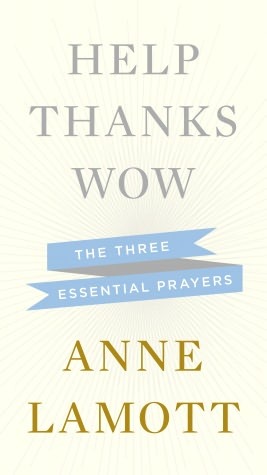
Book Review: Help Thanks Wow


There are times when we don't know what to pray. Sometimes it's because we're so broken or lost or speechless. At other times it's because we've come to the conclusion that prayer is supposed to be done in a certain way or else it's not valid.

I'll never forget the high school kid who talked like a normal high school kid, complete with the usual assortment of cuss words, but when he prayed, he suddenly switched to High King James English: "O Lord, we do bless Thee, and thankest Thee for Thy bountiful blessings, and we do look to Thee in our hour of need."

Some people are gifted with the gift of eloquence, while the rest of us flounder around trying to make sense of life in our common vernacular.

Help Thanks Wow is Anne Lamott's effort at making prayer simple and accessible, making sense of something so deep and profound and nonsensical as interacting with the Creator God who is above and beyond all that we know.

Well, not so much the underlying truth of prayer. If anything, Lamott pushes back at our attempts to make prayer too simple, too predictable, too sensible. As if prayer could be made routine, as if it were a formula employed to make God do what we want. Instead, she reminds us that prayer doesn't make sense - our prayers are often selfish, they don't often get answered, they often conflict with other prayers. Prayer doesn't often save us from sickness or divorce or addiction, at least not in the usual way we would hope for.

And God - Lamott honestly admits to not really understanding God, and goes to great lengths to not try to paint any specific understanding of God on the reader. God is so much bigger and stronger and stranger and magnificent and mysterious than any of us really consider, and Lamott readily admits to confusion and mystery in the presence of the Almighty.

All of which makes many Christians uncomfortable. She challenges commonly-held beliefs and assumptions, she refers to God in the feminine, she sometimes calls God "Something." Her understanding of God's Kingdom is a lot broader and inclusive than most Christians, at least the conservatives and evangelicals, like. There are certainly pieces of her belief system with which I disagree.

But the heart of this book is prayer, the place where humanity and divinity meet. And this, says Lamott, should be simple. So she offers three little prayers: Help, Thanks, and Wow. (to those seasoned Christians reading this, think Supplication, Gratitude, Adoration).

Help - the prayer at the end of our rope, when nothing makes sense, when the kid has run away, when sickness is winning, when money is running out, we pray help.

Thanks - the word spoken for the blessings that come, for friends, for a paycheck, for a sunrise, for a parking space, for breath, for bread, for a smile, for a bird's song, for love, we pray thanks.

Wow - when we are pulled outside of ourselves by the beauty of an aria, by the sharp tang of a blackberry, by the beauty of new life in spring, for transcendent moments, by an unexpected treat, we say wow.

Lamott ends with an Amen, which is simply surrender that it will be, and it will be well. Giving it all to God and letting it remain there. We let go, we trust, we forgive, we surrender.

Help Thanks Wow is a simple little book and a fairly easy read; I've probably made this review even more complicated than the book. But this is a helpful book to remind us that prayer can be simple; it's an especially helpful book if you are have a hard time getting into prayer and need something fresh to push you in a new direction. Lamott is a fine writer with her own unique perspective on the world, and while I disagree on some of her conclusions regarding God and faith, I still think she has given us something valuable, if only her own take as a person struggling to find a prayer language that fits her life, her story, and her unique relationship with God.

Wednesday, December 19, 2012

A couple of book reviews about books about hell

Our local denominational pastor cluster decided to read a book and discuss it together. Somebody suggested reading Love Wins, Rob Bell's recent book about hell and eternity. Somebody else suggested we read Francis Chan's Erasing Hell, which was written as a response to Bell, too; the idea being it would be interesting to get both points of view before having the discussion. And so we did.

Quickly. . .


Rob Bell asks good questions. He asks the questions many Christians are afraid to ask. He challenges long-held beliefs, but in a gentle, winsome, inviting way. He invites people into the discussion in a friendly, folksy way. And he makes you think.

He also tends to shy away from direct answers, which leaves some people feeling irritated. Bell pushes the conversation in certain directions that lead to certain conclusions, but he never flat out says "here's the answer." He leaves it up to the reader to decide.

Still, he challenges the traditional understanding of hell and eternity, making the case that it is both untenable and unbiblical, the idea that the God we worship would torture people in hell for all of eternity simply because they never found Christ in the short time they had on earth. And yes, he does deal with the biblical texts, this isn't just Bell opining on his personal opinions. If you want to listen and stretch, you might find yourself agreeing with much of what he says.

Then again, there's this.


Francis Chan supports a much more traditional understanding of hell. While not agreeing with Dante's vision of flaming dungeons and devils with pitchforks, Chan peruses scripture and sees truth in the common doctrine of hell as eternal, conscious punishment for those who don't receive Christ in this lifetime. He responds to Bell and other non-traditionalists, dismantling their arguments against hell. And he makes it quite personal, as he wrestles with his own seeming lack of passion to share Christ while believing so many are destined for eternal torment.

So here's my take: Reading Bell is fascinating and interesting, in that it requires some thinking to understand where he's heading; it's new territory, which at least keeps things intriguing. And, unless one simply reads Love Wins in order to attack Bell, it does force the reader to rethink their own beliefs on both the scriptural texts and the nature of the God we worship. On the other hand, Bell doesn't deal so well with the larger corpus of theological understandings of hell. He makes it clear that nobody could ever talk of God's glory and hell in the same sentence, when, in fact, our Reformed brothers and sisters do that very thing. A fact which Bell seems to ignore or forget.

On the other hand, reading Chan is like retaking a class in Bible College 101. He simply rehashes the common understandings of the texts and seems incredulous that anybody might interpret them differently. For a subject so important, the book reads like "Hell for Dummies," a quick overview that never really wrestles with possible alternate understandings or readings.

I realized while reading these books that it became a nice example of my last book review, Clark Pinnock's The Scripture Principle. Because in the end, while it appears these two are arguing scripture, it's really a hermeneutical argument. Bell is beginning big picture, trying to understand God and then read scripture in light of who God is. Chan is beginning in the minutia of individual verses and working outward to try to understand what God must be like. Both views have some validity; without saying I agree with the outcome, I will say I appreciated Bell's approach more.

In the end, there are better books on the subject, although these two might be the most accessible. If you've never given much thought to the theology of hell, and would like a quick introduction, these books would be a good place to start. If you really want to be challenged to think through the subject, there are many books that are much more comprehensive.

Wednesday, December 05, 2012

Book Review: The Scripture Principle

Over the years, I've come to recognize that most disputes about theology, doctrine, and practice stem not from misunderstanding the Bible itself. So often when we debate and discuss doctrinal issues we spend our time pitting verse against verse, or debating original intent, or attempting to work through translation issues.

In reality, as I've come to realize, it's not the Bible that's the problem, and it's not even our understanding (or lack thereof) of the biblical text. Disagreement comes at a much more fundamental level - how we read the text in the first place.

It's a question of hermeneutic - how do we approach scripture? What assumptions do we bring? Through what lenses are we reading the texts? I find that, more and more, when I debate theology or practice I first have to have a discussion along the lines of "but how do you approach the text in the first place?" Otherwise we spend all our time throwing verses at each other, when in reality we're not even understanding those verses the same way.

In The Scripture Principle, Clark Pinnock attempts to lay out a coherent hermeneutic, a healthy, appropriate way of understanding and reading the biblical texts. And I found it extremely helpful.


For too long, the debate has been between fundamentalists and liberals, inerrantists and critics. For the last 100 years, these two camps have attempted to claim the high ground in reading and understanding the biblical texts. The liberal, critic-minded approach has been to claim human reason, insight, logic, and intelligence over the scripture. The Bible is a human collection of fables and legends, worth reading and studying if only to get a better understanding of the human experience, but anything divine or supernatural is automatically thrown out. The conservative, inerrantist approach has been to claim a complete Divine authorship, as if God penned the Bible as the One Perfect expression of all Truth. Any mention of supposed contradiction, any possibility of error, any challenge to historicity or scientific explanation is tantamount to heresy and proof of evil intent.

The problem, according to Pinnock, is that both approach the Bible from the same position - both become academic discussions and debates about the text, both attempt to push the Bible into human constructs, both seek to control the Bible. In neither case is the Bible given the authority it both claims and deserves for itself. "The Bible is not so interested in our academically proving as in our holistically seeing the truth, in our believing the gospel and actually obeying God."

In The Scripture Principle, Pinnock challenges both sides of the discussion, attempting to find a healthy middle ground. Ultimately, says Pinnock, the only proper response to the Bible is to submit to it, as it stands as God's revelation over us.

Two issues stood out as key for me in reading this book. First, Pinnock frames the Scripture Principle in terms of the Incarnation. Jesus was fully God present on earth. Jesus is the way to the Father. Jesus is the One in whom salvation is found. Jesus was divinity incarnate, able to lead the way to glory. Jesus revealed God's plan, Jesus spoke truth to all who would listen, Jesus performed miracles and so laid claim to the full authority of God. At the same time, Jesus was fully human. Jesus got tired. When he was cut, Jesus bled. Jesus could become irritated. Jesus had human skin that would scar when damaged. Jesus used all manner of stories and teaching methods. Jesus told fables. Jesus was very much "of the earth." God could have come in all Divine Glory and smacked us a good one. Instead, God chose to come in frail human form. We don't have to like it or even make sense of it, but it's what God did, so we can only accept it.

So, too, should we see scripture, according to Pinnock. Held within its pages is truth, is the revelation of God's plan; held within is the power to lead seekers to salvation, the power to give sight to the blind. The Bible speaks truth to all who will listen, the Bible claims the authority of God. And yet, the Bible was penned by humans. Humans who wrote out of anger, and love, and despair, and doubt, and joy. The Bible uses all manner of methods including stories and fables and arguments; the Bible is full of 'untruths' (think of Job's friends). The Bible reveals a progressive awareness of God's work, leading from the dim awareness of Abraham up through the ultimate revelation of God in Jesus. The Bible was written by specific men and women in specific cultures in specific locations at specific times in history. The Bible is full of seeming contradictions (the warlike OT God vs. the peace-making of Jesus; Paul commanding women to be silent, and then explaining how they should present themselves when speaking in public). This is the Bible we have. We don't have to like it, and we probably spend too much time trying to make sense of it, but it's how God has given it to us, so we can only accept it.

Secondly, Pinnock is clear about the role of the Spirit in wrestling with the text. Our understanding of the text is borne out of the wrestling between the Inspired Word and our human attempt at reading it. The Biblical world and our own worlds collide, and in that place, the Spirit continues to bring life and meaning. Sometimes that meaning is the same as the original writing; sometimes the Spirit brings new meaning to light. This is seen in the NT writings, as the authors mined the OT texts and found much there that was new in the light of Christ. It was true when Martin Luther, wrestling with Paul's teachings in Romans, suddenly understand the doctrine of grace in a new and clearer light. It may even be true of us today as we find teachings that apply to 21st century society that were unknown to men and women in the 1st century. But all of this comes, according to Pinnock, under two conditions. It comes when readers submit themselves to the texts, giving the texts the place of authority that we too often claim for ourselves, and it comes when the Spirit is alive and active in the reader. Thus, Pinnock would argue, we would never expect non-Christian critics to grasp the greater truths found within the pages of Scripture, as these are only truly revealed by the Spirit to Christ's followers.

Ultimately, Pinnock is clear that none of this discussion is worthwhile if it allows us to keep scripture at a distance. "God speaks through the Bible, not to make us scholars and scientists, but to put us in a right relationship with God and to give us such a religious understanding of the world and history that we can grasp everything better."

Both the liberal and conservative will find themselves challenged in the pages of The Scripture Principle; both, I believe, would be drawn to a healthier respect for each other, and for the Bible itself, if they wrestled with Pinnock's suggestions. It's actually a fairly healthy representation of the Evangelical Covenant Church's position on scripture; we claim the Bible as the Word of God and the only perfect rule for faith, doctrine, and conduct, while not trying to pigeon-hole it into a specific doctrine of inerrancy or inspiration.

I should say this - The Scripture Principle is not an easy read; this is seminary-level stuff, but it certainly is worth the time and effort put into it.

Tuesday, November 13, 2012

A couple of book reviews about books about church leadership

Over the last few weeks I've finished two different books related to church leadership.

The first was Simple Church, which we read as a group project for the Lakebay Church board.


Based on an extensive research project, Simple Church argues that churches are weighted down by complexity, busy-ness, and too many ministries and programs; at the same time, they lack clear vision, focus, and direction. The most important task of the church - building disciples - is lost in the chaos of events and programs and structure.

Simple Church calls churches to refocus, to reclaim their vision, to find their one true calling, and to reorganize around that task. Beyond simply sharing the facts deduced from their research (which are impressive and comprehensive enough to prove their point), the authors describe how to begin to reclaim a simplicity of style and structure, in order that churches would become more effective at living out the gospel.

There were parts of the book I found aggravating - too much statistical information interrupting the flow, attempts at light-heartedness that seemed forced, illustrations that didn't exactly track with the central point - but the overall premise is worth reading and understanding. Rainer and Geiger make clear that Simple Church isn't a program to adopt, but a philosophy to guide and direct whatever program a church decided to pursue.

It is also an easy read, not requiring a college degree to understand, and sincerely lacking in seminary-level words, which the Lakebay board very much appreciated.

The other book, which I mostly read while relaxing in my hammock during the last sunny days of Fall, was How Your Church Family Works by Peter Steinke.


HYCFW is a slightly older book (first published in '93), but I found it one of the most useful ministry-related books I've read. Steinke takes Family Systems Theory and applies it to church. His premise is that we too often fail to see the forest for the trees - when looking at churches, we look at individuals and how they behave, but we forget to look at the whole, at the overarching system. But Family Systems Theory tells us we are all interconnected, and the organism is much more than the sum of its part, for better or for worse.

Specifically, Steinke writes about the process anxiety plays in the system - the things that make us anxious, and how that anxiety plays out across the group. Because, quite often systems will behave in predictable, if somewhat unexpected ways. Or to put that another way, people respond in systems differently than you would expect them to as individuals. Sometimes the nicest, kindest, gentlest folks react in surprising ways when the system is infected with anxiety.

This book is filled with theory and research, but also with case studies and stories to flesh out the concepts. It deals with the direct conflict that often happens between people in systems, but also spends considerable time working through the triangles we create to ease our anxiety. Finally, it gives helpful ideas and tools that can be implemented to manage anxiety, whether we seek to ease it or use it to spur healthy decision-making.

HYCFW is both diagnostic and prescriptive; it gives language to the issues that happen all around us; it also gives us tools to move ahead into health and vitality. It isn't a program or study for the whole church to digest and implement, but it does give healthy language to understand the reality that is all around us, helping leaders name the issues that they face, and decide how to move ahead even in the midst of those issues.

Over the years I've read a number of books on church leadership; this one ranks up there with the most important of them. Many times I've found myself in confusing situations, wherein people were reacting in odd and unexpected ways. Steinke's work on anxiety and the different ways it pushes people has been very helpful. More importantly, it helps me understand better my own tendencies within systems - how I respond to anxiety, how my fears and doubts and natural patterns sometimes aren't the healthiest response.

As a side note . . . a friend of mine had loaned me his copy of HYCFW, and after I returned it I decided I needed my own. So it was sitting in my Amazon shopping cart, when, much to my joy and surprise, I was given a copy at last week's Navigate Conference in Minnesota. So thank you, Covenant Church, for also recognizing the importance of this book, and for passing it along to us pastors.

Wednesday, May 30, 2012

Women that Rock My World: Two Book Reviews


Neither Anne Rice nor Sara Miles would be obvious choices to represent Christianity in American Culture. Rice is the renowned author of vampire novels and an erotic romance trilogy; Miles is a feminist lesbian former war-correspondent and chef. Both have walked difficult roads, far outside of, and often strongly critical of, the Church in America. And yet both experienced a conversion in their lives, not unlike Paul on the road to Damascus. While running from God, both were met by God and began new journeys as Christ-followers.

Miles told the story of her conversion in her previous book, Eat this Bread (read my review here). Out of that encounter came a passion to serve the people of her inner-city San Francisco neighborhood. She began a food ministry which has since grown to a city-wide endeavor. In Jesus Freak, Miles tells of the ongoing work of that ministry, and of her life, to feed the hungry, love the broken, heal the sick, provide for the destitute, offer friendship to the desperately lonely; to be the hands and feet of Jesus in the sharp brokenness of people's lives. This is a ministry to the immigrant, to the schizophrenic, to the addict, and to those who work amongst them. In beautiful prose, with humor and candor, Miles introduces us to the people of her world, tying them into the larger vision of the Kingdom of God. The parables of Jesus come to life in her community, and by revealing them to us, Miles challenges the rest of us to be about the work of God in our own world. This is raw, gritty stuff; often uncomfortable and painful, but it is the real stuff of life, and a prophetic message to the Church in America today.

Rice comes at it from a different angle; she is one who was raised in the church, but wandered away for many years. Only after decades of literary success and acclaim did she return to a faith she was convinced was dead. Whereas Miles came face-to-face with God in one completely unexpected moment, Rice came to a slowly dawning awareness that God had been pursuing her ever since she left. In her words, she was "Christ haunted." Drawn in by sacred images, by statues and paintings and the holiness of small South American sanctuaries, she felt her resistance fading, and finally stepped back into the embrace of God.

Both Miles and Rice offer the interesting perspective of newcomers, those looking at Christianity with fresh eyes. Both struggled (and continue to struggle) with the cultural and social trappings of the Church. Both describe the power of meeting Christ in the Lord's Supper, both speak of the impact of liturgy and art and language and song. Both have had difficulty bridging their progressive, liberal, left-leaning beliefs and ideologies with the conservate, fundamentalist, right-leaning American church. In fact, Rice would famously later 'quit the church in the name of Christ.' Miles, on the other hand, speaks regularly of her begrudging acceptance of the fact that, in the name of Christ, she willingly shares in the Kingdom of God with many who would cast her out, who disagree with fundamental issues of her life. In the words of one of the characters gracing the pages of Jesus Freak, "Since Jesus loves the knuckleheads who are running things I must try to, also, but I don't have to agree with them."

Rice reminds us of the beauty of God's presence in creation, in liturgy, in the soul's hunger for transcendence. Her descriptive passages of childhood memories of sanctuaries, flowering trees, and school gatherings remind us to open our own eyes to God's presence in the world around us. Miles reminds us of the image of God present in every human being, be they wealthy lawyer or tweaked-out crack-head. Her humor, and her obvious love for the outcasts and ragamuffins remind us to take people seriously - and not take ourselves so seriously. Both challenge the reader to take faith seriously; not as a hobby or accessory, but as the very thing that defines life.

Not that I don't find frustrations here, as well. Miles, in developing an earthy spirituality, grounded in the dust and grime of the Tenderloin, seems to miss out on the possibility of the supernatural showing up. Healing, to Miles, comes about when the soul is mended, when the heart is healed even if the sickness carries on. Comfort and hope are found in accepting the way life is and the way people are. Stories abound of people laughing in the face of death, or finding moments of grace in the midst of severe brokenness; on the other hand, the possibility that God might actually cure a disease seems missing. I agree that often-times the miraculous is hidden right there in the real stuff of life; sometimes, though, the miraculous blows us away and the lame do, in fact, walk again.

In Rice's case, the frustration comes in knowing the end of the story. Called Out ends so hopeful, with so much expectation; knowing that a decade later her frustrations overwhelmed that hope clouds the message. And yes, that frustration lies just as much with the Church as it does with Rice. We do lose sight of Christ in our debates over lesser things; we do focus too much on people's supposed sins, and don't care enough about their longings, their pains, their hopes and dreams. It's just sad that Rice felt the need to disassociate, giving up the possibility of engagement.

Near the end of Called Out, Rice writes, "The Lord Jesus Christ is where my focus belongs. And my commitment to Christ must remain unchanged." Near the end of Jesus Freak, Miles writes, "But Jesus is real, and so, praise God, are we." In the end, that's what is important in these two books. They are the autobiographical struggles of women trying to follow Jesus in the midst of a fractured world. Through fits and starts, failures and glorious successes, they continue on that journey. Through it all, they keep Jesus at center, and challenge the rest of us to do so. Neither is a sinless Saint, but both responded to the Call, and both are witnesses to the power of God's Spirit to change lives. They are, in many ways, examples of 21st century saints, following Christ in spite of long odds, and inviting us to do the same.

Wednesday, May 16, 2012

Book Review: One.Life


Are you a young person, trying to make sense of where your life fits into the larger scheme of this world? Are you out of college, hoping your life will mean something, and not just disappear into the haze of meaningless that is our culture? Have you hit middle age, and find yourself feeling like "there must be more to life than this?"

If so, then Scot McKnight's One.Life is the book for you.

It is McKnight's intention that life is supposed to be more than the humdrum of mindless entertainment, empty pleasure, vacuous reality-show stories, accumulation of stuff, boredom, disappointment, silly fights with friends, and all those other things we fill our lives with. Instead, we are given one life to live, and called into a glorious adventure of love, service, compassion, meaning, and world-changing work.

However, that can only happen when people truly and fully give their lives over to Jesus, letting Jesus lead, following his dreams, surrendering everything to his lordship. In McKnight's words,

Christianity isn't enough. Religion isn't enough. Being accepted in a church isn't enough. Climbing the corporate ladder isn't enough. Solving intellectual problems isn't enough. Chasing the American dream isn't enough. Friends aren't enough. Science isn't enough. Food and drink aren't enough. Fame isn't enough. Nothing's enough. The only thing that is enough is Jesus, and the only way to get to Jesus is to follow him, and that means one thing: giving your One.Life to him and following his dream.

McKnight makes clear that he is redefining a common misunderstanding of Christianity; namely, that following Christ is about making a one-time decision, and then spending the rest of our lives trying to follow a bunch of rules. Instead, the author slowly builds up his central theme, which is that followers of Jesus follow Jesus, devoting their lives to the Kingdom vision of Jesus.

The earlier part of One.Life is spent sketching this vision of discipleship even as he defines what, exactly, the Kingdom Vision of Jesus is (think peace, compassion, justice, and wisdom). In the latter chapters of the book, McKnight addresses some of the specific issues and contexts with which people struggle - why is the Church important? What does the Kingdom have to do with sex? How do I follow Jesus in a 'secular' job? Finally, the last few chapters are given to exploring God's Kingdom in light of eternity, God's nature, and the work of Jesus at the cross.

One.Life is a powerful book that is also accessible, fairly easy to read yet full of profound insight. There is so much confusion in the world about what it means to be a Christian (and let's be honest: to many, 'Christian' is not a good word). McKnight has offered a positive, hopeful, meaningful vision for what life can and should be, a life that finds its meaning simply by following Christ through the ordinary moments as they come.

Thanks to Zondervan for offering One.Life as a free gift to Ministers in the Evangelical Covenant Church at our Midwinter Conference.

Wednesday, April 04, 2012

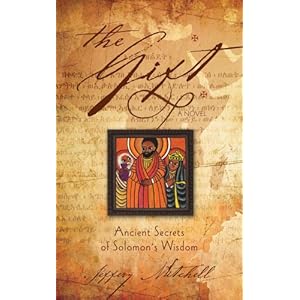
Book Review: The Gift


In The Gift, Jeffery Mitchell (a Covenant Pastor and colleague) has penned a fable bringing ancient wisdom into present-day life. The larger narrative is a fictionalized tale of Mitchell's visit to a fabled Ethiopian monastery, and his encounter with a fascinating document there. The heart of the story is that document itself - "The Book of Zadok" - which tells of a priest and his work with King Solomon.

While the story is fiction, Mitchell uses the biblical account of Solomon as his framework. We find Solomon lost and confused, seeking clarity from Zadok, Israel's priest. As the story progresses, Mitchell shows a deep insight into the human heart with all its questions, doubts, temptations and hopes. All too often I discovered Solomon's words describing my own inner discussions; Zadok's probing questions forced me to consider the masks behind which I often hide. Mitchell's work as a spiritual director shines through in the way he senses the work of the Spirit in the human heart.

Most helpful, rather than come from a position of already knowing it all, Mitchell shares his own struggles to understand and implement Solomon's "Seven Pillars of Wisdom." Thus the book comes across as the gentle encouragement of a friend, rather than a lecture of a superior guru.

The Gift is a small book and an easy read, with enough of a plot to keep the reader interested, but its depth is surprising. This is a book that could be read multiple times, with new insights gleaned at each passing. One could make comparisons to other, more famous 'fictional allegories' in the Christian book market (I won't name names), and the truth is, The Gift is among the best I've read in recent years. As a bonus, a small study guide is available on Jeff's website.

Thanks to Evergreen Press for gifting all ECC pastors with The Gift at this year's Midwinter Conference, and to Jeff for sharing his gift with the world.

Sunday, March 25, 2012

Book Review: Recovering the Scandal of the Cross


As we rapidly approach Holy Week, the thoughts of many Christians will turn to the sacrificial death of Jesus of Nazareth on a Roman cross. The biblical texts are clear on this point: Jesus' death and resurrection were a necessary part of God's plan to overthrow evil and redeem creation. And so the church repeats again the truth that "Christ died to save sinners."

Exactly how his death accomplished this feat isn't so clear. Across the pages of the New Testament, a multitude of images and metaphors are used to explain what Jesus' death meant. These include sacrifice, ransom, battle, covenant, worship, and personal relationship. Since the time of Christ, the church and its theologians have wrestled with the meaning of the cross in their particular time and place. Various versions of atonement theology have arisen across the ages, including Christus Victor, Recapitulation, and, most famously, Penal Substitutionary Atonement.

In Recovering the Scandal of the Cross, Green and Baker cover in some detail the various atonement images used across the pages of scripture, as well as the more popular explanations from church history. In doing so, they come to the conclusion that there are so many images because there can be no single explanation covering the saving significance of the cross and resurrection. Instead, atonement is a multi-faceted concept that is best described using a variety of images. The New Testament writers followed this model; so, too, should Christians today avoid claiming any one model as THE model explaining the work of the cross.

This, of course, has raised no little controversy. To many Christians, Penal Substitutionary Atonement is most definitely the singular explanation of the saving significance of the cross. From Kirk Cameron to John Piper, voices have been raised in protest, arguing that denying PSA is denying the gospel. But Green and Baker make a powerful case that other images are truer to the biblical message; in fact, they agree with many who claim that PSA is a dangerous misunderstanding of the nature of wrath, that it too often leads to the support of abuses of power, and that it paints an unhealthy picture of God.

In the end, the authors believe it more important to seek out new ways of explaining the cross in our current contexts. Shame-based cultures will need to hear a different telling than would guilt-based cultures. The model used in Japan could and should be different from the model used in central Africa, which would differ still from models used on college campuses in the U.S. The basics are all the same - sin and rebellion have left humanity alienated from God, the source of all life. But on the cross Jesus has overcome the effects of sin and rebellion, and created new opportunities for life and wholeness for humanity.

From that starting point, Christians are encouraged to think broadly and deeply, exploring how their culture experiences the effects of sin, and what salvation means to them. Green and Baker offer some examples of this in action, using models developed in Great Britain, Tanzania, Japan, and the U.S. They then encourage the reader to move beyond simply accepting models created centuries ago across the world, and to ponder what the cross means in our world, and how best we can articulate that to those around us.

This is the 2nd Edition of Recovering the Scandal, and it has been heavily updated to reflect the decade of atonement discussion since its first publishing; in addition, sections have been expanded and clarified in response to criticisms of the first edition. It is an important read for anyone seeking to understand the broader atonement debate that has opened up in the last 10 years; it is equally important to anyone seeking to understand the meaning of the cross in their life, and in the world.

Note: Mark Baker was my professor in seminary, and he gave me a free copy of this book for the purpose of this review. I was pleasantly surprised to find myself in the book, although the reader would never know it was me. . .

Tuesday, February 21, 2012

Book Review: Forgiving the Unforgivable


"Forgiving the Unforgivable" is a simple little book dealing with a painful and complex problem - forgiving when forgiveness seems impossible. There are a variety of reasons forgiveness may seem out of reach - the offense is so huge, or the offender is out of our lives. But forgiveness remains the only true path toward total healing in our lives.

Stoop spends the early part of the book discussing what might fall into the category of "unforgivable." He then sketches out his understanding of the basics of forgiveness, dealing with both myths and truths of forgiveness. After offering up two false paths people walk down when they are hurt (denial and bitterness), Stoop draws out a map toward forgiveness and healing.

There are no promises of quick healing; sorrow, pain, grief and anger all play a role in true forgiveness. In the end, though, as people learn to place blame appropriately, to identify and own their pain, and to realize that forgiveness never absolves the wrong done, they can release the offender from their lives, let go of the wrong, and move into a new freedom and joy.

Stoop's work is firmly planted in scripture, based on an understanding that our forgiveness of others is possible because God has already forgiven us, and also because we trust in a God who will hold wrongdoers appropriate when necessary. If we struggle with forgiving ourselves, we find hope in the knowledge that Jesus forgave us at the cross; if we struggle with others who have horrifically wronged us, we find solace in the knowledge that God knows our pain, and will deal with them in his time.

There is much to be gleaned from this little book; even those not dealing specifically with 'unforgivable' sins will learn a lot about forgiveness. I was a little disappointed in some of the theological work, especially in what I perceive as Stoop's false comparison of Old Testament forgiveness vs. New Testament forgiveness. In addition, the book's size and tone keep it from going very deep; it's more an introduction to forgiveness than a deep exploration of the topic.

However, all that being said, it's a worthwhile book, and one I wouldn't hesitate to recommend to people wondering just how to forgive someone who has deeply wounded them.

Thursday, February 09, 2012

Book Review: The Emotionally Healthy Church


We are a messed-up people, living in a messed-up world. Anybody want to deny that?

Peter Scazzero hit upon an interesting idea after years of hitting his head against the wall, seeking to grow disciples without any real success. His idea was this: most discipleship and evangelism programs deal with knowledge (believing the right things) and performance (doing the right things) without addressing the very real emotional issues plaguing us all. This leads to what Scazzero calls an Imbalanced Spirituality. ". . .when you go beyond the praise and worship of our large meetings and conventions and into the homes and small group meetings of God's people, you often find a valley littered by broken and failed relationships."

He puts this in practical terms in a descriptive paragraph that sounds all-too-familiar: "Many are supposedly 'spiritually mature' but remain infants, children, or teenagers emotionally. They demonstrate little ability to process anger, sadness, or hurt. They whine, complain, distance themselves, blame and use sarcasm - like little children when they don't get their way. Highly defensive to criticism or differences of opinion, they expect to be taken care of and often treat people as objects to meet their needs."

Realizing the a healthy discipleship process must include the emotional component, Scazzero set out to change the way he ministered, and the way his church discipled its people. Following the story of his personal journey in this area. the author lays out seven principles that make up the core of their understanding of emotional health:

1. We  need to look beyond the surface of our lives. "My focus was upward and outward - growing our church, reaching people for Christ, raising up leaders, buying a building. But an authentic relationship with Christ also takes us into the depths - the shadows, the strongholds and the darkness deep within our own souls that must be purged."

2. We must break the power that the past holds on our lives. "New roots are needed for new fruit. All we do is modify the same tree when we make resolutions and commitments to pray more, go to church more consistently, or resolve to stop bad behavior. The root needs to be pulled up. A new tree is needed. (this chapter spends significant time exploring genograms - the charting out of family history and its influence on who we've become)

3. We learn to live in our brokenness and vulnerability. "The choice to live in brokenness and vulnerability challenges us in profound ways to let go of what other people think and to surrender to God's love and mercy."

4. We receive our limits as a gift from God. "People with poor boundaries feel compelled to do what others want even though it is not what they want to do. They are afraid of disappointing someone or being criticized."

5. We embrace grieving and loss. In fact, embracing grief helps us to become more like God. "People in our churches minimize their failures and disappointments. The result is that for many today, at least in prosperous North America, there is a widespread inability to face pain." One of the outcomes of facing grief is the ability to truly forgive those who have caused us grief.

6. We follow the model of Jesus by making incarnation our model of love. ". . .bold announcements of what God is doing or saying are common. People who follow the humble way of Jesus are much more difficult to find."

7.  We slow down to live with integrity. "It is an illusion to imagine we can lead our people on a spiritual journey we have not taken ourselves. When we skim in our relationship with God, no program can substitute for the superficiality and self-will that inevitably follow."

Two bonuses of the book are a self-inventory to determine our current level of spiritual and emotional maturity, and a copy of the Rule of Life adopted by the church Scazzero pastors.

The strength of this book is the reminder that emotions are a crucial, yet long-neglected facet of discipleship, and that we are living in a culture that seems to create emotionally broken/stilted people. The weakness would be its brevity; each of these chapters could fill up a book in itself. Also, pastors and church leaders would be wise to discern just which emotional issues they can help with, and which are better left in the hands of qualified therapists and counselors.

In the end, it was a worthwhile and helpful read, challenging me both in how I lead my own life, and how I minister.

Tuesday, January 17, 2012

Book Review: A Christmas Carol


I've seen the movie countless times; in fact, I've seen countless versions of the book countless times. There's no denying it's a classic in Western Literature; perhaps one of the best-known stories in the English language.

Not that anybody's ever read it.

I hadn't, up until this year. But last spring I found it at the Borders Going-Out-Of-Business sale, and decided it was about time to hear it as Dickens intended.

It's a difficult book to read, both because we're not used to reading Victorian English, and because it's impossible to avoid hearing the voices of Kermit the Frog and Michael Caine and George C. Scott. And yet, it's such a necessary book.

It's become important to the pantheon of "necessary items for Christmas," along with "A Christmas Story" and The Carpenters and ugly sweaters. But even more so, I think it's necessary for our world today. It's a little unfortunate that it's become window dressing for the festive season, because the message is entirely prophetic, judgmental, and yet hopeful. It's a message we need once again.

I don't need to rehearse the story or themes for you, but think about it for just a second - there's a message here about the proper place of money in relationships, there's a message of the importance of all people, whether they are rich or poor, there's a message about the voluntary redistribution of wealth; but it's all couched in a story of redemption. Yes, there is strong judgment against selfishness and greed (perhaps echoes of the Rich Man and Lazarus), but rather than simply condemn that man, Dickens paints a picture where even the worst can be redeemed and restored. That is a message sadly lacking in the 21st Century.

It's interesting to read the story, as so many familiar lines pop off the page; at the same time, there are tender and poignant scenes that I have yet to see in the movie versions; young couples in love, ships' crews huddled in their cold cabin celebrating Christmas far out at sea. The Ghost of Christmas present even gets in a pretty direct shot at the church of Dickens' day.

In the end, though, we're left with the familiar story of an angry, bitter, broken man who has all the money in the world but has lost all human connection, and the work of spirits to save him. Dickens reminds us that there is hope for even the worst of sinners, if repentance is found.

The bonus of this book is the addition of two lesser-known Christmas tales penned by Dickens - The Chimes, and The Cricket on the Hearth. The Chimes tells us of a broken-down man beset with terrible dreams while (accidentally) locked inside a church steeple; it's a mystic, visionary tale, lacking a bit of the clarity of A Christmas Carol. It's a cold story, and yet hopeful and redemptive. The Cricket on the Hearth is a warmer tale, with brighter characters and (in my opinion) a more interesting story. There's an old cartoon version of this one out there; I remember seeing it some years ago. Like Carol, it can be a little difficult to follow simply due to the Victorian English vernacular, but it's a fun story full of lame dogs and old horses and mysterious strangers and inept babysitters and blind saints and grumpy old men. And yes, in keeping with the others, it brings a surprise redemptive end, complete with a homespun party.

So Borders, I'm sorry you went out of business. But your sale finally convinced me to pick this one up, and for that I'm grateful.

Tuesday, December 06, 2011

Book Review: Reaching Out


Loneliness, hostility, illusion - these things mark the lives of so many humans, wandering through life trying to survive, trying to find meaning, trying to make sense of it all. Broken by a sinful world, we find ourselves isolated and angry, living in illusions of our own making that cover over the reality of our pain.

Rather than avoiding all three, Henri Nouwen sees each as a starting place toward wholeness, as we realize each has something to teach us, and each can lead us deeper into the heart of God. In Reaching Out, Nouwen explains how our loneliness, painful and frightening as it is, can be transformed into solitude, the quiet place where we can know ourselves better, and the place where we can finally rest in the comforting presence of God's Spirit. "Instead of running away from our loneliness and trying to forget or deny it, we have to protect it and turn it into a fruitful solitude." The Christian life needs its time in the desert; by developing hearts that are comfortable with solitude, we can find again what it means to commune with God, and thus be better equipped to live with our neighbors.

This leads to the second movement - from hostility to hospitality. Because we are lonely we are protective of our space, and we often use others to fill up the empty spaces in our lives. "When hostility is converted into hospitality then fearful strangers can become guests revealing to their hosts the promises they are carrying with them." Hospitality, according to Nouwen, is "the creation of a free space where  the stranger can enter and become a friend instead of an enemy." Hospitality is a ministry in which the host creates space for the guest to come as they are and find themselves. Nouwen sketches this out in the context of the teacher/student, parent/child, and healer/patient relationships. In each of these, says Nouwen, "Affirmation, encouragement and support are often much more important than criticism. The good host is the one who not only helps the guests to see that they have hidden talents, but who is able to help them develop and deepen these talents so that they can continue their way on their own with a renewed self-confidence."

Unfortunately, our loneliness and hostility is often hidden behind a veneer of illusion. We have such a hard time getting to the heart of our brokenness. We live as if we are immortal. We cover over our hostility with sentimentality. We make idols of our dreams, thinking ourselves much greater and of more importance than we really are. The answer is found only in prayer - not the pious platitudes of religion, but open, honest communication before the God who knows us better than we know ourselves. "When, however, prayer makes us reach out to God, not on our own but on his terms, then prayer pulls us away from self-preoccupations, encourages us to leave familiar ground, and challenges us to enter into a new world which cannot be contained within the narrow boundaries of our mind or heart."

Like all of Nouwen's writings, this book is deceptively simple. It is a short and easy read, yet so rich and deep that it requires time to ponder, contemplate, and re-read. Even more, it requires action - not programs or plans, but action of the soul, as we seek to reorient our lives back into line with God's loving desires for us. It is an extremely helpful book for people whose lives have settled into religious routine, who feel stifled, who feel like it's time for something new but are uncertain where to turn. It's a book that requires a little maturity, but will lead to so much more.

Friday, October 28, 2011

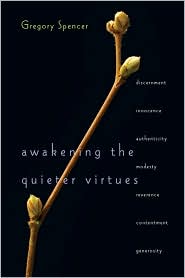
Book Review: awakening the quieter virtues


We often define our faith by a big list of things we should do, and things we shouldn't do. Most of the items on those list also fall into the category of obvious and important things we should do (like go to church, love our mother, behave respectfully) and, more explicitly, the Big Sins we should avoid (murder, lust, pornography, addictions, voting for a Democrat, and stealing).

Gregory Spencer has written Awakening the Quieter Virtues, a very helpful book calling our attention to the fact that more often it's the little things that really count, the quieter virtues that really make a difference. It's the unseen practices that mold us and shape us as Christ-followers, and that slowly change the world around us. Much like yeast working through the dough, the quieter virtues act from deep within us, not calling attention to themselves yet all the while forming us and assisting us as we seek to be like Christ.

Not only does he point out this often-overlooked point; Spencer spends the bulk of the book working through these quieter virtues, explaining what they may look like in our 21st-Century lives. He peppers his work with stories from his own life and the lives of his friends and students (he teaches at Westmont College). The book is not an esoteric description of spiritual disciplines unattainable by normal, non-spiritual folks. He proves that with a little effort, anybody can put these virtues into practice and slowly see their spirit drawn closer to the Spirit who gives life.

Certainly these are important virtues for our world today, and if the church were to put these into practice, we would begin to shine a brighter light into a dark world. Virtues Spencer explores include discernment, innocence, modesty, reverence, contentment, and generosity. Each virtue is paired with a spiritual discipline that is useful to form that virtue in the reader's heart. However, I must say again that Spencer is not working toward a pious, self-righteous unearthly spirituality. He labors to plant these virtues firmly into the soil of our postmodern lives.

This certainly isn't a theological tome, and the fact that Spencer teaches college students shows up in his writing. Some may be put off by his attempts to be catchy, but in the end I appreciated his efforts to contextualize this work, making sense of it for our time and place. It reads lighter than Nouwen or Merton, but to that end would be especially useful for people without much (if any) experience with the concept of spiritual disciplines.

Awakening the Quieter Virtues was a gift given to Covenant pastors at last year's Midwinter conference. I appreciate that people within our denomination are generous in their gifts, and thoughtful in the books they send out way.

Thursday, August 11, 2011

Book Review: The Pastor


Ever pick up a book and realize it's written directly to, and about, you? Ever have a book that comes along at just the right moment, perfectly matching your situation, essentially changing your life?

I'd been meaning to get to Eugene Peterson's memoir The Pastor ever since it came out, but had a large pile of unread books I was working through. Then Ron came in and dropped a copy on my desk. He had no idea I was about to enter into a long summer of introspection and assessment. He had no idea I was going to need a friendly voice to sit with me as I sat and pondered my ministry and my life this summer. He just knew I probably needed to get to this book sooner rather than later.

And so Peterson has been a voice speaking into my life all summer, whether sitting in the quiet of my living room, or flying with me on the way into Chicago, or sitting beside the Skykomish River waiting to catch a fish. And his truly has been a helpful, and necessary, voice.

Peterson has written a lot of books during his storied career as pastor, writer, and professor; now that he has laid most of those titles aside, he has chosen to look back over the last decades and find the places God was working, using them as signposts to the rest of us, clues to the ways God might be working still. He points out quickly that Pastor has never been an easy title, and is probably more confusing now than ever. "North American culture does not offer congenial conditions in which to live vocationally as a pastor. Men and women who are pastors in America today find that they have entered into a way of life that is in ruins."

Thankfully, Peterson chose another way, a non-comformist way; or, as Peterson would probably say, God led him through this vocation to another way, a way of life in which he learned to live as Pastor to a specific people in a specific place over a long period of time.

I liken it to a long walk through a dark wood. There is beauty and terror along the way, with no clear path, no obvious trail. But God has left markers along the way to keep us on the path. Peterson has gone ahead of us, sometimes failing and sometimes succeeding, but he's now teaching us how to live in this forest. No quick plans to bring the forest to submission, no designs on fame or fortune; instead, an attentiveness to God's provision in the moment, and his people traveling with us.

One of the most helpful pieces throughout this book is Peterson's attempt at reclaiming the role of Pastor, a role this world can't seem to figure out. Whereas often the role of pastor is co-opted into CEO, therapist (my personal temptation), or simply village dimwit (Rev. Lovejoy, anyone?), Peterson works hard at drawing healthier, more vibrant pictures of what it means to represent Christ, to serve a people, to become part of a place and witness to what God is doing there. It certainly challenged me to consider why I'm in Lakebay, and what, in the end, God is calling me to do here.

So I need to thank Ron for dropping it on my desk, I need to thank Peterson for writing it. . .and now that I'm finished, I think I need to read it again. And again. And again.

Wednesday, July 06, 2011

Book Review: The Way of Simplicity


This was one of those books I picked up at the "Borders is Going out of Business Sale" a few months ago. I've been refocusing my reading lately, digging into books on prayer, simplicity, and heart-work. And this was a nice counterpoint to so many books on the latest fads in Christian ministry.

Going back a millennium, the Cistercians are the Catholic order that gave us both Bernard of Clairvaux and Thomas Merton. With a focus on living out the Rule of St. Benedict, focusing on communal living and simple faith, the Cistercians offer a deep, rich faith that speaks well to our fast-paced, disposable society.

In The Way of Simplicity, Esther De Waal mines the writings of the Cistercians to reveal the heartbeat of their order. These are a people grounded in a place (she spends an entire chapter speaking to Cistercian architecture), motivated with the simple desire of living as Christ, informed by the Word, seeking to love God and love neighbor in all they do. De Waal explains the prayer and study habits of these monks (and nuns); she shares their writings both to support her work, and as poetic prayer guides (a la lectio) in an addendum at the back.

The Cistercians teach us that the Christian life is not easy, but neither is it drudgery. We live in a tension of Mary (attentive to Christ) and Martha (attentive to the other). We are called to love, but only because we are first called forth by the great Love. We are called to live in a community of faith, even while we are all responsible to walk our own journey with Christ. Mostly, we are called to lay aside our own striving, our own desires for comfort and success on our terms, and allow Christ to mold us and shape us as he desires - a process that is never easy but is rich with reward.

The Way of Simplicity is but a mere introduction to a much richer, deeper tradition, and the book gives only a taste of those who have lived out its path. But it was certainly thought-provoking and challenging, as the men and women on its pages become a witness to 'forsaking all else' for the sake of Christ and his people.

Monday, June 06, 2011

Book Review: 10 Power Principles for Christian Service (2nd ed.)


This has to be one of the worst titles for a book ever. I don't know about you, but 10 Power Principles brings to mind door-to-door insurance sales people, used car sales people, or multi-level marketing schemes. A title like 10 Power Principles reminds me of one too many seminars I've attended, promising magical practices that will transform my work and turn me into Joel Osteen.

And this book is nothing like that.

Instead, it reads like the wisdom collected over a lifetime of faithful ministry, of lessons learned through deep struggles and challenges, of basic, necessary, obvious and yet so often neglected practices at the root of God-pleasing ministry.

There's nothing surprising here. It could all be summed up as "Pray, spend time in the Word, rely on the Spirit, expect pain, rejoice when trials lead to growth, submit to God and his people; in other words, be like Christ." Written in the gentle, winsome tone of a seasoned minister, filled with stories that set these principles at home in the hearts of ministers, 10 Power Principles is one of the best books I've read on ministry and the necessary heart-work it requires. There is nothing here about church growth or magical successes, no promises of winning thousands to Christ, no lessons on marketing or sermon-writing or website development. Just a call to return to the foundational work of prayer. Of spending time in the Word. A call to lay aside dreams of comfort and prestige, replacing them with sacrifice and service. A challenge to live lives of honesty and integrity before God and others. And a reminder that our entire work is to bring people to growth and maturity in Christ.

This is one of those books that probably needs to be read every 5 years or so; especially when discouragement sets in, or the mailbox fills up with promotional material for one more ministry scheme, or when we've lost our way in the fog of herding ornery sheep. It's one of those 'reset' books, that reminds us who we are and what we're supposed to be doing. I certainly needed it right about now, and I do believe I'll be passing along copies to a pastor friend or two in the days to come.

Friday, May 13, 2011

Book Review: I See the Rhythm of Gospel

(Note: This was first posted earlier this week. Blogger seems to have eaten it, so I'm posting it again)


I See the Rhythm of Gospel is a richly textured tale of the African American experience over a 500+ year period, told through art, poetry, and song. Beginning with life in Africa, through the journey of slave ships and plantations, escape and emancipation, the community of church and the language of song, this story weaves Gospel - both the music of hope and strength, and the work of God to liberate people from darkness - throughout the long struggle faced by African Americans. It deals artistically, yet realistically, with the pain of slavery and the civil rights struggles of the 50s and 60s. I See the Rhythm confronts and laments the deep abyss of pain left over from centuries of abuse, and yet is ultimately a story of hope, that this people found a way to survive, to thrive, to overcome (a journey which sadly is still not complete). And the role of the Church, and gospel music in particular, can't be overstated in that work to overcome.

Many famous names are here - Mahalia Jackson, Thomas Dorsey, Shirley Caesar, Andrae Crouch - as are the old gospel quartets - the Soul Stirrers, the Dixie Hummingbirds. Along with the musicians are others we know of, from Nelson Mandela to Rodney King, from Harriet Tubman to Toni Morrison. More importantly, however, are probably the millions of nameless people whose faces have been lost to history. The ones who struggled and died, the ones who marched and sang, the ones who simply put food on the table for their children. These are the ones honored by artist Michelle Wood in the beautiful, colorful, profound artwork that graces these pages.

I was touched by the dignity and hope pervading these pages; I was educated about pieces of African American history I hadn't yet heard. This is a wonderful book for children and adults alike, and worthy reading by people of all ages as we all seek to understand our unique yet shared history.

A bonus CD is supplied with the book, containing five representative gospel songs, from the classic "Wade in the Water" by the Golden Gate Quartet, up through the Holy Hip-Hop of Cross Movement's "I Love You."

The music, along with the lyrical text and the lush, bright, powerful artwork, all combine to help us see the rhythm of gospel, and the way it has woven itself into the history of African Americans in the United States.

Special Thanks to Zondervan for Supplying a Complimentary Copy for the Purposes of This Review

Friday, March 25, 2011

Book Review: Unshaken


In early 2010, Dan Woolley found himself trapped beneath the rubble of Haiti's Hotel Montana, following the 7.0 earthquake that devastated that country. In Haiti as part of a media production team for Compassion International, Woolley had just entered the hotel when the earthquake hit, bringing it down on him and all those inside. For 65 hours he struggled to survive, cobbling together a strategy that included iPhone apps, memories of Man vs. Wild episodes, prayer, worship, and a digital camera. Encouraged by the hope of friendly voices, thrust to the depths of despair as hunger and thirst set in, his body broken and yet unable to do anything but wait, Woolley experienced the full range of emotion and physical trauma. And now, having been rescued from that place, he is telling his personal piece of that immense national tragedy.

Note #1: I went to college with Dan and his wife. We were all at Azusa Pacific University at the same time. Not that we were friends, but I do remember them from back in the day.

Unshaken is certainly a gripping story, and a deeply personal one as well. It goes beyond the struggles Woolley faced underneath all that rubble to explore the struggles faced in his life and marriage, struggles compounded by a wife stricken with clinical depression. It asks difficult questions about the nature of faith and how we live it out in our lives. And it speaks of hope, hope for redemption and hope for change. None of us has to stay where we are; we are all given opportunities to move toward health and fulness in our lives.

There was one area, though, where the book left me frustrated. It stems from that common Evangelical tendency to elevate personal experience over most anything else. Woolley does mention multiple times that the purpose of this book is to tell his story, and not to explore the larger question of what it means that 200,000 people died (and many more still suffer even today). But I wonder if we can actually do that: isn't it a bit insensitive to say "here's my story of survival which shows God's grace" even while ignoring the epic tragedy endured by so many?

I don't really fault the author for this; as I mentioned, he does at least recognize the issue even if he chooses to sidestep it. I just wish we in the church could be more sensitive about praising Jesus for the wonderful things he's done in our lives, when so many more are still, like Job, sitting in the dust mourning their losses.

Then again, it should probably be pointed out that Woolley is doing his part to help out in the ongoing recovery efforts in Haiti. His website points toward recovery work which people can support, and a portion of the sales of Unshaken go to support Compassion International's work in Haiti. That is to be commended.

Perhaps even more so now, following floods in Australia, earthquakes in New Zealand, and the tsunami in Japan, people need reason for hope, and assurance that even in the darkest places God is still present. Unshaken is a good reminder that even in the valley of the shadow of death, God never forsakes his children.

Note #2: Thanks to Zondervan for sending me a free copy of Unshaken for the purposes of this review.

Tuesday, March 22, 2011

Book Review: The Importance of Being Foolish


Few people get to the heart of things like Brennan Manning. Like a personal trainer, he challenges all the self-justification, the excuses, the laziness in our spiritual lives. With hawk-like eyes he discerns the murky depths of the soul and pulls it screaming into the light where we see it for the ugly thing it is.

And yet, nobody seems to understand grace like Brennan Manning. No sooner does he excoriate our propensity to sin but that he jumps in with the marvelous good news of the gospel: God loves us more than we can ever hope, dream, or imagine.

In The Importance of Being Foolish, Manning challenges three temptations common to our lives: the temptations to security, pleasure, and power. He debunks the thought that any of these have any place in the life of a disciple of Christ. Security is impossible to achieve, pleasure never satisfies, and power always comes at the expense of others. Pursuit of any of these proves that the soul has yet to fully trust God to protect, to please, to provide.

The only worthwhile pursuit, according to Manning, is the pursuit of the mind of God. For in God's mind we find that we are the beloved of God; that God promises safety in his arms, joy in his heart, and victory over the things that weigh us down. As we pursue our heavenly Father, we also find ourselves drawn into his Kingdom work, proclaiming and seeking God's holiness in this world. As we seek the power and love of Jesus, a love revealed in all its fullness on the cross, we are filled with the marvelous gifts of God: freedom from fear of death, forgiving love, poverty of spirit, selfless service, a joyful heart, fidelity to commitments, and reckless love.

One thing I so appreciate about Manning is his amazing attention to the craft of writing. He gets to the point, and does so quickly. There are no superfluous words here. It seems Manning doesn't have much space for extraneous pondering. Some of the more memorable lines from this book:

"In the Scriptures intelligence does not consist in the more or less brilliant performance of the mind. It consists in recognizing the omnipresent reality of God. . .From the biblical perspective, a great theologian may be stupid; an illiterate washerwoman praising God for the sunset immeasurably more intelligent."

"Paul's cheeks are still streaked [with tears] because of the tepidity, rank insincerity, spiritual adultery, indifference to prayer, ignorance of God's Word, comfortable piety, and apostolic sloth that dapple the Christian life in America today."

"It is symptomatic that, despite the church having been around for two thousand years, the mass of people still pass Christianity by. Why? Because the visible presence of Jesus Christ is rarely present in Christians as a whole. We will never move people to Jesus Christ and the gospel merely by making speeches about them. . .contact with Christians should be an experience that proves to people that the gospel is a power that transforms the whole of life."

"There is no Christ the humanitarian, Christ the master of interpersonal relationships, or Christ the buddy. It is Christ the Lord and Savior who calls us to repent, change our lives, and strike out in a new direction."

"The Christ of Paul was not merely a great teacher, an example of a great man, or a symbol of man's noblest aspirations; he was Lord and Savior. To reinterpret Jesus any other way is to bleed Christianity of its point."

"Life in the Spirit is the thrill and the excitement of being loved by and falling in love with Jesus Christ. If the Spirit is not fire, it does not exist."

It's been a good ten years since I last read Manning, and, although it was challenging, I have to say I was glad to let him in my life again. He's had a strong influence in my life over the years, and this book, like all his others, challenged me regarding the sincerity of this thing called the Christian walk, and reminded me again just how real and all-consuming is the love of God.

Thursday, January 27, 2011

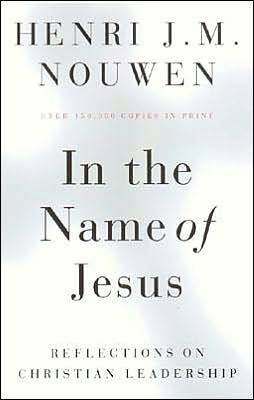
Book Review: In the Name of Jesus


Have you ever picked up a book and found it was exactly what you needed at that moment? That was my experience with Henri Nouwen's In the Name of Jesus

Written originally as a lecture for the Center for Human Development, this small book contains Nouwen's thoughts on Christian Leadership in the 21st Century.  He speaks to three temptations facing ministers, and offers three spiritual disciplines to disarm those temptations.

Nouwen begins by speaking the question many ministers face: "After twenty-five years of priesthood, I found myself praying poorly, living somewhat isolated from other people, and very much preoccupied with burning issues. Everyone was saying I was doing really well, but something inside was telling me that my success was putting my own soul in danger. I began to ask myself whether my lack of contemplative prayer, my loneliness, and my constantly changing involvement in what seemed most urgent were signs that the Spirit was gradually being suppressed."

Typical of Nouwen, much wisdom follows. His first 'temptation' is one that runs deeply in the church today: the temptation to relevance. To be important. To prove our worth with great wisdom and accomplishment. But, as he points out, "Many priests and ministers today increasingly perceive themselves as having very little impact. They are very busy, but they do not see much change. It seems that their efforts are fruitless. They face an ongoing decrease in church attendance and discover that psychologists, psychotherapists, marriage counselors, and doctors are often more trusted than they are. . .The secular world around us is saying in a loud voice, 'We can take care of ourselves. We do not need God, the church, or a priest. We are in control.'" The answer, according to Nouwen, is to give up our desire for worldly relevance and instead return our gaze to Christ. "The question is not: How many people take you seriously? How much are you going to accomplish? Can you show some results? But: Are you in love with Jesus? Perhaps another way of putting the question would be: Do you know the incarnate God?" He then calls the reader to consider the discipline of contemplative prayer, saying that future leaders of the church need not be experts or professionals in their field, but people who 'dwell in God's presence, [who] listen to God's voice, [who] look at God's beauty, [who] touch God's incarnate Word, [and who] taste fully God's infinite goodness."

The second temptation Nouwen explores is the temptation to popularity, the temptation to success. Speaking of his training for ministry, he writes, "I was made to feel like a man sent on a long, long hike with a huge backpack containing all the things necessary to help the people I would meet on the road. Questions had answers, problems had solutions, and pains had their medicines." The problem is, that sets the minister up as the healer who helps others, rather than a member of the community itself. "When you look at today's church, it is easy to see the prevalence of individualism among ministers and priests. Not too many of us have a vast repertoire of skills to be proud of, but most of us still feel that, if we have anything at all to show, it is something we have to do solo." The answer, according to Nouwen, is to remove ourselves from the pedestals and truly identify with our local community. "We cannot bring good news on our own. We are called to proclaim the Gospel together, in community." The spiritual discipline suggested by Nouwen is the act of confession and forgiveness. ". . .ministers and priests are also called to be full members of their communities, are accountable to them and need their affection and support, and are called to minister with their whole being, including their wounded selves."

Finally, Nouwen attacks the temptation of Power. Often leadership becomes "a desire to control complex situations, confused emotions, and anxious minds." Or, as he later writes, "power offers an easy substitute for the hard task of love. It seems easier to be God than to love God, easier to control people than to love people, easier to own life than to love life." The discipline suggested here by Nouwen is an intense theological reflection, bringing our all our lives and activities under the leadership of scripture. "Theological reflection is reflecting on the painful and joyful realities of every day with the mind of Jesus and thereby raising human consciousness to the knowledge of God's gentle guidance."

I've read quite a few books on Christian leadership (and leadership in general), and while In the Name of Jesus is one of the shortest, it is also one of the most profound. It may not ever be the most popular, since it doesn't speak to building large congregations or having great success in life, but it's probably important for that very reason. Too many ministers (this one included) are prone to judge our lives by the world's standards, and Nouwen here is calling us back to our first duty of loving God, loving others, and living our lives under the lordship of Christ.