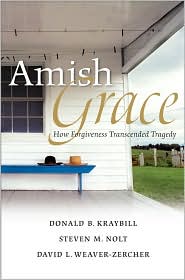
In their book
Amish Grace, Kraybill, Nolt, and Weaver-Zercher explore the concept of forgiveness through the lens of the Amish, and specifically the Amish response to the tragedy at Nickel Mines, PA.
You probably remember the story - Ten small schoolgirls shot in their one-room schoolhouse by a distraught gunman, who then turned the gun on himself to end the slaughter. One more school shooting in a long series of attacks on our country's children. Yet what made this particular event stand out was the reaction of the Amish. Within days, they were speaking of forgiveness. They visited the family of the shooter; some attended his funeral. They cared for his family even as they grieved their own losses. Glaringly absent was talk of reprisal, revenge, condemnation. Instead, there was grace.
The whole event took America by surprise. Comparisons were drawn between this reaction and the aftermath of Columbine and other school shootings. Many couldn't help but notice the sharp difference between this response of forgiveness, and America's bloodthirsty call to retaliation and revenge following the 9/11 attacks.
The authors of
Amish Grace, having spent considerable time studying the Amish, stepped into this counter-culture and explored their unique method of dealing with tragedy. They interviewed many in the area of Nickel Mines, including some of the families who lost children; they read Amish papers and listened to their stories, and have gathered all that work into this wonderful, challenging, thought-provoking book.
There are any number of different threads running throughout
Amish Grace, and the authors don't shy away from Big Questions. What is forgiveness? Is Forgiveness always appropriate? What about the role of the state to punish wrongdoers? Does forgiveness ignore the price paid by the victim? Is forgiveness realistic for the rest of us?
To understand the Amish perspective on these issues, one must first understand the Amish culture, and the authors spend considerable time exploring their history, their understanding of the world and Christianity and the future. It was in this section that I was pleasantly surprised to have some of my own thoughts and feelings clarified. For four years I studied with the Mennonites, distant cousins with the Amish, and even as the authors were explaining the basic underpinnings of Amish thought, the lightbulb went on in my head saying "aha - so that's why I see things the way I do." One quote, in particular:
From their beginning in the sixteenth century, Anabaptists have emphasized 'following Jesus' as an essential mark of the Christian life. Of course, other Christian traditions value Jesus' life and example, but they find the essence of the Christian faith in something other than discipleship. Roman Catholics, for instance, give priority to the Eucharist, and Pentecostals stress the work of the Holy Spirit. For anabaptists, the primary expression of faith is following - even imitating - Jesus.
This works itself out in the often literal interpretation of the words of Jesus. The sermon on the mount is meant to be lived, not admired. When they pray "forgive our sins, as we forgive those who sin against us," they believe it - our forgiveness is dependent upon our willingness to forgive everyone else. If Jesus chose death over self-protection, if he chose non-resistence over violence, than we must do the same. If he chose submission over self-promotion, then we, too, must submit to the Lord and to each other, rather than seek our own comfort or safety.
It is from this foundation that Amish forgiveness flows, not as an aberration but as the most natural thing in the world. Multiple times the Bible teaches that forgiveness is an expectation for followers of Christ. On the cross, Jesus cried out "Father, forgive them." Any question of retaliation is put to rest when God says "Vengeance is mine."
But is forgiveness that simple? What about the reality of evil, of the unrepentent wrongdoer? It was here that I was truly taken by Amish thought, and the work of the authors to tease it out. For the Amish, forgiveness and reconcilation are two different things. Forgiveness is a requirement on the part of the wronged person to release the wrongdoer of any harm or ill intent, to not hold against them anger or a desire for revenge. But reconciliation requires repentence on the part of the wrongdoer, and often restitution or acceptance of punishment meted out by the larger society. "Amish members emphasize that forgiving an offender does not mean releasing that person from disciplinary action." And, "Restoration is always the goal, but because repentance by the wayward person is the key to restoration, the goal is not always achieved."
Or, in an extended passage,
Amish forgiveness, like forgiveness in the outside world, can be offered regardless of whether an offender confesses, apologizes, or expresses remorse. Extended by the victim to the offender, it is an unconditional gift. Pardon, on the other hand, at least in the Christian tradition, requires repentance. The Amish believe that the church is responsible to God to hold members accountable to their baptismal vows. When a member transgresses. . .he or she is given several chances to repent. Upon making a confession and accepting discipline, a member receives pardon from the church and is restored to full fellowship. If the person does not confess, the Amish, drawing on particular New Testament texts, practice shunning, with the goal of restoring an offender to full fellowship.
There is much about the Amish that seems odd to the rest of the world - their dress, their avoidance of most modern technology, their isolation from the world, and, not least of all, their willingness to forgive, rather than seek restitution or vengeance. But, I'm convinced, when we look closely at the Amish we see a people seeking to live faithfully as disciples of Jesus, and, often, they are doing a better job than the rest of us. They cry out as modern-day prophets to the world, and to the larger church, who too often blindly adopt the ways of the world. The church is called as a community of believers, a family - and the Amish show us what true community looks like. The church is called to forgive when wronged, and the Amish represent that to its fullest.
No, the Amish aren't perfect. They have their own weaknesses, and the authors don't shy over that fact. Amish life is neither idyllic nor utopian. Even forgiveness, they admit, is an ideal the Amish don't always live up to.
But that only strengthens
Amish Grace, for showing that even broken humanity can still get it right sometimes.
I'd recommend this book to anybody interested in exploring the issue of forgiveness, including anybody struggling with forgiving someone who has wronged them. If even for a socialogical exploration of the Amish people, the book is well-worth the time to read. Mostly, as people who will one day stand face-to-face with God, giving an account for the ways in which we've lived our lives, it can only help us as we learn from a group who take discipleship so much more seriously than the rest of us often do. This book, and the Amish it represents, are a challenge to us all, but also point us in helpful directions, opening up pathways onto which we can enter as we seek to live as Christ lived.
_____
(with thanks to Ron and Cathlee, who gifted me Amish Grace in the first place.