

It was about 3 years ago, in the midst of a particularly stressful time in life and ministry. A lot of things weren't making sense, and I was struggling to find my way through. Answers weren't coming very easily. A lot of people around me wanted solutions that were exclusive of one another. I was feeling worn down and more than a little hopeless. I sat at my desk, figuratively beating my head against a wall, wondering if there was a way out of all the pain.
And then a friend walked in, saying "I have something for you." He told me to move from behind my desk, and sit in one of the comfy chairs I usually reserve for guests. Then he walked over to the CD player in the corner, and put in a CD.
"Now," he said, "just close your eyes and listen."
And he played this song.
(if you want the full effect, do the same. Close your eyes. The pictures are nice enough, but can distract from the power of the ancient words Alison is singing)
It was, of course, exactly what I needed, although I didn't know it until then. To get outside of all the pain and chaos and tribulation, and rest. To rest my mind, my heart, and my soul. To stop, and just be.
And to be reminded that the answer wouldn't be found in the complexity of it all. Even, that there's no shame in walking away from the problem. That, perhaps, too much pride was at stake in figuring it all out. And that, maybe, it was time to place it back in God's hands, where it should have been in the first place.
It is also the perfect blend of instruments, the simplicity of voice and cello, Alison's sweet, rich, hopeful lyrics over Yo Yo Ma's thick, complex, soul-stirring counter-melody. The arrangement itself reminds us of the truth that less is more.
Why do we strive? Why do we grasp? What's left but to rest, and trust in the almighty hand of God.
'Tis the gift to be simple, 'tis the gift to be free,
'tis the gift to come down where you ought to be,
and when we find ourselves in the place just right,
'twill be in the valley of love and delight.
When true simplicity is gained,
to bow and to bend we will not be ashamed,
to turn, turn, will be our delight,
'til by turning, turning we come round right.
Showing posts with label ministry. Show all posts
Showing posts with label ministry. Show all posts
Tuesday, November 12, 2013


Tuesday, January 15, 2013
If only
It's been a weekend of saying "if only."
It began about 1:00 on Sunday, just about the time the Atlanta Falcons kicked the game-winning field goal over the Seattle Seahawks, following Seattle's furious fight back from the brink of total domination.
If only the defense could have made a play in the last 30 seconds, they'd be playing again this Sunday.
If only the Seahawks had held a lead earlier in the season against Miami. If only they had found a way to beat Arizona or St. Louis or one of the other teams they should have beaten this year. Then they would have been the NFC West champs and had home-field advantage, and they're still playing this weekend against San Francisco.
If only they actually showed up in the first three quarters and played like they're capable of. If only Chris Clemons isn't hurt in the game against the Redskins.
Any number of tiny details, had they gone the other way, and Seattle is still in the hunt for the Super Bowl. Which made the loss bitter, and the response a litany of "if only?"
But then Monday morning rolled around, and I took a call from a church member who is also the local school librarian. In a broken voice, she told me that a young mother in the community had killed herself over the weekend, taking a gun to her own head to end her life. And that her two daughters and their dad were in the house and heard the shot, and he went in and found her dead on the floor.
This mother used to bring her daughters to the activities at our church. Her youngest was part of our children's group, her older daughter came to the girls' Bible study led by my wife. More recently, that youngest daughter had come to our youth group in the last few months.
Last Thursday I went to the Middle School for a band concert. At the intermission I was standing near the front and saw this mother near the back, standing by herself. You know the thought that runs through your mind. "I should go say hi." But then somebody wanted to talk to me, and the concert began again, and afterward you have to pick up your kid and it's all chaotic and you never do go say "hi."
And there's a whole new slew of "if only."
If only I had gone and said "hi" on Thursday. If only our kids' program had been healthier, and the Bible study hadn't fallen apart in turmoil at the end. If we'd been able to keep them in our loop, instead of losing them when our church went through some hard times a few years ago.
But, no. There's really no blame to be had, no great lesson to be learned. Not knowing the explanation behind the act, there's no knowing whether we could have made a difference. The only truth is that a woman was distraught enough to end her life, and she's left behind a grieving, broken family. The mind begins to run down the "if only" road, but I can't go there. Yes, I wish I'd talked to her on Thursday, but there was no reason to believe at that point that this would happen. So I can't regret my choices that night.
What I do take away is this: we're surrounded by hurting people. And we need to love them. And we need to be involved in peoples' lives. And we need to look them in the eye and say "how are you doing?" And we need to realize this isn't a game. And we need to take the chance when we have it, because there may not be a tomorrow. We're not responsible for the actions of other people, but we can at least let them know we care.
If only we can do that, then we're going to make a difference.
It began about 1:00 on Sunday, just about the time the Atlanta Falcons kicked the game-winning field goal over the Seattle Seahawks, following Seattle's furious fight back from the brink of total domination.
If only the defense could have made a play in the last 30 seconds, they'd be playing again this Sunday.
If only the Seahawks had held a lead earlier in the season against Miami. If only they had found a way to beat Arizona or St. Louis or one of the other teams they should have beaten this year. Then they would have been the NFC West champs and had home-field advantage, and they're still playing this weekend against San Francisco.
If only they actually showed up in the first three quarters and played like they're capable of. If only Chris Clemons isn't hurt in the game against the Redskins.
Any number of tiny details, had they gone the other way, and Seattle is still in the hunt for the Super Bowl. Which made the loss bitter, and the response a litany of "if only?"
But then Monday morning rolled around, and I took a call from a church member who is also the local school librarian. In a broken voice, she told me that a young mother in the community had killed herself over the weekend, taking a gun to her own head to end her life. And that her two daughters and their dad were in the house and heard the shot, and he went in and found her dead on the floor.
This mother used to bring her daughters to the activities at our church. Her youngest was part of our children's group, her older daughter came to the girls' Bible study led by my wife. More recently, that youngest daughter had come to our youth group in the last few months.
Last Thursday I went to the Middle School for a band concert. At the intermission I was standing near the front and saw this mother near the back, standing by herself. You know the thought that runs through your mind. "I should go say hi." But then somebody wanted to talk to me, and the concert began again, and afterward you have to pick up your kid and it's all chaotic and you never do go say "hi."
And there's a whole new slew of "if only."
If only I had gone and said "hi" on Thursday. If only our kids' program had been healthier, and the Bible study hadn't fallen apart in turmoil at the end. If we'd been able to keep them in our loop, instead of losing them when our church went through some hard times a few years ago.
But, no. There's really no blame to be had, no great lesson to be learned. Not knowing the explanation behind the act, there's no knowing whether we could have made a difference. The only truth is that a woman was distraught enough to end her life, and she's left behind a grieving, broken family. The mind begins to run down the "if only" road, but I can't go there. Yes, I wish I'd talked to her on Thursday, but there was no reason to believe at that point that this would happen. So I can't regret my choices that night.
What I do take away is this: we're surrounded by hurting people. And we need to love them. And we need to be involved in peoples' lives. And we need to look them in the eye and say "how are you doing?" And we need to realize this isn't a game. And we need to take the chance when we have it, because there may not be a tomorrow. We're not responsible for the actions of other people, but we can at least let them know we care.
If only we can do that, then we're going to make a difference.
Wednesday, January 02, 2013
Lord, Have Mercy
There is so much in ministry that is functional. Pastors do things. We create things. We write things. We organize things. We preach sermons. We plan Christmas Eve services. We meet people for coffee and talk about stuff - usually, somewhat important stuff. Sometimes we blog about life and other important things. We pray, we read, we update our church's facebook and twitter status. We go to meetings and retreats. It can be a busy life.
And then. . .sometimes we just sit. We sit with the woman, the single mother, who is dying of cancer. We sit and hold her hand, and say a prayer, and offer words of comfort (that she may or may not hear) and we modestly avert our eyes when, in her confusion, she rolls out of her hospital gown. We offer kind words to family members who stop by. We read scripture. But mostly, we sit, because there's not much else to do. And we promise her that she is held firmly in the grasp of God, so she can let go when she feels ready, because, really, it's all good.
But we sit, with death. Nurses come and go, because they have stuff to do. But we mostly sit.
And we realize that this is the real stuff, the place where life is at its most real and most raw. Everything else feels like treading water. These are the holy moments. And so we sit, and, if we are wise, we mostly keep our mouths shut.
And then we say a few halting words, and head out into the bright sunshine, but our hearts are heavy, because we carry the burden of death with us.
Lord, have mercy on a friend who is going home, and have mercy on those who care for her these long days and long nights.
And then. . .sometimes we just sit. We sit with the woman, the single mother, who is dying of cancer. We sit and hold her hand, and say a prayer, and offer words of comfort (that she may or may not hear) and we modestly avert our eyes when, in her confusion, she rolls out of her hospital gown. We offer kind words to family members who stop by. We read scripture. But mostly, we sit, because there's not much else to do. And we promise her that she is held firmly in the grasp of God, so she can let go when she feels ready, because, really, it's all good.
But we sit, with death. Nurses come and go, because they have stuff to do. But we mostly sit.
And we realize that this is the real stuff, the place where life is at its most real and most raw. Everything else feels like treading water. These are the holy moments. And so we sit, and, if we are wise, we mostly keep our mouths shut.
And then we say a few halting words, and head out into the bright sunshine, but our hearts are heavy, because we carry the burden of death with us.
Lord, have mercy on a friend who is going home, and have mercy on those who care for her these long days and long nights.
Tuesday, September 04, 2012
Turn down the volume - I'm getting feedback
Long ago, on a warm summer morning, I was in the midst of preparing for our Sunday worship gathering. This was fairly early into my time at this particular church, so I was still getting to know everybody and coming to understand the particular culture of the church.
A few minutes before the service began, I was cornered by one of the church matriarchs. This is what she told me: "Every Sunday I get up and pray that God won't let you destroy my worship by playing those bongo drums. They're horrible, and they distract us all from worship. You need to stop."
The back story: a month or two prior, we'd been working on a new song, but the rhythm wouldn't gel. The church didn't have a drummer, so it was difficult to lay down a rhythm and get everybody to feel it. To solve the problem, I went down to the local music store and bought a small pair of bongo drums, and used them to help the worship team finally get the beat of this song. And just about everybody seemed to like it.
Except this one particular person. And she didn't just 'not like' those bongos, she detested them and everything they stood for. (as a side note, here's a helpful suggestion: don't criticize people 10 minutes before the worship service starts. That's a guaranteed way to ruin the day for everybody). Later that afternoon I was telling this story to a friend, and in one of my few truly prophetic insights, said "I think she's going to try to get me fired." (She did try. She didn't succeed, but she made my life miserable.)
It's well established that any time you put yourself in the public eye, you invite feedback. Pastors, authors, musicians, celebrities all know - the moment you take on a public persona, you open the door for people to decide they don't like you, and to decide they need to let you know how much they don't like you.
Throw in the fact that pastors deal with such intensely personal issues - religion, belief, soul-work, music preferences, family histories ("we've always sat in that pew!") and it quickly becomes obvious: criticism and flack just go with the territory.
I mean, Jesus had his critics and detractors, right? So why should it be any different for those who attempt/claim to speak for Jesus?
Many of you know I write a bi-monthly column in our local monthly paper. Which puts me even more into the public arena. And I get a lot of positive feedback. I meet people around town who say "Do you write those columns? I really like them!" I've had some wonderful conversations with people who were taken by an article and wanted to talk about it further. Writing that column has been a blessing and a positive experience.
But. . .the first ever article I wrote for the KP News resulted in at least one irate phone call the morning after it was published. I wrote another article calling for civility in political discussion; one woman misunderstood my point and emailed the paper a missive declaring her anger at the way I slandered our president (I hadn't; I was quoting somebody else who had). A recent article musing on the lack of ethnic diversity in our community led to two response letters taking me to task (although, to be honest, one was from a friend of mine who was just having some fun with me).
But now I think we've reached the pinnacle. My article in the August edition has resulted in an angry, dismissive letter to the editor, declaring me a heretic, a neo-gnostic, and unfit for the pulpit in any Christian church. Apparently I'm out of step with orthodox Christianity, and guilty of challenging every doctrine from salvation to sin to creation. And the author of said letter wants the world to know about it.
It's always fun to see your name in print in that context.
I've had quite a few friends jump to my defense via facebook, but truthfully, I'm okay with it. For one, I think feedback is good for both me and the newspaper - it proves people are paying attention, and it probably drives more people to read more closely. Controversy sells, right?
For another, I'm following that classic advice, "consider the source." This particular gentleman wrote a different letter to the editor two years ago after Lakebay Community Church hosted a seminar discussing how Christians ought to relate to Muslims. Since our guest speaker wouldn't say the magic words, "all Muslims are going to hell for all of eternity because they are evil," we were denounced as teaching a false gospel of tolerance, of watering down the Bible, of being false teachers, and, if I remember correctly, I was labelled as unfit for pastoral ministry.
He's done it to many of my friends out here, he's done it to other churches, so I can't take it personally.
Years ago, I heard Jack Hayford give some advice that's always stuck with me. He said, "If you throw a rock into a pack of dogs, the one who barks the loudest is probably the one you hit." If I speak of the grace of God showing up in unexpected ways, and somebody reacts so negatively to that, I can only feel sadness for all the ways they must miss out on experiencing the love of God.
But this isn't so much about this gentleman; if I were to judge him here, I'd be doing the same thing he did. This is really more about responding to criticism. Maybe I'm getting wiser, or maybe I'm becoming more jaded, but it just doesn't bother me all that much any more. Sometimes I listen to the criticism, wondering if maybe there is some truth in there, if there's a lesson to be learned for the next time around. But mostly I realize that there is only One whose feedback is necessary; at the end of it all, I stand before God and answer only to him. At times he's let me know when I've crossed a line, when I've been in the wrong. At other times, I've felt God's affirmation that I'm okay, even if people don't like my bongo playing, or my political opinion, or my distaste for bikini espresso stands. I try each day to please my God, and stand in his grace when I fail.
Still, should there be anybody here still confused about this most recent article and the response, let me state once and for all:
I believe salvation is found in the life, death, and resurrection of Jesus Christ, and nowhere else.
And I also believe God doesn't really mind the bongos.
And that's all I'm going to say about that.
A few minutes before the service began, I was cornered by one of the church matriarchs. This is what she told me: "Every Sunday I get up and pray that God won't let you destroy my worship by playing those bongo drums. They're horrible, and they distract us all from worship. You need to stop."
The back story: a month or two prior, we'd been working on a new song, but the rhythm wouldn't gel. The church didn't have a drummer, so it was difficult to lay down a rhythm and get everybody to feel it. To solve the problem, I went down to the local music store and bought a small pair of bongo drums, and used them to help the worship team finally get the beat of this song. And just about everybody seemed to like it.
Except this one particular person. And she didn't just 'not like' those bongos, she detested them and everything they stood for. (as a side note, here's a helpful suggestion: don't criticize people 10 minutes before the worship service starts. That's a guaranteed way to ruin the day for everybody). Later that afternoon I was telling this story to a friend, and in one of my few truly prophetic insights, said "I think she's going to try to get me fired." (She did try. She didn't succeed, but she made my life miserable.)
It's well established that any time you put yourself in the public eye, you invite feedback. Pastors, authors, musicians, celebrities all know - the moment you take on a public persona, you open the door for people to decide they don't like you, and to decide they need to let you know how much they don't like you.
Throw in the fact that pastors deal with such intensely personal issues - religion, belief, soul-work, music preferences, family histories ("we've always sat in that pew!") and it quickly becomes obvious: criticism and flack just go with the territory.
I mean, Jesus had his critics and detractors, right? So why should it be any different for those who attempt/claim to speak for Jesus?
Many of you know I write a bi-monthly column in our local monthly paper. Which puts me even more into the public arena. And I get a lot of positive feedback. I meet people around town who say "Do you write those columns? I really like them!" I've had some wonderful conversations with people who were taken by an article and wanted to talk about it further. Writing that column has been a blessing and a positive experience.
But. . .the first ever article I wrote for the KP News resulted in at least one irate phone call the morning after it was published. I wrote another article calling for civility in political discussion; one woman misunderstood my point and emailed the paper a missive declaring her anger at the way I slandered our president (I hadn't; I was quoting somebody else who had). A recent article musing on the lack of ethnic diversity in our community led to two response letters taking me to task (although, to be honest, one was from a friend of mine who was just having some fun with me).
But now I think we've reached the pinnacle. My article in the August edition has resulted in an angry, dismissive letter to the editor, declaring me a heretic, a neo-gnostic, and unfit for the pulpit in any Christian church. Apparently I'm out of step with orthodox Christianity, and guilty of challenging every doctrine from salvation to sin to creation. And the author of said letter wants the world to know about it.
It's always fun to see your name in print in that context.
I've had quite a few friends jump to my defense via facebook, but truthfully, I'm okay with it. For one, I think feedback is good for both me and the newspaper - it proves people are paying attention, and it probably drives more people to read more closely. Controversy sells, right?
For another, I'm following that classic advice, "consider the source." This particular gentleman wrote a different letter to the editor two years ago after Lakebay Community Church hosted a seminar discussing how Christians ought to relate to Muslims. Since our guest speaker wouldn't say the magic words, "all Muslims are going to hell for all of eternity because they are evil," we were denounced as teaching a false gospel of tolerance, of watering down the Bible, of being false teachers, and, if I remember correctly, I was labelled as unfit for pastoral ministry.
He's done it to many of my friends out here, he's done it to other churches, so I can't take it personally.
Years ago, I heard Jack Hayford give some advice that's always stuck with me. He said, "If you throw a rock into a pack of dogs, the one who barks the loudest is probably the one you hit." If I speak of the grace of God showing up in unexpected ways, and somebody reacts so negatively to that, I can only feel sadness for all the ways they must miss out on experiencing the love of God.
But this isn't so much about this gentleman; if I were to judge him here, I'd be doing the same thing he did. This is really more about responding to criticism. Maybe I'm getting wiser, or maybe I'm becoming more jaded, but it just doesn't bother me all that much any more. Sometimes I listen to the criticism, wondering if maybe there is some truth in there, if there's a lesson to be learned for the next time around. But mostly I realize that there is only One whose feedback is necessary; at the end of it all, I stand before God and answer only to him. At times he's let me know when I've crossed a line, when I've been in the wrong. At other times, I've felt God's affirmation that I'm okay, even if people don't like my bongo playing, or my political opinion, or my distaste for bikini espresso stands. I try each day to please my God, and stand in his grace when I fail.
Still, should there be anybody here still confused about this most recent article and the response, let me state once and for all:
I believe salvation is found in the life, death, and resurrection of Jesus Christ, and nowhere else.
And I also believe God doesn't really mind the bongos.
And that's all I'm going to say about that.
Thursday, February 09, 2012
Book Review: The Emotionally Healthy Church

We are a messed-up people, living in a messed-up world. Anybody want to deny that?
Peter Scazzero hit upon an interesting idea after years of hitting his head against the wall, seeking to grow disciples without any real success. His idea was this: most discipleship and evangelism programs deal with knowledge (believing the right things) and performance (doing the right things) without addressing the very real emotional issues plaguing us all. This leads to what Scazzero calls an Imbalanced Spirituality. ". . .when you go beyond the praise and worship of our large meetings and conventions and into the homes and small group meetings of God's people, you often find a valley littered by broken and failed relationships."
He puts this in practical terms in a descriptive paragraph that sounds all-too-familiar: "Many are supposedly 'spiritually mature' but remain infants, children, or teenagers emotionally. They demonstrate little ability to process anger, sadness, or hurt. They whine, complain, distance themselves, blame and use sarcasm - like little children when they don't get their way. Highly defensive to criticism or differences of opinion, they expect to be taken care of and often treat people as objects to meet their needs."
Realizing the a healthy discipleship process must include the emotional component, Scazzero set out to change the way he ministered, and the way his church discipled its people. Following the story of his personal journey in this area. the author lays out seven principles that make up the core of their understanding of emotional health:
1. We need to look beyond the surface of our lives. "My focus was upward and outward - growing our church, reaching people for Christ, raising up leaders, buying a building. But an authentic relationship with Christ also takes us into the depths - the shadows, the strongholds and the darkness deep within our own souls that must be purged."
2. We must break the power that the past holds on our lives. "New roots are needed for new fruit. All we do is modify the same tree when we make resolutions and commitments to pray more, go to church more consistently, or resolve to stop bad behavior. The root needs to be pulled up. A new tree is needed. (this chapter spends significant time exploring genograms - the charting out of family history and its influence on who we've become)
3. We learn to live in our brokenness and vulnerability. "The choice to live in brokenness and vulnerability challenges us in profound ways to let go of what other people think and to surrender to God's love and mercy."
4. We receive our limits as a gift from God. "People with poor boundaries feel compelled to do what others want even though it is not what they want to do. They are afraid of disappointing someone or being criticized."
5. We embrace grieving and loss. In fact, embracing grief helps us to become more like God. "People in our churches minimize their failures and disappointments. The result is that for many today, at least in prosperous North America, there is a widespread inability to face pain." One of the outcomes of facing grief is the ability to truly forgive those who have caused us grief.
6. We follow the model of Jesus by making incarnation our model of love. ". . .bold announcements of what God is doing or saying are common. People who follow the humble way of Jesus are much more difficult to find."
7. We slow down to live with integrity. "It is an illusion to imagine we can lead our people on a spiritual journey we have not taken ourselves. When we skim in our relationship with God, no program can substitute for the superficiality and self-will that inevitably follow."
Two bonuses of the book are a self-inventory to determine our current level of spiritual and emotional maturity, and a copy of the Rule of Life adopted by the church Scazzero pastors.
The strength of this book is the reminder that emotions are a crucial, yet long-neglected facet of discipleship, and that we are living in a culture that seems to create emotionally broken/stilted people. The weakness would be its brevity; each of these chapters could fill up a book in itself. Also, pastors and church leaders would be wise to discern just which emotional issues they can help with, and which are better left in the hands of qualified therapists and counselors.
In the end, it was a worthwhile and helpful read, challenging me both in how I lead my own life, and how I minister.
Monday, June 06, 2011
Book Review: 10 Power Principles for Christian Service (2nd ed.)

This has to be one of the worst titles for a book ever. I don't know about you, but 10 Power Principles brings to mind door-to-door insurance sales people, used car sales people, or multi-level marketing schemes. A title like 10 Power Principles reminds me of one too many seminars I've attended, promising magical practices that will transform my work and turn me into Joel Osteen.
And this book is nothing like that.
Instead, it reads like the wisdom collected over a lifetime of faithful ministry, of lessons learned through deep struggles and challenges, of basic, necessary, obvious and yet so often neglected practices at the root of God-pleasing ministry.
There's nothing surprising here. It could all be summed up as "Pray, spend time in the Word, rely on the Spirit, expect pain, rejoice when trials lead to growth, submit to God and his people; in other words, be like Christ." Written in the gentle, winsome tone of a seasoned minister, filled with stories that set these principles at home in the hearts of ministers, 10 Power Principles is one of the best books I've read on ministry and the necessary heart-work it requires. There is nothing here about church growth or magical successes, no promises of winning thousands to Christ, no lessons on marketing or sermon-writing or website development. Just a call to return to the foundational work of prayer. Of spending time in the Word. A call to lay aside dreams of comfort and prestige, replacing them with sacrifice and service. A challenge to live lives of honesty and integrity before God and others. And a reminder that our entire work is to bring people to growth and maturity in Christ.
This is one of those books that probably needs to be read every 5 years or so; especially when discouragement sets in, or the mailbox fills up with promotional material for one more ministry scheme, or when we've lost our way in the fog of herding ornery sheep. It's one of those 'reset' books, that reminds us who we are and what we're supposed to be doing. I certainly needed it right about now, and I do believe I'll be passing along copies to a pastor friend or two in the days to come.
Friday, October 01, 2010
You know what's not fun?
Opening up the local paper and finding a letter to the editor attacking your friends, your church, and you. Accusations that publicly excoriate you and those you love. Being on the receiving end of self-righteous condemnation, being held up as a misfit pastor and heretic. Having to sit back while another's anger and fear cause him to lash out and warn the community of a danger in their midst.
I get it, really. Whenever you take a stand, you open yourself up for criticism. It's the price we pay for leadership, for attempting to speak to the public good. Having been around fundamentalists for a large portion of my life, I also understand their need for 'defending the faith' against any and all who appear 'weak on the fundamentals.' Still, there's nothing like having somebody misunderstand your point, misread your intention, assume all sorts of untrue things, and then put it all in print for the world to see.
If only this gentleman would have called and asked to talk it over. If only he had spent a few minutes on our website. If only he had asked around, to find out what we really teach and believe. But, no. "Fight or Flight" kicked in, and the "fight" option was chosen. And that's sad, really.
The toughest shots to take are always the ones from inside one's own camp.
Still, the Lord is our defender, and ours is the high road to take.
Awake, and rise to my defense! Contend for me, my God and my Lord. Vindicate me in your righteousness, Lord my God; do not let them gloat over me. - Psalm 35
I get it, really. Whenever you take a stand, you open yourself up for criticism. It's the price we pay for leadership, for attempting to speak to the public good. Having been around fundamentalists for a large portion of my life, I also understand their need for 'defending the faith' against any and all who appear 'weak on the fundamentals.' Still, there's nothing like having somebody misunderstand your point, misread your intention, assume all sorts of untrue things, and then put it all in print for the world to see.
If only this gentleman would have called and asked to talk it over. If only he had spent a few minutes on our website. If only he had asked around, to find out what we really teach and believe. But, no. "Fight or Flight" kicked in, and the "fight" option was chosen. And that's sad, really.
The toughest shots to take are always the ones from inside one's own camp.
Still, the Lord is our defender, and ours is the high road to take.
Awake, and rise to my defense! Contend for me, my God and my Lord. Vindicate me in your righteousness, Lord my God; do not let them gloat over me. - Psalm 35
Wednesday, September 01, 2010
Church Reading
A couple of books I finished in the last month - David Olson's The American Church in Crisis, and David Gibbons' The Monkey and The Fish


Both books are by ministers/leaders in the Evangelical Covenant Church, the tribe to which I belong. Both books were gifts to Covenant Ministers at a previous Midwinter Conference, so thanks to Zondervan for your generosity.
Both books cover the same general ground: the world has changed, and continues to change. What was is slowly passing, what is is in flux, and what will be is anybody's guess. Regardless, the church finds itself in trouble - losing touch with society, losing members faster than we realized, losing influence in our world; and, where there is growth, often times it is shallow, narrow, lacking in the depth and breadth that ought to mark the Kingdom of God.
Olson's book is a statistical tour de force, based on substantial research into almost every nook and cranny of the American Church. The results of that survey are pretty disturbing. Church attendance overall is down; compared to population growth, the attendance figures are even worse. Almost every denomination is losing ground in every county in every state. Old churches are stagnating and dying off, and not nearly enough new churches are being planted to stem the tide. Too many churches are simply surfing on the final waves of Christendom, enjoying the remnants of the kingdom they used to control, even while ignoring the changing landscape around them.
Gibbons' book is more of a friendly chat, looking into the amazing cultural forces at work to chance the American (and world) landscape. Any semblance of a monolithic culture is quickly passing. Our neighborhoods are filling up with people from all over the world, and our young people are wired into the world even from their very bedrooms. The 'Seeker-Sensitive' church of the 80s and 90s, the church that tried to tap into singular cultures in order to draw like-minded people, can no longer be counted on to grow the Kingdom. In fact, Gibbons would argue, it's an unbiblical model in the first place. The Church is instead called to be cross-cultural in every way: crossing ethnic lines, social lines, and socio-economic lines. He says, "Here is the reality: if we really want to see our churches grow in the way Jesus would want us to grow, if we really want to see Christ revealed in our communities and through our lives and in this global world of ours, then we must focus our strategic initiatives of love on people who make us feel uncomfortable, who don't fit into our thinking and our conventions, who are marginalized and even considered misfits and outsiders."
He goes on to say, "When the world sees the church willing to forgo size and scale to love and embrace people who are not like us, treating them as neighbors, they can sense an expression of true and genuine love. It's a thing of miraculous beauty. And people know beauty when they see it."
Both books are realistic, but also hopeful. First of all, God is still at work in the Church, so we always have reason to hope in the future. Secondly, God seems to be raising up a new group of leaders, pastors, thinkers, and church planters who can help us all move into this new world. The challenges are real, and many will be tempted to bury their head in the sand. To those who are willing to take a risk, to be "liquid," as Gibbons says, to flow with the Spirit, to carry on conversations rather than making pronouncements, to listening and learning and loving and risking, these are great times. A new wave of the Spirit may be happening before our eyes.
The question is, are we willing to give up our false ideas of importance, our desire for comfort, our (false) belief that we have all the answers? Are we willing to give up the delusion that we can return to the 'good old days'? Or will we sit back, hide, and forgo our mission to the world?
Both Gibbons and Olson challenge the church to step out in faith, to learn anew what it means to minister in the world, and to be a part of this amazing work of God. We would do well to listen.
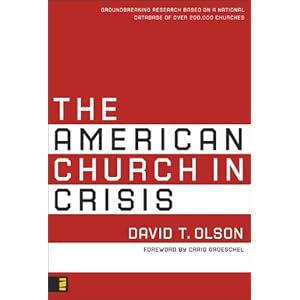

Both books are by ministers/leaders in the Evangelical Covenant Church, the tribe to which I belong. Both books were gifts to Covenant Ministers at a previous Midwinter Conference, so thanks to Zondervan for your generosity.
Both books cover the same general ground: the world has changed, and continues to change. What was is slowly passing, what is is in flux, and what will be is anybody's guess. Regardless, the church finds itself in trouble - losing touch with society, losing members faster than we realized, losing influence in our world; and, where there is growth, often times it is shallow, narrow, lacking in the depth and breadth that ought to mark the Kingdom of God.
Olson's book is a statistical tour de force, based on substantial research into almost every nook and cranny of the American Church. The results of that survey are pretty disturbing. Church attendance overall is down; compared to population growth, the attendance figures are even worse. Almost every denomination is losing ground in every county in every state. Old churches are stagnating and dying off, and not nearly enough new churches are being planted to stem the tide. Too many churches are simply surfing on the final waves of Christendom, enjoying the remnants of the kingdom they used to control, even while ignoring the changing landscape around them.
Gibbons' book is more of a friendly chat, looking into the amazing cultural forces at work to chance the American (and world) landscape. Any semblance of a monolithic culture is quickly passing. Our neighborhoods are filling up with people from all over the world, and our young people are wired into the world even from their very bedrooms. The 'Seeker-Sensitive' church of the 80s and 90s, the church that tried to tap into singular cultures in order to draw like-minded people, can no longer be counted on to grow the Kingdom. In fact, Gibbons would argue, it's an unbiblical model in the first place. The Church is instead called to be cross-cultural in every way: crossing ethnic lines, social lines, and socio-economic lines. He says, "Here is the reality: if we really want to see our churches grow in the way Jesus would want us to grow, if we really want to see Christ revealed in our communities and through our lives and in this global world of ours, then we must focus our strategic initiatives of love on people who make us feel uncomfortable, who don't fit into our thinking and our conventions, who are marginalized and even considered misfits and outsiders."
He goes on to say, "When the world sees the church willing to forgo size and scale to love and embrace people who are not like us, treating them as neighbors, they can sense an expression of true and genuine love. It's a thing of miraculous beauty. And people know beauty when they see it."
Both books are realistic, but also hopeful. First of all, God is still at work in the Church, so we always have reason to hope in the future. Secondly, God seems to be raising up a new group of leaders, pastors, thinkers, and church planters who can help us all move into this new world. The challenges are real, and many will be tempted to bury their head in the sand. To those who are willing to take a risk, to be "liquid," as Gibbons says, to flow with the Spirit, to carry on conversations rather than making pronouncements, to listening and learning and loving and risking, these are great times. A new wave of the Spirit may be happening before our eyes.
The question is, are we willing to give up our false ideas of importance, our desire for comfort, our (false) belief that we have all the answers? Are we willing to give up the delusion that we can return to the 'good old days'? Or will we sit back, hide, and forgo our mission to the world?
Both Gibbons and Olson challenge the church to step out in faith, to learn anew what it means to minister in the world, and to be a part of this amazing work of God. We would do well to listen.
Tuesday, August 31, 2010
the Short and Simple Truth
It's been a rough couple of weeks at Lakebay. It's tough when anybody leaves. But when 4-5 people/families all leave at the same time. . .it's difficult to keep your head up. Even when it's not really about you - people move for financial reasons, for health reasons. Still, as a pastor, you get one more of those phone calls and have to wonder what's going on.
And yet, God is good. Random words of encouragement. A wonderful lunch with another pastor in the area. A great lunch meeting with a denominational colleague, with words of hope and helpful challenge.
And then a breakfast with the core leadership of Lakebay, and a reminder of what amazing people these are. People who love the Lord, who love the church, people dealing with their own pain and struggles, trying to survive, but people who love each other and haven't given up hope.
And a larger, broader conversation with the whole church, and a reminder again of why I love this place. People who refuse to give up hope, who commit to rise to the challenge. People with a longer view of life than I possess, reminding us of God's faithfulness through hard times. People who aren't afraid to ask tough questions, to challenge, to critique, and yet do so in love and a desire to understand, not attack. It's a wonder to see God's Body living out the commands to Love One Another, to Honor Each Other, to Care for One Another.
So, yeah, it's been a rough couple weeks. I've had a few sleepless nights, I've had it out with God once or twice.
But already, tiny shoots of new growth are emerging from the ground. And I've seen clear evidence that our work will continue, that our ministry is far from over. And I've been reminded that I am in the midst of good people. Lovely people. Beautiful people. And that I am blessed.
And yet, God is good. Random words of encouragement. A wonderful lunch with another pastor in the area. A great lunch meeting with a denominational colleague, with words of hope and helpful challenge.
And then a breakfast with the core leadership of Lakebay, and a reminder of what amazing people these are. People who love the Lord, who love the church, people dealing with their own pain and struggles, trying to survive, but people who love each other and haven't given up hope.
And a larger, broader conversation with the whole church, and a reminder again of why I love this place. People who refuse to give up hope, who commit to rise to the challenge. People with a longer view of life than I possess, reminding us of God's faithfulness through hard times. People who aren't afraid to ask tough questions, to challenge, to critique, and yet do so in love and a desire to understand, not attack. It's a wonder to see God's Body living out the commands to Love One Another, to Honor Each Other, to Care for One Another.
So, yeah, it's been a rough couple weeks. I've had a few sleepless nights, I've had it out with God once or twice.
But already, tiny shoots of new growth are emerging from the ground. And I've seen clear evidence that our work will continue, that our ministry is far from over. And I've been reminded that I am in the midst of good people. Lovely people. Beautiful people. And that I am blessed.
Thursday, June 24, 2010
The call nobody wants
always seems to come at night. A friend's neighbor, a man I've met on a couple of occasions, is dead, his life taken at his own hand. A son and daughter-in-law are in shock and grieving. They've requested a blessing before the body is take away. And so off into the night I drive, into the dark, into pain and unimagineable suffering.
There are no answers here, no words to explain this, no morsel of wisdom to dull the knife-edge of pain. There is nothing but to stand, to absorb the pain of others, to show tenderness and love and compassion, to pray desperately that the Holy Spirit is present and flowing through me. There is the opportunity to pray a blessing, to sign this man's forehead with the cross, claiming in faith his own previous confession that, in spite of his pain, he knew the Lord. Standing in the dark while the professionals - the sheriff, the medical examiner - go about their morbid business. To stand under the stars, watching the moon rise over this surreal scene, and realize this is where Jesus is, present in the midst of suffering and pain. To trust that God's promise is still true: blessed are those who mourn, for they shall be comforted.
There are no answers here, no words to explain this, no morsel of wisdom to dull the knife-edge of pain. There is nothing but to stand, to absorb the pain of others, to show tenderness and love and compassion, to pray desperately that the Holy Spirit is present and flowing through me. There is the opportunity to pray a blessing, to sign this man's forehead with the cross, claiming in faith his own previous confession that, in spite of his pain, he knew the Lord. Standing in the dark while the professionals - the sheriff, the medical examiner - go about their morbid business. To stand under the stars, watching the moon rise over this surreal scene, and realize this is where Jesus is, present in the midst of suffering and pain. To trust that God's promise is still true: blessed are those who mourn, for they shall be comforted.
Wednesday, May 26, 2010
Make Yourself At Home?
Note: this was originally printed as the lead article in our May/June church newsletter. I thought it deserved a little bit wider play.
At a recent meeting, one of our board members made an interesting comment. “I never want Church to feel like home.”
It seemed almost heretical, at first. But then they explained. “Home is the place where I get comfortable. It’s the place where I kick my shoes off and relax in front of the television, or with a book. Home is the place I go to get away from the stresses of life. When I’m home, I don’t want to be bothered by people or problems. Home is my space.”
The light started to go on in the hearts of those gathered.
“Church should be the opposite. Church is a place where we get to work, where we create space for all sorts of people. Church isn’t a place to get comfortable and relaxed, it’s not a place to get away from it all. Church is about action and service.”
Wow. I wish I’d come up with that. It’s pretty much genius. And it shows a lot of insight into Kingdom values.
When it comes to Christianity, one of the most difficult aspects for us to embrace is the idea that this isn’t about us. That this isn’t about our comfort, our tranquility, our well-being. This Christ-walk that we are on does come with the promise of blessing, of joy and peace and healing and provision. But it is not primarily a call to comfort; it is instead a call to a task. To a mission.
It is a call to serve the world. This is a fact we must never forget. We have been saved by God, filled by his Holy Spirit, and created together to be the Church, His presence on earth. But just as quickly, we are called and commissioned to serve Him by serving the World.
In other words, Lakebay Community Church doesn’t exist primarily for you and me (technically speaking, it exists AS you and me). It exists for those people out there who don’t yet know the joy of salvation in Christ. Yes, the church exists to glorify God. Yes, many in the church have gifts that are used for the good of the Body – gifts like prayer and encouragement. But all of these exist so that we can serve Christ by serving the world (go read Ephesians 2:10, paying special attention to that part about the good works God has prepared for us to do).
It is all too often the case that, when we start talking about the future direction of the church, or the current worship, or the paint scheme, we use too much “me” language. As in, “this isn’t convenient for me.” Or “this isn’t comfortable for me.” Or “I don’t really like that” or “this isn’t what I want.”
I hear you. I understand you. I’m just as tempted to think about my comfort, my preferences, the ease of my service here. I would love to come and be well-fed, sitting in my barcalounger singing Maranatha! hits from the 1980s. I’d love to take in all the blessings and simply forget about the hard work ‘out there.’ But we can’t. The church isn’t our home. It’s a mission station. Or, to be precise, it’s a people on a mission to seek and to serve and to share the love of Christ.
The good news is, all those blessings still come to us as we serve. Lakebay can be, and is, a home for many. It is a place of comfort and blessing, a place where joy can be felt and peace can be found. It is a place of respite for weary saints and sinners. It is a place where we meet our God.
But we must never confuse all these blessings with our primary identity, we must never grasp after these blessings as if they are the Main Thing. And we must never allow our desire for comfort to be the primary guide in our decision making. We want God to bless us; we desire God’s blessing on Lakebay; we must then be about the business of serving him by serving those around us, giving up our own wants, wishes, and desires. We can’t kick up our feet and relax. Instead, let’s get busy serving the world around us.
At a recent meeting, one of our board members made an interesting comment. “I never want Church to feel like home.”
It seemed almost heretical, at first. But then they explained. “Home is the place where I get comfortable. It’s the place where I kick my shoes off and relax in front of the television, or with a book. Home is the place I go to get away from the stresses of life. When I’m home, I don’t want to be bothered by people or problems. Home is my space.”
The light started to go on in the hearts of those gathered.
“Church should be the opposite. Church is a place where we get to work, where we create space for all sorts of people. Church isn’t a place to get comfortable and relaxed, it’s not a place to get away from it all. Church is about action and service.”
Wow. I wish I’d come up with that. It’s pretty much genius. And it shows a lot of insight into Kingdom values.
When it comes to Christianity, one of the most difficult aspects for us to embrace is the idea that this isn’t about us. That this isn’t about our comfort, our tranquility, our well-being. This Christ-walk that we are on does come with the promise of blessing, of joy and peace and healing and provision. But it is not primarily a call to comfort; it is instead a call to a task. To a mission.
It is a call to serve the world. This is a fact we must never forget. We have been saved by God, filled by his Holy Spirit, and created together to be the Church, His presence on earth. But just as quickly, we are called and commissioned to serve Him by serving the World.
In other words, Lakebay Community Church doesn’t exist primarily for you and me (technically speaking, it exists AS you and me). It exists for those people out there who don’t yet know the joy of salvation in Christ. Yes, the church exists to glorify God. Yes, many in the church have gifts that are used for the good of the Body – gifts like prayer and encouragement. But all of these exist so that we can serve Christ by serving the world (go read Ephesians 2:10, paying special attention to that part about the good works God has prepared for us to do).
It is all too often the case that, when we start talking about the future direction of the church, or the current worship, or the paint scheme, we use too much “me” language. As in, “this isn’t convenient for me.” Or “this isn’t comfortable for me.” Or “I don’t really like that” or “this isn’t what I want.”
I hear you. I understand you. I’m just as tempted to think about my comfort, my preferences, the ease of my service here. I would love to come and be well-fed, sitting in my barcalounger singing Maranatha! hits from the 1980s. I’d love to take in all the blessings and simply forget about the hard work ‘out there.’ But we can’t. The church isn’t our home. It’s a mission station. Or, to be precise, it’s a people on a mission to seek and to serve and to share the love of Christ.
The good news is, all those blessings still come to us as we serve. Lakebay can be, and is, a home for many. It is a place of comfort and blessing, a place where joy can be felt and peace can be found. It is a place of respite for weary saints and sinners. It is a place where we meet our God.
But we must never confuse all these blessings with our primary identity, we must never grasp after these blessings as if they are the Main Thing. And we must never allow our desire for comfort to be the primary guide in our decision making. We want God to bless us; we desire God’s blessing on Lakebay; we must then be about the business of serving him by serving those around us, giving up our own wants, wishes, and desires. We can’t kick up our feet and relax. Instead, let’s get busy serving the world around us.
Friday, April 02, 2010
I love creative people, part 2
Sometime last December or January I floated the idea of Lakebay hosting a Seder Dinner come holy week. Last night that idea found its fruition in a powerful time of remembrance, dining, fellowship, holiness, reflection, and fun. I won't stake any claims on this being a completely authentic Seder, although we (being gentiles and all) did the best we could, following resources we'd found across the internet, and adding in memories of past Seders I'd attended and led.
In the end, 5 dozen plus entered into the Passover story, recalled Israel's ransom from Israel, celebrated Messiah coming in Jesus, and enjoyed a fine meal that included game hens, matzo ball soup, hummus and pita bread, a variety of vegetables, and even some lovely olives and pickles. Not to mention all the traditional pieces - the matza, the bitter herns, the charoset, and the rest.
Most of this rested in the hands of our fellowship committee, and our two chefs, Larry and Betty. I threw out a couple ideas but they did all the work. And when you consider what it takes to feed over 60 people - all the planning, shopping, preparing, cooking, decorating, serving, and cleaning up - they put in a lot of time and energy. So for the record I want to say how grateful I am to have these wonderful people in our church community. Nothing was done half-way here; it truly was a marvelous event, and hopefully the beginning of a new tradition out here on the Key Peninsula.
In the end, 5 dozen plus entered into the Passover story, recalled Israel's ransom from Israel, celebrated Messiah coming in Jesus, and enjoyed a fine meal that included game hens, matzo ball soup, hummus and pita bread, a variety of vegetables, and even some lovely olives and pickles. Not to mention all the traditional pieces - the matza, the bitter herns, the charoset, and the rest.
Most of this rested in the hands of our fellowship committee, and our two chefs, Larry and Betty. I threw out a couple ideas but they did all the work. And when you consider what it takes to feed over 60 people - all the planning, shopping, preparing, cooking, decorating, serving, and cleaning up - they put in a lot of time and energy. So for the record I want to say how grateful I am to have these wonderful people in our church community. Nothing was done half-way here; it truly was a marvelous event, and hopefully the beginning of a new tradition out here on the Key Peninsula.
Monday, March 29, 2010
Know anybody who can raise the dead?
I might be in need of a resurrection sometime this week. It's not even Easter, and I'm exhausted. Can't. get. moving. today.
A lot of that has to do with yesterday. A typical Sunday morning of preaching and leading worship and conversing with all sorts of people. Followed by a splendid Artists Reception for Lakebay's Stations of the Cross installation. Add in a birthday party and a late-afternoon rehearsal for Easter morning, and it's a long day. And my voice is shot.
Of course, back that up to Friday and Saturday and our trip to Portland for Jake and Shontee's wedding (which was a lot of fun; and it's always good to see C.V., Bruce and Katy, Scottie, and 'the other' Jake). Throw in the head cold I've been fighting for two weeks now, and that becomes a recipe for exhaustion.
But a couple things keep me going:
1) Easter is almost here, and we can crash afterward
2) We're going on vacation in a few more weeks
3) All this stuff is really a lot of fun, and very exciting. The wedding was great, the Stations of the Cross is more than I expected, the music for Easter is going to be exciting, and worship yesterday was wonderful; I even felt pretty good about the sermon. So I've no right to complain. Well, maybe I'm not happy about the head cold part. Other than that, life is good, and great things are happening. Maybe instead of a resurrection, I just need a bit more coffee to make it through.

A lot of that has to do with yesterday. A typical Sunday morning of preaching and leading worship and conversing with all sorts of people. Followed by a splendid Artists Reception for Lakebay's Stations of the Cross installation. Add in a birthday party and a late-afternoon rehearsal for Easter morning, and it's a long day. And my voice is shot.
Of course, back that up to Friday and Saturday and our trip to Portland for Jake and Shontee's wedding (which was a lot of fun; and it's always good to see C.V., Bruce and Katy, Scottie, and 'the other' Jake). Throw in the head cold I've been fighting for two weeks now, and that becomes a recipe for exhaustion.
But a couple things keep me going:
1) Easter is almost here, and we can crash afterward
2) We're going on vacation in a few more weeks
3) All this stuff is really a lot of fun, and very exciting. The wedding was great, the Stations of the Cross is more than I expected, the music for Easter is going to be exciting, and worship yesterday was wonderful; I even felt pretty good about the sermon. So I've no right to complain. Well, maybe I'm not happy about the head cold part. Other than that, life is good, and great things are happening. Maybe instead of a resurrection, I just need a bit more coffee to make it through.

Tuesday, March 09, 2010
Another long one
One more step in saying goodbye to Abbie: this Friday at 11 we're laying her to rest with her mother in Puyallup. Hard to believe it was only 8 months ago we were there to say goodbye to Katy. So there's some funeral prep to take care of.
This coming weekend is also our Alpha weekend away, at Soundview Camp in Longbranch. I'm looking forward to it; it looks like a great group of people going. But it also requires some prep work.
And honestly, the resounding thunder that is Easter is pounding in my ears. Lots to do before that all rolls around.
So today, and most of this week, will be spent hunkered down trying to get all that prep work done. So far, the soundtrack has been the Verdi Requiem, the Mozart Requiem, and a Canadian songstress thrown in between. And we're on track, I think. But here I go, back to work. . .
This coming weekend is also our Alpha weekend away, at Soundview Camp in Longbranch. I'm looking forward to it; it looks like a great group of people going. But it also requires some prep work.
And honestly, the resounding thunder that is Easter is pounding in my ears. Lots to do before that all rolls around.
So today, and most of this week, will be spent hunkered down trying to get all that prep work done. So far, the soundtrack has been the Verdi Requiem, the Mozart Requiem, and a Canadian songstress thrown in between. And we're on track, I think. But here I go, back to work. . .
Tuesday, February 23, 2010
More on Sunday
KOMO 4 News in Seattle ran a story on Abbie's death. It begins with a couple shots of the baptism.
Monday, February 22, 2010
Confessions
I have to be honest. If ever I were to lose my faith, it would be days like yesterday that would do it.
I don't get death. I can't wrap my head around it. I hate it.
Biologically, I understand how life ends. Even theologically; I can accept that we live in a broken world and bad things happen sometimes. But that age-old question of why the innocent suffer, why the meek have to go gently into that good night - I just can't live with it.
Old age is different. In that case, death is a release. A life well-lived is the legacy. Leaving behind an aged body for a new one in glory - that sits with me just fine.
Likewise 'deserved' death, if you can call it that. A life of drug or alcohol abuse, fast and hard living, ravaging the body until it can no longer sustain life; or the drunk driver who heads out and drives straight into a telephone pole. I may not like it, but I can accept it.
But days like yesterday, I just can't make sense of. A father and his family, all gathered in a hospital room, his infant daughter kept alive solely with the aid of machines. And his choice to keep her alive with those machines, or to turn them off and let her die. And this no sickness, no disease, no result of sin; this a tragic accident, a choking in the night.
The family held her and loved her. I baptized her, splashing the water on the wisps of hair covering her head. We prayed, I anointed her with oil, signing the cross of Christ onto her forehead. We claimed the promise that she belongs to God, is loved by God and her family here. And we released her into God's care.
Later her father held her as she breathed her last.
I'm going to say it here, for the world to see. I think God has got a lot of explaining to do someday. This is not how it's supposed to be. And any who would try to offer up an explanation will fall desperately short.
I don't doubt God's goodness. I don't doubt that eternal life awaits God's children. I don't doubt that the blood of Jesus still saves. Don't worry about that.
It's that place where answers evaporate and hope seems all that's left - I confess I don't like it. In fact, I hate it. I can't accept it. It's not how this world is supposed to be. The silence of God is thundering.
It was a hard day.
I don't get death. I can't wrap my head around it. I hate it.
Biologically, I understand how life ends. Even theologically; I can accept that we live in a broken world and bad things happen sometimes. But that age-old question of why the innocent suffer, why the meek have to go gently into that good night - I just can't live with it.
Old age is different. In that case, death is a release. A life well-lived is the legacy. Leaving behind an aged body for a new one in glory - that sits with me just fine.
Likewise 'deserved' death, if you can call it that. A life of drug or alcohol abuse, fast and hard living, ravaging the body until it can no longer sustain life; or the drunk driver who heads out and drives straight into a telephone pole. I may not like it, but I can accept it.
But days like yesterday, I just can't make sense of. A father and his family, all gathered in a hospital room, his infant daughter kept alive solely with the aid of machines. And his choice to keep her alive with those machines, or to turn them off and let her die. And this no sickness, no disease, no result of sin; this a tragic accident, a choking in the night.
The family held her and loved her. I baptized her, splashing the water on the wisps of hair covering her head. We prayed, I anointed her with oil, signing the cross of Christ onto her forehead. We claimed the promise that she belongs to God, is loved by God and her family here. And we released her into God's care.
Later her father held her as she breathed her last.
I'm going to say it here, for the world to see. I think God has got a lot of explaining to do someday. This is not how it's supposed to be. And any who would try to offer up an explanation will fall desperately short.
I don't doubt God's goodness. I don't doubt that eternal life awaits God's children. I don't doubt that the blood of Jesus still saves. Don't worry about that.
It's that place where answers evaporate and hope seems all that's left - I confess I don't like it. In fact, I hate it. I can't accept it. It's not how this world is supposed to be. The silence of God is thundering.
It was a hard day.
Friday, February 12, 2010
Warren
I first met Warren a couple years ago, when he was volunteering in our church's ministry to the homeless and low-income of the Key Peninsula. He'd had a rough life, made some bad decisions, but was working to get his life back together.
Last year, on a walk with some friends around the town of Home, we saw Warren sitting out on his front porch in the sun; we had a good talk about the warm weather and God's goodness to us all.
He came to our Christmas Eve service this last December. One of our 'festive' pieces was a dramatic reenactment of the 12 Days of Christmas. Warren made a joyous and hilarious Partridge in a Pear Tree. 12 times, he played that partridge, as we counted down each of the days.
A few weeks ago he came to our church and asked for prayer; he'd had heart surgery and wasn't feeling well, wasn't recovering. So Howard and I prayed over him, anointing him with oil.
Shortly thereafter, he collapsed, and was rushed to the hospital. He's been there, in a coma, ever since. (editor's note: don't try to draw any conclusions from that sequence about the dangers of letting me pray for you)
This morning his son called, and let us know they expect Warren to die today. In the next few hours, most likely. So a few of our people are heading up there to be by his side, to pray with him as he leaves this earth and goes to be with the Lord.
It always amazes me how quickly some people go; full of life and energy one minute, gone the next. I expected Warren to stick around for quite a bit longer. But it seems life caught up to him; perhaps some of his old mistakes wore his body down too much. But Warren loved people, he loved serving others, and he loved the Lord, so I don't doubt that paradise awaits him, a place where all those old mistakes are washed away, where redemption replaces brokenness.
Our prayers are with Warren and his family and community today.
Last year, on a walk with some friends around the town of Home, we saw Warren sitting out on his front porch in the sun; we had a good talk about the warm weather and God's goodness to us all.
He came to our Christmas Eve service this last December. One of our 'festive' pieces was a dramatic reenactment of the 12 Days of Christmas. Warren made a joyous and hilarious Partridge in a Pear Tree. 12 times, he played that partridge, as we counted down each of the days.
A few weeks ago he came to our church and asked for prayer; he'd had heart surgery and wasn't feeling well, wasn't recovering. So Howard and I prayed over him, anointing him with oil.
Shortly thereafter, he collapsed, and was rushed to the hospital. He's been there, in a coma, ever since. (editor's note: don't try to draw any conclusions from that sequence about the dangers of letting me pray for you)
This morning his son called, and let us know they expect Warren to die today. In the next few hours, most likely. So a few of our people are heading up there to be by his side, to pray with him as he leaves this earth and goes to be with the Lord.
It always amazes me how quickly some people go; full of life and energy one minute, gone the next. I expected Warren to stick around for quite a bit longer. But it seems life caught up to him; perhaps some of his old mistakes wore his body down too much. But Warren loved people, he loved serving others, and he loved the Lord, so I don't doubt that paradise awaits him, a place where all those old mistakes are washed away, where redemption replaces brokenness.
Our prayers are with Warren and his family and community today.
Wednesday, February 03, 2010
Book Review: Kem Meyer's "Less Clutter. Less Noise."

Marketing and promotion aren't exactly a favorite subject for churches and pastors. For one, it seems somehow kind of dirty; the gospel should speak for itself and not need any P.R., right? For another, it's one more thing for which pastors don't have time. We spend so much time preparing sermons, counseling people in crisis, reading and studying and praying (and blogging) - who has time to think about websites and promotion and bulletins and newsletters? And for another, too often we in the church become so insulated in our little worlds that we forget to think about the image and message we present to the world. It's just comfortable here in the world of simplistic websites, clip-art, and lo-fi audio.
Whether we like it or not, though, we all send messages to the world around us, to people looking for hope and answers, to people trying to decide whether or not the church ought to play a part in their lives. We're also sending messages to the people already inside the building. And too often, those messages are confusing, overwhelming, difficult to follow, stale, and even cheesy.
Which is where Kem Meyer's book "Less Clutter. Less Noise." becomes so valuable. In even drawing our attention to the issue, if even for forcing us to think about the ways our public message impacts our people and the larger community, this book is well worth the price.
This is a book about communication. About messages. About putting the best possible face forward. About treating our people with respect. About creativity. About clarity. About reducing clutter and confusion and overkill. About using best practices to streamline our communication, to reduce white noise, to focus on what's important and not bury our people in overkill.
Meyers takes us into the wonderful world of church newsletters, of websites, of bulletins, of physical location and flow, of Sunday morning announcements, of blogs and social networking. And she does it with whit and humor, using plenty of real-world examples, both good and bad. She brings her expertise into the church and shines the light around, which can be uncomfortable at times. Yet her attitude is winsome and self-deprecating, making it easy to laugh at ourselves.
She also gives resources and recommendations.. There's a whole seminar and a half in here, with links to books and websites; in addition, the last 35 pages are full of lists, samples. and examples of how to do it right and how to do it wrong. And each chapter ends with a series of questions to further discussion and action.
The simple fact is, our people are living in a world flooded with noise. All too often, our efforts at communication either add to that noise, or are lost within it. Our websites turn people away, our newsletters don't have the impact we desire. Sometimes we're so excited about ourselves that we forget to consider our audience. Sometimes we offend that audience through insensitivity to their situation. And most of us don't have the time to become well-trained communications directors; most of our churches can't afford even a part-time communications expert. Which is why I recommend most of us take the time to read this book, and allow it to stimulate out thinking. To teach us bow to better communicate in this world.
And why I recommend we have all our administrative assistants read it. And maybe our ministry directors. Not every piece is relevant to every ministry, but the heart is challenging and overall, very helpful. It's going onto my shelf, with the plan to pop it open every couple months and read a piece here or there, just to make sure I'm staying on track.
Thursday, January 07, 2010
Book Review: Think Orange

Reggie Joiner is rightfully concerned that the Church, in general, isn't doing a very good job at family ministry. At youth ministry. At children's ministy. He's also rightfully concerned that families are struggling like never before, and that, in that struggle, our society is facing turmoil and upheaval at its core. Think Orange, the book and the philosophy, is his response, a challenge to the church to partner with the family in order to raise up generations who know what it is to walk "in the way," and in order to strengthen families in the here and now.
Joiner's primary image is this: The church is called to shine the Light of Christ in the world, illuminating the work of Christ and drawing people to Christ. (Hint: Light is represented by yellow). Families are the heart and soul of society, families are the primary location people learn of love, acceptance, sacrifice, and relationships. (Hint: Love is represented by red (think Valentine's Day)). When you mix red and yellow you get -what? Orange!
This is the heart of Think Orange - mixing red and yellow. The problem, according to Joiner, is that families are struggling to survive, parents are struggling to raise their children, young people are leaving the Church for the world in droves. . .and the Church is over in the corner, running programs that seem to have no effect in helping any of these problems. The Church, it seems, has developed a host of programs and ministries that help the individual groups: children, youth, and adult, but none of these maintain any synchronicity with a larger plan. The childrens' ministry does its thing, youth ministries do their thing, and adults go their way to study the theology of the minor prophets. Then families go home and struggle to make sense of it all in a confused and confusing world. As Joiner laments, "Most churches are characterized by random acts of ministry to the family." Parents have no idea how to impact the spiritual life of their children. Children don't know how to navigate the multiple messages that bombard them day in and out. Youth have no clue how all this 'church stuff' impacts their larger life.
The answer, says Joiner, is for the church and family to combine forces. "What we should really be concerned about is our collective ability to influence a generation to have a stronger, deeper, and more authentic relationship with God." All of this he summarizes with two important points:
1. Kids need parents who will help them advance in their relationship with God.
2. Parents need churches that will help them know how to be spiritual leaders.
Think Orange is not, then, another book on catchy childrens' ministry. It is, instead, a complete reworking of the junction where churches and families come together to disciple, raise, cherish, teach, and lead children and youth in their pursuit of Christ.
A couple of strengths of this book:
1) One of the earlier chapters lays out an impressive theology of family, something sorely lacking in the overall discussion.
2) The book is biblical - while it includes cultural references and sociological research, the ideas and plans are all soundly based within a biblical framework of ministry.
3) The book has lots of pictures and charts.
4) The book recognizes the reality that no family or church is perfect, that setting impossible standards only frustrates people; it is realistic in the goals it sets out, while still setting a high bar in pushing us toward excellence.
5) The book is a great place to even start the discussion. I bought a couple extra copies for a few people in our church, and hope this stimulates us toward new growth and a stronger overall sense of mission.
6) The book comes with a host of resources, and is backed up by Joiner's Orange Leaders website.
7) If anything, the book will challenge and stimulate your own thinking regarding how you go about your family ministry, the assumptions behind it, and why it may or may not be working very well.
A couple things about which I wasn't quite so impressed:
1) Honestly, at times the whole "orange" metaphor seemed a little stretched. By the time the metaphor was presented, I could have done without the multiple examples of Orange showing up in society. Perhaps, to this reader, it came too close to "cutesy" at that point. So what if somebody sells an orange amp? It doesn't seem to matter to the rest of the book.
2) There were other times when it seemed Joiner was writing primarily to large churches with multiple staff and large creativity budgets. The idea of regularly re-painting your children's area to go with that quarter's theme seems fun and exciting, but how many churches have the people and the finances to do that? Of course, the response would be that we all need to read with discerning ears and take away what we can, but I would have enjoyed some examples of how small churches with small budgets and small, over-committed volunteer staffs can bring these ideas to fruition.
Overall, I am glad somebody sent me a copy of Think Orange. I confess I probably wouldn't have picked it up myself, and I wasn't all that eager to dig into it, but once I did (mostly on a flight to Denver last November), I found myself drawn in, challenged, and encouraged by the vision it contains. As I said, I'm hoping it influences the vision and work of our church; I think it would be of value to any and all who are concerned about families and those who minister with and to them.
Monday, October 05, 2009
Blessing
Yesterday, I had the absolute privilege of joining in with other local clergy and community leaders in leading a 'blessing ceremony' for the Gig Harbor/KP Fire/Law Enforcement/EMT/EMS workers. A good 200+people gathered together in the parking lot and front lawn of the GH United Methodist Church, where a number of games, face painting booths, food tents, and emergency vehicles were assembled. Music was provided by the GH Civic Orchestra (that's not the one I play in). The blessing ceremony lasted about 30 minutes, under a beautiful, clear blue sky. On the platform were various chaplains, fire captains, representatives of the different services, a couple of us clergy, and president of the local LDS stake. A local color guard presented the flags, a local fireman sang the Star Spangled Banner (complete with a 'random' wind gust unfurling the flag at the exact moment he hit 'and the home of the brave. . .'), a piper played 'Amazing Grace' as all paused to remember those fallen in the line of duty. Then the chaplains, clergy, and LDS representative led a responsive reading/blessing, and a few thank-yous were offered up to the community.
One moment in particular was poignant for me. Near the end I found myself sitting on stage, following the blessing, listening to a short speech by one of the fire chiefs - Mike Miller, the same man who led the search committee that brought me to Lakebay in the first place.
It was good to see others we knew from the community as well - kids who come to our Pioneer Clubs, fellow preschool parents, a few of our church members, and fire captains like Tom Lique and Chuck West, who both serve out here on the Peninsula.
The only disappointment I felt was the lack of participation from the church community. Two pastors from the GH United Methodist took part, and my colleague Arlyce from down in Longbranch was there (she and I to represent the KP side of things), and that was it, unless you count the LDS stake president. I was told by one of the event coordinators that over 80 local clergy were invited. If you remove the two from the church hosting the event, Arlyce and I were the only two to respond.
I know. . .Sundays are tough. And some will balk at the 'ecumenical' nature of the event, but it seemed in the end this was a great opportunity to show appreciation to many who serve in such dangerous and crucial places, and to let them know we support them. If anything, to keep the door open between the church community and the first responder community. So I was glad to take part, and hope more will at future events.
In the end, it was a perfect day, it was fun for the family, and a chance for me to represent Christ in the larger community. It was a blessing for me to have the chance to take part, and I hope it truly was a blessing to those who serve.
One moment in particular was poignant for me. Near the end I found myself sitting on stage, following the blessing, listening to a short speech by one of the fire chiefs - Mike Miller, the same man who led the search committee that brought me to Lakebay in the first place.
It was good to see others we knew from the community as well - kids who come to our Pioneer Clubs, fellow preschool parents, a few of our church members, and fire captains like Tom Lique and Chuck West, who both serve out here on the Peninsula.
The only disappointment I felt was the lack of participation from the church community. Two pastors from the GH United Methodist took part, and my colleague Arlyce from down in Longbranch was there (she and I to represent the KP side of things), and that was it, unless you count the LDS stake president. I was told by one of the event coordinators that over 80 local clergy were invited. If you remove the two from the church hosting the event, Arlyce and I were the only two to respond.
I know. . .Sundays are tough. And some will balk at the 'ecumenical' nature of the event, but it seemed in the end this was a great opportunity to show appreciation to many who serve in such dangerous and crucial places, and to let them know we support them. If anything, to keep the door open between the church community and the first responder community. So I was glad to take part, and hope more will at future events.
In the end, it was a perfect day, it was fun for the family, and a chance for me to represent Christ in the larger community. It was a blessing for me to have the chance to take part, and I hope it truly was a blessing to those who serve.
Subscribe to:
Posts (Atom)