Showing posts with label discipleship. Show all posts

Wednesday, May 16, 2012

Book Review: One.Life


Are you a young person, trying to make sense of where your life fits into the larger scheme of this world? Are you out of college, hoping your life will mean something, and not just disappear into the haze of meaningless that is our culture? Have you hit middle age, and find yourself feeling like "there must be more to life than this?"

If so, then Scot McKnight's One.Life is the book for you.

It is McKnight's intention that life is supposed to be more than the humdrum of mindless entertainment, empty pleasure, vacuous reality-show stories, accumulation of stuff, boredom, disappointment, silly fights with friends, and all those other things we fill our lives with. Instead, we are given one life to live, and called into a glorious adventure of love, service, compassion, meaning, and world-changing work.

However, that can only happen when people truly and fully give their lives over to Jesus, letting Jesus lead, following his dreams, surrendering everything to his lordship. In McKnight's words,

Christianity isn't enough. Religion isn't enough. Being accepted in a church isn't enough. Climbing the corporate ladder isn't enough. Solving intellectual problems isn't enough. Chasing the American dream isn't enough. Friends aren't enough. Science isn't enough. Food and drink aren't enough. Fame isn't enough. Nothing's enough. The only thing that is enough is Jesus, and the only way to get to Jesus is to follow him, and that means one thing: giving your One.Life to him and following his dream.

McKnight makes clear that he is redefining a common misunderstanding of Christianity; namely, that following Christ is about making a one-time decision, and then spending the rest of our lives trying to follow a bunch of rules. Instead, the author slowly builds up his central theme, which is that followers of Jesus follow Jesus, devoting their lives to the Kingdom vision of Jesus.

The earlier part of One.Life is spent sketching this vision of discipleship even as he defines what, exactly, the Kingdom Vision of Jesus is (think peace, compassion, justice, and wisdom). In the latter chapters of the book, McKnight addresses some of the specific issues and contexts with which people struggle - why is the Church important? What does the Kingdom have to do with sex? How do I follow Jesus in a 'secular' job? Finally, the last few chapters are given to exploring God's Kingdom in light of eternity, God's nature, and the work of Jesus at the cross.

One.Life is a powerful book that is also accessible, fairly easy to read yet full of profound insight. There is so much confusion in the world about what it means to be a Christian (and let's be honest: to many, 'Christian' is not a good word). McKnight has offered a positive, hopeful, meaningful vision for what life can and should be, a life that finds its meaning simply by following Christ through the ordinary moments as they come.

Thanks to Zondervan for offering One.Life as a free gift to Ministers in the Evangelical Covenant Church at our Midwinter Conference.

Friday, October 28, 2011

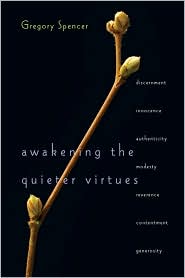
Book Review: awakening the quieter virtues


We often define our faith by a big list of things we should do, and things we shouldn't do. Most of the items on those list also fall into the category of obvious and important things we should do (like go to church, love our mother, behave respectfully) and, more explicitly, the Big Sins we should avoid (murder, lust, pornography, addictions, voting for a Democrat, and stealing).

Gregory Spencer has written Awakening the Quieter Virtues, a very helpful book calling our attention to the fact that more often it's the little things that really count, the quieter virtues that really make a difference. It's the unseen practices that mold us and shape us as Christ-followers, and that slowly change the world around us. Much like yeast working through the dough, the quieter virtues act from deep within us, not calling attention to themselves yet all the while forming us and assisting us as we seek to be like Christ.

Not only does he point out this often-overlooked point; Spencer spends the bulk of the book working through these quieter virtues, explaining what they may look like in our 21st-Century lives. He peppers his work with stories from his own life and the lives of his friends and students (he teaches at Westmont College). The book is not an esoteric description of spiritual disciplines unattainable by normal, non-spiritual folks. He proves that with a little effort, anybody can put these virtues into practice and slowly see their spirit drawn closer to the Spirit who gives life.

Certainly these are important virtues for our world today, and if the church were to put these into practice, we would begin to shine a brighter light into a dark world. Virtues Spencer explores include discernment, innocence, modesty, reverence, contentment, and generosity. Each virtue is paired with a spiritual discipline that is useful to form that virtue in the reader's heart. However, I must say again that Spencer is not working toward a pious, self-righteous unearthly spirituality. He labors to plant these virtues firmly into the soil of our postmodern lives.

This certainly isn't a theological tome, and the fact that Spencer teaches college students shows up in his writing. Some may be put off by his attempts to be catchy, but in the end I appreciated his efforts to contextualize this work, making sense of it for our time and place. It reads lighter than Nouwen or Merton, but to that end would be especially useful for people without much (if any) experience with the concept of spiritual disciplines.

Awakening the Quieter Virtues was a gift given to Covenant pastors at last year's Midwinter conference. I appreciate that people within our denomination are generous in their gifts, and thoughtful in the books they send out way.

Tuesday, March 22, 2011

Book Review: The Importance of Being Foolish


Few people get to the heart of things like Brennan Manning. Like a personal trainer, he challenges all the self-justification, the excuses, the laziness in our spiritual lives. With hawk-like eyes he discerns the murky depths of the soul and pulls it screaming into the light where we see it for the ugly thing it is.

And yet, nobody seems to understand grace like Brennan Manning. No sooner does he excoriate our propensity to sin but that he jumps in with the marvelous good news of the gospel: God loves us more than we can ever hope, dream, or imagine.

In The Importance of Being Foolish, Manning challenges three temptations common to our lives: the temptations to security, pleasure, and power. He debunks the thought that any of these have any place in the life of a disciple of Christ. Security is impossible to achieve, pleasure never satisfies, and power always comes at the expense of others. Pursuit of any of these proves that the soul has yet to fully trust God to protect, to please, to provide.

The only worthwhile pursuit, according to Manning, is the pursuit of the mind of God. For in God's mind we find that we are the beloved of God; that God promises safety in his arms, joy in his heart, and victory over the things that weigh us down. As we pursue our heavenly Father, we also find ourselves drawn into his Kingdom work, proclaiming and seeking God's holiness in this world. As we seek the power and love of Jesus, a love revealed in all its fullness on the cross, we are filled with the marvelous gifts of God: freedom from fear of death, forgiving love, poverty of spirit, selfless service, a joyful heart, fidelity to commitments, and reckless love.

One thing I so appreciate about Manning is his amazing attention to the craft of writing. He gets to the point, and does so quickly. There are no superfluous words here. It seems Manning doesn't have much space for extraneous pondering. Some of the more memorable lines from this book:

"In the Scriptures intelligence does not consist in the more or less brilliant performance of the mind. It consists in recognizing the omnipresent reality of God. . .From the biblical perspective, a great theologian may be stupid; an illiterate washerwoman praising God for the sunset immeasurably more intelligent."

"Paul's cheeks are still streaked [with tears] because of the tepidity, rank insincerity, spiritual adultery, indifference to prayer, ignorance of God's Word, comfortable piety, and apostolic sloth that dapple the Christian life in America today."

"It is symptomatic that, despite the church having been around for two thousand years, the mass of people still pass Christianity by. Why? Because the visible presence of Jesus Christ is rarely present in Christians as a whole. We will never move people to Jesus Christ and the gospel merely by making speeches about them. . .contact with Christians should be an experience that proves to people that the gospel is a power that transforms the whole of life."

"There is no Christ the humanitarian, Christ the master of interpersonal relationships, or Christ the buddy. It is Christ the Lord and Savior who calls us to repent, change our lives, and strike out in a new direction."

"The Christ of Paul was not merely a great teacher, an example of a great man, or a symbol of man's noblest aspirations; he was Lord and Savior. To reinterpret Jesus any other way is to bleed Christianity of its point."

"Life in the Spirit is the thrill and the excitement of being loved by and falling in love with Jesus Christ. If the Spirit is not fire, it does not exist."

It's been a good ten years since I last read Manning, and, although it was challenging, I have to say I was glad to let him in my life again. He's had a strong influence in my life over the years, and this book, like all his others, challenged me regarding the sincerity of this thing called the Christian walk, and reminded me again just how real and all-consuming is the love of God.

Monday, March 02, 2009

Book Review: Amish Grace


In their book Amish Grace, Kraybill, Nolt, and Weaver-Zercher explore the concept of forgiveness through the lens of the Amish, and specifically the Amish response to the tragedy at Nickel Mines, PA.

You probably remember the story - Ten small schoolgirls shot in their one-room schoolhouse by a distraught gunman, who then turned the gun on himself to end the slaughter. One more school shooting in a long series of attacks on our country's children. Yet what made this particular event stand out was the reaction of the Amish. Within days, they were speaking of forgiveness. They visited the family of the shooter; some attended his funeral. They cared for his family even as they grieved their own losses. Glaringly absent was talk of reprisal, revenge, condemnation. Instead, there was grace.

The whole event took America by surprise. Comparisons were drawn between this reaction and the aftermath of Columbine and other school shootings. Many couldn't help but notice the sharp difference between this response of forgiveness, and America's bloodthirsty call to retaliation and revenge following the 9/11 attacks.

The authors of Amish Grace, having spent considerable time studying the Amish, stepped into this counter-culture and explored their unique method of dealing with tragedy. They interviewed many in the area of Nickel Mines, including some of the families who lost children; they read Amish papers and listened to their stories, and have gathered all that work into this wonderful, challenging, thought-provoking book.

There are any number of different threads running throughout Amish Grace, and the authors don't shy away from Big Questions. What is forgiveness? Is Forgiveness always appropriate? What about the role of the state to punish wrongdoers? Does forgiveness ignore the price paid by the victim? Is forgiveness realistic for the rest of us?

To understand the Amish perspective on these issues, one must first understand the Amish culture, and the authors spend considerable time exploring their history, their understanding of the world and Christianity and the future. It was in this section that I was pleasantly surprised to have some of my own thoughts and feelings clarified. For four years I studied with the Mennonites, distant cousins with the Amish, and even as the authors were explaining the basic underpinnings of Amish thought, the lightbulb went on in my head saying "aha - so that's why I see things the way I do." One quote, in particular:

From their beginning in the sixteenth century, Anabaptists have emphasized 'following Jesus' as an essential mark of the Christian life. Of course, other Christian traditions value Jesus' life and example, but they find the essence of the Christian faith in something other than discipleship. Roman Catholics, for instance, give priority to the Eucharist, and Pentecostals stress the work of the Holy Spirit. For anabaptists, the primary expression of faith is following - even imitating - Jesus.

This works itself out in the often literal interpretation of the words of Jesus. The sermon on the mount is meant to be lived, not admired. When they pray "forgive our sins, as we forgive those who sin against us," they believe it - our forgiveness is dependent upon our willingness to forgive everyone else. If Jesus chose death over self-protection, if he chose non-resistence over violence, than we must do the same. If he chose submission over self-promotion, then we, too, must submit to the Lord and to each other, rather than seek our own comfort or safety.

It is from this foundation that Amish forgiveness flows, not as an aberration but as the most natural thing in the world. Multiple times the Bible teaches that forgiveness is an expectation for followers of Christ. On the cross, Jesus cried out "Father, forgive them." Any question of retaliation is put to rest when God says "Vengeance is mine."

But is forgiveness that simple? What about the reality of evil, of the unrepentent wrongdoer? It was here that I was truly taken by Amish thought, and the work of the authors to tease it out. For the Amish, forgiveness and reconcilation are two different things. Forgiveness is a requirement on the part of the wronged person to release the wrongdoer of any harm or ill intent, to not hold against them anger or a desire for revenge. But reconciliation requires repentence on the part of the wrongdoer, and often restitution or acceptance of punishment meted out by the larger society. "Amish members emphasize that forgiving an offender does not mean releasing that person from disciplinary action." And, "Restoration is always the goal, but because repentance by the wayward person is the key to restoration, the goal is not always achieved."

Or, in an extended passage,

Amish forgiveness, like forgiveness in the outside world, can be offered regardless of whether an offender confesses, apologizes, or expresses remorse. Extended by the victim to the offender, it is an unconditional gift. Pardon, on the other hand, at least in the Christian tradition, requires repentance. The Amish believe that the church is responsible to God to hold members accountable to their baptismal vows. When a member transgresses. . .he or she is given several chances to repent. Upon making a confession and accepting discipline, a member receives pardon from the church and is restored to full fellowship. If the person does not confess, the Amish, drawing on particular New Testament texts, practice shunning, with the goal of restoring an offender to full fellowship.

There is much about the Amish that seems odd to the rest of the world - their dress, their avoidance of most modern technology, their isolation from the world, and, not least of all, their willingness to forgive, rather than seek restitution or vengeance. But, I'm convinced, when we look closely at the Amish we see a people seeking to live faithfully as disciples of Jesus, and, often, they are doing a better job than the rest of us. They cry out as modern-day prophets to the world, and to the larger church, who too often blindly adopt the ways of the world. The church is called as a community of believers, a family - and the Amish show us what true community looks like. The church is called to forgive when wronged, and the Amish represent that to its fullest.

No, the Amish aren't perfect. They have their own weaknesses, and the authors don't shy over that fact. Amish life is neither idyllic nor utopian. Even forgiveness, they admit, is an ideal the Amish don't always live up to.

But that only strengthens Amish Grace, for showing that even broken humanity can still get it right sometimes.

I'd recommend this book to anybody interested in exploring the issue of forgiveness, including anybody struggling with forgiving someone who has wronged them. If even for a socialogical exploration of the Amish people, the book is well-worth the time to read. Mostly, as people who will one day stand face-to-face with God, giving an account for the ways in which we've lived our lives, it can only help us as we learn from a group who take discipleship so much more seriously than the rest of us often do. This book, and the Amish it represents, are a challenge to us all, but also point us in helpful directions, opening up pathways onto which we can enter as we seek to live as Christ lived.
_____
(with thanks to Ron and Cathlee, who gifted me Amish Grace in the first place.

Wednesday, October 15, 2008

On economic disasters and political discussions: A Christian Approach

For whatever reason, I find myself one step removed from the daily onslaught of breathy newscasters prognosticating doom and gloom regarding the economy, and slashing lives and destroying souls as they "report" the latest news from the Election Trail.

It helps not having television. Whatever news I get I either hear on NPR over breakfast, or read in the few online news sites I frequent, or catch as I work out at the YMCA. But I'm spared the 5:00 news, which is repeated in the 5:30 news, and then rehashed in the 6:00 news, which is then spun over in the 6:30 news, and then repeated all over again in the 10:00 news. And I'm fortunate to not be swamped by the 24-hour-a-day, never-ending "It's the End of the World as We Know It" coverage on the cable news networks.

Perhaps because of that separation, because we get our news sparingly, I find myself more interested in the HOW question than the WHAT question. I'm truthfully not all that interested in what is being reported, so much as I'm fascinated (and troubled) by how the issues are being discussed, both at the "professional news" level and at the "common citizen" level. It is obvious by now that professional news organizations are anything but impartial - whether you are watching Fox or CNN or MSNBC, as much time is spent mocking Obama or Palin or McCain or Biden as is spent reporting what they actually say and do. Vitriolic diatribes fly back and forth, making fun of Palin's wink or blasting Obama's ex-pastor. And it's not just the candidates: let's show clips of rednecks carrying McCain/Palin signs; let's find clips of Christians praying for certain candidates; let's make caricatures of them lib'ruls and their money-wasting, anti-American ways.

I probably don't need to say anything more about that. You're smart enough to know what I mean.

The other issue, of course, is the economic disaster facing our world. And the tsunami-o-blame crashing around in its wake. It's the double-whammy, really. People are frightened, people are losing their jobs and their retirement funds. I had the "good wisdom" about a year ago to take a chunk of cash out of a low-interest savings account and invest it with the Covenant Trust Company. I'm sure the plan, which was to do better than that savings account, has actually backfired. I've been hit hard, too.

And so people are fearful, they are doubtful, they are wondering what tomorrow brings. They are tied into the news, rejoicing over every uptick on the Stock Market, despairing with each successive drop.

Between the two - the political scene and the economic scene, it seems that two emotions rule the day: anger and fear. The anger manifests itself every time a person says "I'm thinking about voting for. . ." Friends of mine have had threats leveled at them because of the political bumper stickers on their car. Internet message boards are filled with slander and venom toward those who support one candidate or the other. Anyone who disagrees with another is an "ignoramous" or a "neo-con" or a "fundamentalist" or a "socialist." I've been warned against discussing politics in the church, because we may end up causing anger and division. And, there's probably some truth to that.

The fear manifests itself in the endless stock reports, the sell-offs, the message boards and coffee shops where people sit around comparing our time to the Great Depression, where people stare into the opening chasm of financial chaos and see the end of their hopes and dreams, and wonder if they'll be left selling apples on the street corner. People who are beginning to stock up on cans of soup, people afraid to rent a DVD or go out to dinner, people who lie awake at night and feel the cold snake of anxiety slither into their room, constricting around their heart and smothering their soul. Fear that the world is sinking around us, that our ship is going under and we may just miss the lifeboats. Fear that the sun will not, in fact, come out tomorrow.

Fear and anger. Anger and fear. Perhaps the two most prevalent emotions of the day.

And as I sit back and watch all this, as I ponder the how of this conversation, I'm struck that the conversation within the church isn't much different.

I get the letters in the mail, I read the internet message boards, I notice the advertisements. There are a lot of angry Christians out there. Christians angry at the "liberals trying to ruin the country." Christians angry at the gays for trying to ruin the country. Christians angry at the fundamentalists for giving a bad name to Christianity. Christians declaring "no follower of Jesus could vote for Obama." And Christians saying "anybody who reads the words of Jesus HAS to vote for Obama."

And Christians who are afraid. Or at least silent in the face of doubt and uncertainty. Christians who are fearful of what tomorrow may bring.

Or, of course, those other Christians who are ecstatic -the ones who figure that all this means Jesus must be coming back in the next week or so, so "Praise the Lord for all the devastation! It just means prophecy is being fulfilled!"

In the end, it seems to me that these reactions - anger, fear, exaltation at the suffering of others - are the exact opposite of the emotions that ought to mark followers of Christ.

Instead, the people of God ought to shine in the world as examples of gentleness, peacefulness, and simple trust. Consider:

Blessed are the peacemakers, for they will be called children of God.

Peace I leave with you, my peace I give you. I do not give to you as the world gives. Do not let your hearts be troubled and do not be afraid.

All the believers were together and had everything in common. They sold property and possessions to give to anyone who had need.

Bless those who persecute you; bless and do not curse. Rejoice with those who mourn. Live in harmony with one another. Do not be proud, but be willing to associate with people of low position. Do not think you are superior.

As a prisoner of the Lord, then, I urge you to live a life worthy of the calling you have received. Be completely humble and gentle, be patient, bearing with one another in love. Make every effort to keep the unity of the Spirit through the bond of peace.

Get rid of all bitterness, rage and anger, along with every form of malice. Be kind and compassionate to one another, forgiving each other.

. . .I have learned to be content whatever the circumstances. I know what it is to be in need, and I know what it is to have plenty. I have learned the secret of being content in any and every situation, whether well fed or hungry, whether living in plenty or in want. I can do all this through him who gives me strength.

Do not be anxious about anything, but in every situation by prayer and petition, with thanksgiving, present your requests to God. And the peace of God, which transcends all understanding, will guard your hearts and your minds in Christ Jesus.

The name of the Lord is a strong tower; the righteous run to it and are safe.

So, then, this is the proper response for Christians in the midst of political turmoil and economic disaster: love, respect, gentleness, trust, prayer, peace.

Imagine if Christians engaged in political discussion in a way that was truly respectful of the opinions of others. If Christians could strongly disagree over candidates and issues, and yet treat each other with humility, considering each other better than themselves. Imagine if Christians utterly refused to allow political beliefs and opinions to divide them. Imagine if every time Christians had a political discussion we did so under a huge banner that said "Make every effort to keep the unity of the Spirit through the bond of peace." And what if we actually lived it?

In other words, what if our common faith in Christ was more important, more precious to us than our opinions on earthly political matters?

And what if we chose to believe God's promises of provision? What if Christians truly were a people of hope and courage in the midst of recession? What if we joyously professed our belief that God will provide? And, just as important, what if those who still had money and possessions shared what they had with those who had lost jobs, those who had witnessed the disappearance of their savings?

What if the Body of Christ were enthused with hope, and practiced love and care for those who suffer?

Just what kind of impact would that make? How would it change the conversation?

So this is what I believe:
1. Those who follow Christ must be marked by the fruit of the Spirit - gentleness, kindness, love, peace foremost. We must not behave like news broadcasters, pundits, and so many bloggers, spitefully mocking those with whom we disagree. We must listen and respect all who come to the conversation.
2. No matter how bad things become, Christians must not lose their hope that God will make all things well. Thus, Christians can radiate joy and gladness even in the midst of pain and sorrow, for we know that, ultimately, we are in God's hands, and, in the words of the great song, "no power of hell, no scheme of man can ever pluck me from his hand."
3. In all things, the Body must stand strong together, meeting each other's needs, caring and providing for those who hurt and hunger, challenging those who are becoming divisive and unruly.

What I'm really saying is this: we are not of this world; thus, we ought not to behave like this world. May the mind of Christ dwell richly within us, so that it is his light that shines through us, bringing hope and civility to a world that has lost its way.

Thursday, September 11, 2008

9/11 redux

"You have head that it was said, 'Love your neighbor and hate your enemy.' But I tell you, 'Love your enemies and pray for those who persecute you, that you may be sons of your father in heaven." Matthew 5:43-44 (NIV)

++++

"But I tell you who hear me: Love your enemies, do good to those who hate you, bless those who curse you, pray for those who mistreat you." Luke 6:27-28 (NIV)

++++

"This suffering is all part of what God has called you to. Christ, who suffered for you, is your example. Follow in his steps. He never sinned, and he never deceived anyone. He did not retaliate when he was insulted. When he suffered, he did not threaten to get even. He left his case in the hands of God, who always judges fairly." 1 Peter 2:21-23 (NLT)

++++

"The present administration has adopted a sort of official Christianity, and it obviously wishes to be regarded as Christian. But 'Christian' war has always been a problem, best solved by avoiding any attempt to reconcile policies of national or imperial militarism with anything Christ said or did. The Christian gospel is a summons to peace, calling for justice beyond anger, mercy beyond justice, forgiveness beyond mercy, love beyond forgiveness. It would require a most agile interpreter to justify hatred and war by means of the Gospels, in which we are bidden to love our enemies, bless those who curse us, do good to those who hate us, and pray for those who despise and persecute us.

. . .It is useless to try to adjudicate a long-standing animosity by asking who started it or who is the most wrong. The only sufficient answer is to give up the animosity and try forgiveness, to try to love our enemies and to talk to them and (if we pray) to pray for them. If we can't do any of that, then we must begin by trying to imagine our enemies' children, who, like our children, are in mortal danger because of enmity that they did not cause."

- Wendell Berry, Citizenship Papers

++++

. . ."This is why one cannot practically believe in the second coming and also take up arms. When we take up arms, we not only disobey Jesus' teachings, but we foolishly think that we can effectively change the course of history through force. We falsely think that violence will soon end with this act of violence, just as it was thought that World War I would be 'the war to end all wars.' We think, 'The perfect world is just around the corner. We just got a pious man in office, have killed a good share of the essential evildoers, and have set up a few good governmental systems.' This is like praying 'Give us more time.' And whether it's pursued by 'the establishment' or by zealous liberationists, the desire to be 'authors of history' ultimately ends in hubris, unending conflict, and the victimization of others. Instead of trusting in the command to love our enemies, we insist that having the right people take office to direct the right bombs to fall on the right places is a more effective way to deal with evil. We can't be peaceful now, we say. So give us time to rid the world of evil; eventually it will work. After thousands of years, we haven't learned that violence begets only violence.

As much as we balk at its mysticism, the central political prayer and hope of Christians is, 'Lord, come quickly; may your kingdom come.'"

-Shane Claiborne and Chris Haw, Jesus for President

++++

"Bless those who persecute you, bless and do not curse. Rejoice with those who rejoice; mourn with those who mourn. . .Do not repay anyone evil for evil. Be careful to do what is right in the eyes of everybody. If it is possible, as far as it depends on you, live at peace with everyone. Do not take revenge, my friends, but leave room for God's wrath, for it is written, 'It is mine to avenge, I will repay,' says the Lord. On the contrary, 'If your enemy is hungry, feed him; if he is thirsty, give him something to drink. In doing this, you will heap burning coals on his head.' Do not be overcome by evil, but overcome evil with good."

Romans 12:12-21

Friday, May 04, 2007

Let's Think About This For A Moment. . .

Item #1: Spotted on the back of a pickup in Port Orchard approximately 2 1/2 weeks ago: One yellow sticker attached to rear window, with the following text: "Official Terrorist Hunting Permit/Serial #91101/No Bag Limit."

Four inches below said bumper sticker was another one: a bright, shiny, silver fish with the name "Jesus" inside.

Item #2: On Monday as I drove into Tacoma, a small green sports car with 3-4 younger people inside passed me by in the carpool lane, driving somewhere in the 90-100 mph range. As they got ahead of me they weaved in and out of traffic in order to maintain their extremely high rate of speed. Clearly visible on their back bumper was a bright, shiny "Jesus" fish.

Item #3: Early this morning as I made my way across the Tacoma Narrows Bridge on my way to the Pierce County Prayer Breakfast, a silver Jeep Wrangler (Rubicon Edition) rode approximately 2 inches off my bumper, headlights brightly reflecting in my mirror. All along Highway 16 through Tacoma he remained approximately 2 inches off my bumper. As soon as the carpool lane ended and opened to all traffic, he shot into that lane and blew away at a high rate of speed.

No Jesus fish on this one. But 3 hours later, as I left the prayer breakfast and headed back to my car, I spotted the exact same Jeep in the parking lot, with the exact same driver inside. I guess tailgating is justified if you are A Really Important Person on your way to Really Important Prayer Meetings.

I was going to write a witty conclusion here, but I think you're all smart enough to get the point, right? So let me just say this:

If you're going to claim to be a follower of Christ, THEN DON"T ACT LIKE A BLOOMIN' IDIOT when you're out in public. Your actions speak much louder than your little bumper sticker.