Saturday, February 12, 2011
Worst Date Ever
In honor of the upcoming Valentine's Day, Jonathon Acuff over at Stuff Christians Like tells the story of his worst date ever, and asks readers to respond with their own stories. I thought I'd get in on the action and tell a not-so-fun tale of my own romantic past.
I was at a Bible College where romance was mostly frowned upon. You had to get permission to go on a date. Fill out forms and promise to be good, stuff like that. So there wasn't a lot of dating going on in the first place. But my friend and I got to talking and realized I sort-of-liked this one girl, and he sort-of-liked her friend. Neither of us had the gumption to ask our lady-interest out alone, but a double-date seemed a good idea. More fun, less pressure, plus maybe the powers-that-be would see fit to give us permission, since it's probably harder to get into trouble in a group of four than when a man and woman find themselves alone together in a public restaurant.
We asked and - glory be! - they both said yes. We went to the dean and asked permission and - glory be! - he said yes. And so we had our first date with real college women, and cute ones, at that.
The big day came; we had arranged to meet them at the new pizza place in town. The time came, my friend and I were waiting, when we saw our dates outside, talking on the payphone. They seemed to be having an argument with somebody. Eventually they came in.
"Everything all right?" I asked.
"Fine," said my date. "It's just my mom's birthday today, and she's mad at me because I'm not staying home to celebrate." And things were off to a, ahem, great start.
Which lasted all of five minutes. Pleasantries were exchanged, pizza was ordered, and a cold gust of wind blew in as the front door opened. In walked two young men. Our dates responded with shrieks of delight. Turns out these two young men were former high-school classmates of our dates, and they hadn't seen each other in 5 months. So it was reunion time.
These two young men sat at the table right next to us. Our dates spent the entire evening talking with them, and basically ignoring my friend and me. They were all old friends talking about the old times, catching up on the latest smalltown gossip. My friend and I, so recently eagerly anticipating an evening of fun and romance. . .we were the proverbial third wheel. At one point our dates just left our table and joined their friends (although first they finished off the pizza my friend and I had paid for). And after a couple hours we all said goodbye and went home. No sweet nothings shared over pizza and root beer, not even a light-hearted conversation. In fact, no conversation at all. Just us sitting there listening to them all have a great time. And the pizza wasn't very good, either.
So there you go. The only date I ever went on in Bible College, and my worst date ever.
Happy Valentines Day, everyone!
Wednesday, February 09, 2011
Dan's trip to Chicago and back: the picture book!
The plot may not be exciting, but the graphics are pretty spiffy!
Leaving Seattle on a Rainy Monday Morning
A Snowy Morning at the Hyatt
More Snow at the Hyatt
Lots of Snow at the Hyatt
But then the sun came out
Dinner With Pastor Jim
Worship with Pastor Jim
Coffee with Pastor Andrew
Leaving Chicago (5 hours late)
Morning View
St Paul, Minnesota
A Junk Yard in St. Cloud, Minnesota
Staples, Minnesota
Detroit Lakes, Minnesota
Fargo, North Dakota
Rugby, North Dakota
Minot. In Nightvision.
Waiting for Breakfast
Breakfast
Browning, Montana
Marias Pass. Continental Divide. Note the gray marker.
Apgar Mountain, Glacier N.P.
Whitefish, Montana
An old engine in Whitefish, Montana
Me looking grizzled in Whitefish, Montana
The end of The Gut, Libby, Montana
Snoqualmie Pass Rest Stop
Seattle
Monday, February 07, 2011
The BiPolar Express
I love trains. I love riding trains. I also needed some time to myself, time to process and dream and relax and pray and sleep, so the idea of riding the train from Chicago to Seattle post-Midwinter was the perfect connection between those two.
And in many ways, it was everything I'd hoped for. I read a lot, I sat and watched endless North Dakota prairies roll by, I was amazed at the grandeur of Marias Pass and the Snow-covered Rocky Mountains. I watched a deer, startled by the train, swimming across the Kootenai River (I also saw a deer that wasn't so lucky, laying headless in a ditch beside the tracks). I saw bald eagles perched high in aspens, I watched the snow falling in Minot. I woke to a fog-shrouded Minneapolis and a ghost town in the Montana flatlands. I waved at ice-fisherman in Idaho. I read some more. I planned out my sermon schedule for the rest of the year. I did some journaling and praying. I slept on and off. I enjoyed a dinner conversation with two sisters heading to Wisconsin to see their mother, suffering from alzheimers. I sat and talked with a roofer who fell off a roof last summer, breaking both his feet. I watched young men racing snowmobiles beside the train. I turned my mind off and watched Minnesota slide by. I got out and walked around in Fargo and Whitefish. I arranged some music parts for our worship team. It was nice.
On the other hand. . .
- the train was five hours late leaving Chicago. Five hours spent in a stuffy, low, uncomfortable room, sitting on the floor waiting for the train to come. At least they gave us some crackers and bottled water.
- outside of Milwaukee, somebody discovered some boxes lining the tracks; boxes suspicious enough that they called the police, who called the FBI, who called Homeland Security, who called a bomb squad from Chicago. And so there we sat for 4 more hours. Apparently it was all a hoax.
- The train alcoholic sat in front of me. And his friend sat across from me. They were drunk before they got on the train. They sat and talked about the $200 they'd spent at the strip club before getting on the train. In great detail.
- The young man next to me hooked up with a young lady on the train, in the restroom. The porter caught them and almost kicked him off the train. Which led to a shouting match at midnight. The next morning I sat and listened to this fine young man talking to his girlfriend on the phone, telling her just how much he loved her and couldn't wait to see her. Except when he got off the phone he kept asking the guy in front of me where the girl from the previous night went, because he wanted to go see her again.
- A traveler from Switzerland connected with the alcoholic in front of me. They shared beer after beer. They were so drunk the porter told them they couldn't be together any more. So they sat in front of me and cussed about the porter. Did I mention they reeked of booze?
- Somebody next to me was sound asleep. And their alarm went off. They slept. For 20 minutes it went off.
- When we got to Minneapolis, we were 9 hours behind. By the time I woke up in Shelby, we were 12 hours behind. By the time we reached Whitefish, we were 16 hours behind. Needless to say, I missed the Super Bowl.
- Because the train was so late, they made us get off in Spokane, where we boarded buses for the rest of the trip. Thus, I missed my favorite part of the journey, the part I was most anticipating - the Cascade crossing. But they did give us Subway sandwiches.
- We made it to Seattle after 10:00 p.m.
Still, on the 2nd night I'd had enough, so upgraded to a sleeper car and left the alcoholics behind. And because we were so late, we crossed the Rockies in daylight, whereas usually it's done at night, in the dark. So the scenery was a blessing, and the sleeper car made all the difference - especially when they ran short on food, and only gave lunch to the sleeping car passengers.
It was a marvelous trip; it had no shortage of challenges. I may even do it again next year. I just may need to get a sleeper from the start. Truthfully, the Amtrak staff on board were marvelous, considering they were in the same predicament we were. They handled it well, and even most of the passengers took it in stride. Seriously, consider airplane passengers delayed 12 hours - they'd be freaking out. But everybody on the train took it as part of the adventure, laughing it off.
I'll post some pictures later.
Friday, February 04, 2011
So the fun is over. . .now the fun begins
Midwinter 2011 is over. In my experience, it was one of the best I've attended. I'll probably post some highlights later. But now the next part of this journey commences. I decided a couple months ago to take the train home from Chicago - a 45 hour journey. Call it a mini-sabbatical, a personal retreat, a chance to think and process and do some long-range planning. . .and maybe just to sit and watch the country go by.
So here I sit at Chicago's Union Station, waiting to board the Empire Builder. . .and it's already delayed an hour. We're off to a great start!
Saturday, January 29, 2011
Ow
Ever had somebody drive an ice pick into your ankle and then twist it around a bit? Neither have I. Nevertheless, that's what my ankle felt like last night. What started as a bit of tightness became agony like I've never felt before. And for no reason that I could see. No injury, no swelling, no rash. Just burning pain.
To make matters worse, the longer it stayed still, the more it hurt. Getting up and walking around a bit lessened the pain. For awhile. Then it came crashing back. So that was last night. Fall asleep for 20 minutes, wake to intense pain, walk around a bit, go back to sleep for 30 minutes. . .and repeat.
I had it looked at today by a professional. He said it didn't fit the symptoms for gout or a blood clot, so he really couldn't say what it is. But he did take some blood for tests, and he did get me some mighty powerful medicines to get me through the next few days.
Oh, and after I iced it most of today, it actually feels a bit better. So maybe it was just one of those unexplainable things that passes with time.
However, if I start speaking in tongues during my sermon tomorrow, it'll probably be the drugs. And if you see me limping around Chicago this week. . .now you know. I was living my own little Misery.
Thursday, January 27, 2011
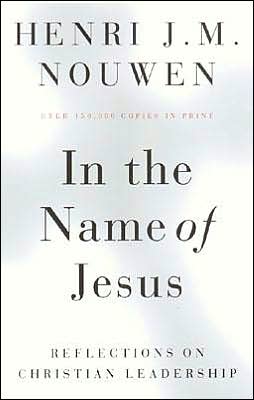
Book Review: In the Name of Jesus
Have you ever picked up a book and found it was exactly what you needed at that moment? That was my experience with Henri Nouwen's In the Name of Jesus.
Written originally as a lecture for the Center for Human Development, this small book contains Nouwen's thoughts on Christian Leadership in the 21st Century. He speaks to three temptations facing ministers, and offers three spiritual disciplines to disarm those temptations.
Nouwen begins by speaking the question many ministers face: "After twenty-five years of priesthood, I found myself praying poorly, living somewhat isolated from other people, and very much preoccupied with burning issues. Everyone was saying I was doing really well, but something inside was telling me that my success was putting my own soul in danger. I began to ask myself whether my lack of contemplative prayer, my loneliness, and my constantly changing involvement in what seemed most urgent were signs that the Spirit was gradually being suppressed."
Typical of Nouwen, much wisdom follows. His first 'temptation' is one that runs deeply in the church today: the temptation to relevance. To be important. To prove our worth with great wisdom and accomplishment. But, as he points out, "Many priests and ministers today increasingly perceive themselves as having very little impact. They are very busy, but they do not see much change. It seems that their efforts are fruitless. They face an ongoing decrease in church attendance and discover that psychologists, psychotherapists, marriage counselors, and doctors are often more trusted than they are. . .The secular world around us is saying in a loud voice, 'We can take care of ourselves. We do not need God, the church, or a priest. We are in control.'" The answer, according to Nouwen, is to give up our desire for worldly relevance and instead return our gaze to Christ. "The question is not: How many people take you seriously? How much are you going to accomplish? Can you show some results? But: Are you in love with Jesus? Perhaps another way of putting the question would be: Do you know the incarnate God?" He then calls the reader to consider the discipline of contemplative prayer, saying that future leaders of the church need not be experts or professionals in their field, but people who 'dwell in God's presence, [who] listen to God's voice, [who] look at God's beauty, [who] touch God's incarnate Word, [and who] taste fully God's infinite goodness."
The second temptation Nouwen explores is the temptation to popularity, the temptation to success. Speaking of his training for ministry, he writes, "I was made to feel like a man sent on a long, long hike with a huge backpack containing all the things necessary to help the people I would meet on the road. Questions had answers, problems had solutions, and pains had their medicines." The problem is, that sets the minister up as the healer who helps others, rather than a member of the community itself. "When you look at today's church, it is easy to see the prevalence of individualism among ministers and priests. Not too many of us have a vast repertoire of skills to be proud of, but most of us still feel that, if we have anything at all to show, it is something we have to do solo." The answer, according to Nouwen, is to remove ourselves from the pedestals and truly identify with our local community. "We cannot bring good news on our own. We are called to proclaim the Gospel together, in community." The spiritual discipline suggested by Nouwen is the act of confession and forgiveness. ". . .ministers and priests are also called to be full members of their communities, are accountable to them and need their affection and support, and are called to minister with their whole being, including their wounded selves."
Finally, Nouwen attacks the temptation of Power. Often leadership becomes "a desire to control complex situations, confused emotions, and anxious minds." Or, as he later writes, "power offers an easy substitute for the hard task of love. It seems easier to be God than to love God, easier to control people than to love people, easier to own life than to love life." The discipline suggested here by Nouwen is an intense theological reflection, bringing our all our lives and activities under the leadership of scripture. "Theological reflection is reflecting on the painful and joyful realities of every day with the mind of Jesus and thereby raising human consciousness to the knowledge of God's gentle guidance."
I've read quite a few books on Christian leadership (and leadership in general), and while In the Name of Jesus is one of the shortest, it is also one of the most profound. It may not ever be the most popular, since it doesn't speak to building large congregations or having great success in life, but it's probably important for that very reason. Too many ministers (this one included) are prone to judge our lives by the world's standards, and Nouwen here is calling us back to our first duty of loving God, loving others, and living our lives under the lordship of Christ.
Sunday, January 23, 2011
Communal Response to a sermon on Matthew 4:12-23
The world is too tempting, and our desires for comfort and fame too powerful.
We turn from God and choose glory, we hoard our wealth and doubt God’s provision.
In fear we use others to our end;
in pride we insult and gossip and bicker.
Instead of building God’s Kingdom, all too often we are builders of our own little kingdoms, protecting the walls of our hearts and lives while ignoring the lost and lonely outside.
And so we repent, admitting our failures, our pride and doubt and fear.
With David we cry out “Have mercy on me, O God, and cleanse me from my sin.”
With the disciples, we hear the call of Christ to “follow me,” and we stand, turn, and follow.
We repent of our pride and pray for humble hearts;
we repent of our greed and pray for generous hearts;
we repent of our anger and pray for loving hearts;
we repent of our comfort, and pray for hearts willing to give it all away for the sake of Christ.
We repent, turn, and follow, knowing the new life God offers is better than the life we now live.
Wednesday, January 19, 2011
Book Review: Common Prayer
Praying The Hours, or Set Prayers, is an ancient custom that Evangelicalism has been relearning in recent years. While The Church has incorporated communal common prayers since the time of Christ (following in the even more ancient practice of our Jewish roots), it is a practice mostly ignored in evangelical protestantism until the last decade. Thankfully, it seems to be making a comeback.
Many books are being written about the subject, like Arthur Paul Boers' The Rhythm of Grace, and Scot McKnight's Praying with the Church. In addition, many prayer books are being published to help people in their journey into this old way; books like Celtic Daily Prayer, the youth-oriented Book of Uncommon Prayer, and Phyllis Tickle's monumental Divine Hours. These join the more traditional communal prayer books published by churches and denominations, such as the Episcopal Book of Common Prayer, the Anglican Book of Common Prayer, the New Zealand Prayer Book, and the Presbyterian Book of Daily Worship.
One of the newest additions to this collection is Common Prayer, published in late 2010 by Zondervan and assembled by Shane Claiborne, Jonathon Wilson-Hartgrove, and Enuma Okoro. Common Prayer contains morning prayers for every day of the year, with an extra week added for use during Holy week. It has a shorter evening prayer for each night of the week, and a midday prayer for use throughout the year. In addition, it has a collection of Occasional Prayers for various situations; among them are a House Blessing, a Prayer for Adoption, Prayer for Healing, and a Prayer for the Death of Someone Killed in the Neighborhood. Finally, there is a short songbook at the back, a collection of music from a variety of traditions, including African spirituals, hymns, chants from the Taize tradition, and Mennonite worship gatherings.
Common Prayer is ultimately meant to be used in community, reflecting Claiborne's roots in the New Monasticism movement. It certainly can be used to guide one's personal prayer life, but most of the prayers are designed in a responsive manner. Some readers will be surprised at the political nature of the book. Claiborne is one who believes faith impacts the way we walk in the world, and is no private matter. To this end, Common Prayer is liberally sprinkled with stories of saints new and old who have impacted the world for Christ. Some are not so surprising - Brother Lawrence, Cyprian of Carthage, and Dietrich Bonhoeffer are all highlighted. Others might catch the reader off guard just a bit - Dorothy Day, Clarence Jordan, and Oskar Schindler.
Besides sharing the stories of individuals whose lives reflected Kingdom values, Common Prayer also highlights historical events both good and bad. October 10 remembers the Women in Black and their vigil against war in Serbia. October 16 remembers the Cuban Missile Crisis. August 21 remembers Nat Turner and a slave revolt in Virginia. March 21 retells the story of protest and violence in South Africa. February 25 remembers the Hebron Massacre and ongoing tensions in the Middle East. Each of these prompt us to consider Christ the peace-maker, and to continue to pray for God's Kingdom to reign on earth.
In addition, paragraphs appear throughout asking us to consider issues such as living our liturgy, practicing confession, and being thoughtful about creating sacred spaces. Also included are short teaching pieces on practices such as the Eucharist and church seasons. Each month concludes with a short list of suggestions for Becoming the Answer to our Prayers (the title of an earlier book by Claiborne and Wilson-Hartgrove).
In other words, there is a lot packed into this book. It takes prayer out of the context of 'personal religious practice' and sets in within the larger framework of the Kingdom of God on earth. It asks the user to dig deeper in prayer, but also to spread our arms wider around our fellow Christians and the world.
Of course, to fit all that in meant they created a rather large book. At almost 600 pages, this isn't an easy book to lug around in your backpack, or store in your church library. On the other hand, it's a well-crafted book whose cover, binding, and weight add to the substantial nature of the content. A few basic prints of woodcut art add to the beauty found inside. People used to the idea of common prayer might find this book a refreshing wind blown into their ancient tradition; those new to the idea will find it simple enough to engage and learn this meaningful practice.
In order to expand on their ideas, a website has been created with prayers for the day, .pdf files of the songs included in the book, and information regarding the contributors and their communities.
Special Thanks to Zondervan for providing a copy of Common Prayer for the purpose of this review.
Monday, January 17, 2011
At least the NBA gets one thing right
I don't like the NBA. I've never enjoyed basketball as much as baseball or football. And since the travesty of the Supersonics' "relocation" to OkayCity, I've pretty much ignored it. But there is one thing the NBA gets right - the NBA finals always match up the best team from the east and the west. So even if your team doesn't get in, at least you have some regional affinity toward one of the teams. You can have some ownership, some reason to root for a team from your area to cream those thugs from the East Coast.
This year, even the BCS got lucky enough to match up teams from opposite sides of the country, and in an inverse way, it made rooting for one team over the other an easy pick. Oregon is a hated rival, and it gave all of us out here great satisfaction to see them go down to Auburn.
But look at the final four teams in the NFL playoffs. They all reside far up there on America's right shoulder, where all the dandruff from Canada falls down. Green Bay, Chicago, New York, Pennsylvania. . .that entire region probably makes up, what, 15% of the county? Sure, Green Bay-Chicago is a storied rivalry, but it means as much out here as an Oakland-San Francisco World Series means to people in Florida. I'm sure at ESPN studios in New York this seems like Christmas came again, with all the action right in their backyard. But there's a huge country out here that no longer has any ownership in any of these teams, and therefore no longer really cares.
Thursday, January 06, 2011
In the CD player
Two CDs I picked up last month that have been getting regular play at home and in the office:
This year's Christmas selection. I kept hearing Alison Krauss singing the Wexford Carol on the radio, and said to myself, "I didn't know Alison Krauss did a Christmas album. That's wonderful!" But it's not AK that did the Christmas album, it's Yo Yo Ma, who did a Christmas album with a lot of guest artists, AK included.
It's not really a Christmas album, per se, although it includes "The Wexford Carol," "Joy to the Word," "The Wassail Song," "Happy Christmas" and "Auld Lang Syne. It expands on the idea of Christmas and becomes a Celebration album, full of holiday songs and joyful songs from around the world. James Taylor sings "Here Comes the Sun," Amelia Zirin-Brown sings a soulful "This Little Light of Mine," Wu Tong and the Silk Road Ensemble perform "Kuai Le," and the Assad family perform "Familia."
Listening to this album feels akin to gathering with a group of musically talented friends, spending the evening sharing talents and stories from their traditions. Chris Botti's trumpet shines on "My Favorite Things" and "Auld Lang Syne." Diana Krall's lush vocals and smooth piano dance across "You Couldn't Be Cuter." The old master Dave Brubeck takes a turn on "Joy to the World." Chris Thile's mad mandolin skills fly around "Dona Nobis Pacem" and "Touch the Hand of Love" (in which he backs up Renee Fleming's glorious vocals. Alison Krauss mourns the previously mentioned "Wexford Carol." Jake Shimabukuro pulls his ukelele out for a spin on "Happy Xmas (Was is Over)." Joshua Redman graces us with "My One and Only Love." Natalie McMaster rips into a dance with "A Christmas Jig/Mouth of the Tobique Reel." And threading all these various pieces is the repeated refrain of "Dona Nobis Pacem," improvised upon time and again by the various artists.
This album goes in a lot of directions, from Spanish dance to Canadian reel to Christmas carol to experimental mandolin to smooth jazz to Americana to classical to gospel. It never settles into any genre or feel for very long, before somebody else picks up the pace and runs in a different direction. What does hold it together is the cello of Yo Yo Ma, and the passion of the friends he chose to partner with. At the end, once the instruments are put away and the voices grow quiet as they head into the night, one is left with the warmth of joyful celebration exhibited with such passion and talent. And you can't quite wait for it all to happen again, soon.
It's difficult to know how to describe Eric Whitacre's choral music. Except to say it's necessary. It's beautiful. It's ethereal, dreamlike. Ebullient and Ethereal. One can hear the angels singing. It hearkens back hundreds of years to Tallis and Taverner, and yet feels ahead of its time. Beginning with texts culled from classic literature, Whitacre paints tapestries of sound; tight, shimmering chords, blocks of sound carrying one after another, gentle melodies and complex harmonies. In many ways restful, peaceful, gentle, and yet profound and moving all the same.
Eric Whitacre is probably the closest thing there is to a choral superstar; choirs love his music, and I've even heard him a few times on Classic King FM, Seattle's classical music station. Some criticize this success (composers aren't supposed to be famous unless they're dead; otherwise they're 'too commercial' or they've 'sold out'); others who think choirs still ought to sound like Mitch Miller probably won't quite get Whitacre. But I've been enjoying him for a few months straight now, and am saving my pennies up to buy his latest CD.
If you're curious, here's a sample, and a wonderful example of the use of technology to create something worthwhile and beautiful.
Saturday, January 01, 2011
Counterpoint: First sunset of 2011
Leaving Edmonds. That's a blue heron sitting up there.
Across the Puget Sound, looking toward the Olympic Mountains
Friday, December 31, 2010
It was a very nice day
According to Douglas Adams, my age is now equivalent to the answer to life, the universe, and everything.
So it stands to be a good year.
And it got off to a nice start. Wrestling with the girls in bed is a good way to wake up. Then off to Marlene's Deli and lunch with my parents. And presents. The girls went off with grandma and grandpa, leaving me alone to play the rest of the day. So I did the most adult thing I could think of, and went to Seattle Center and watched the new Tron movie, in 3-D, at the Imax theater. Yes. Good decision. Good movie.
After the movie it was a stroll a couple blocks over to the Crow for dinner. I had the chicken wrapped in prosciutto. she had the fish. We sat at the chef's bar, a long bar facing the kitchen, and we enjoyed bantering with Steve and his crew all night. He even gave us a sample of the risotto. Heavenly.
About 7:45 I checked the current score of the Holiday Bowl, fully expecting to find UW behind by 3 touchdowns. Surprise. It was almost halftime, and they were up 10-7. So we paid out and hurried back to the car, stopped for some coffee on Capitol Hill, and then drove home, with the game on the radio. Seriously, this is the Huskies. They had to find a way to lose.
But no, a signature win, finalized just as we pulled into the driveway. What a way to end a birthday. Good times, all around. I am blessed in many ways.
Oh, and Susan - as to your presents, I'll cherish them, always. I think.
Friday, December 24, 2010
A Poem for Christmas Eve
Where is this stupendous stranger
Prophets, shepherds, kings, advise:
Lead me to my master's manger,
Show me where my Saviour lies.
O most mighty, O most holy,
Far beyond the seraph's thought!
Art thou then so mean and lowly
As unheeded angels taught?
O the magnitude of meekness,
Worth from worth immortal sprung!
O the strength of infant weakness,
If eternal is so young!
God all-bounteous, all creative,
Whom no ills from good dissuade,
Is incarnate - and a native
Of the very world he made.
Christopher Smart (1722-1771)
Friday, December 17, 2010
Book Review: What is God Really Like?
"What is God Really Like?" is a collection of sermons preached by a long list of pastors for "One Prayer," which was, according to the book jacket, "a monthlong, multichurch campaign unifying churches around the world." Each sermon focuses in on a different aspect of God's character. They include:
- God is Here
- God is Certain
- God is Encouraging
- God is in Control
- God is Big
- God is Not Like Me
- God is Father
and a host of others (17 chapters in all).
On the whole, it is a powerful collection, and a good reminder to the reader to keep focusing back on God's character in the craziness of life. It is the immutable aspects of God that give us hope, courage, strength, and the ability to keep moving forward. And with 17 different sermons expounding on 17 different characteristics of God (well, there is some overlap), this book goes a long way to painting a fuller picture of the God we serve.
Equally helpful is the way each pastor explains the impact of God's character on our lives. It's not just a still portrait of a God from across the universe, it's a dynamic, interactive picture that invites the reader to form his or her own according life to God's purpose, to understand how God touches us, works in and through us, carries us through hard times and places us in amazing, wondrous places and situations. Pieces of this book sing in adoration of a God 'who so wondrously reigneth;' others dig into the tough places and explore God's presence in the midst of pain.
As a collection of sermons, it reads much like a devotional; each chapter stands on its own, so it makes for a good book to have lying around for spare moments. And as a collection, it has some variety; each preacher has his own style, his own method, his own way of painting this picture. Which means not every sermon will speak to the reader in the same way; truthfully, some I didn't really care for. But overall, there's something in here for just about everybody.
However, the book does have a few weaknesses. Not every sermon in here would fit in the 'outstanding' category. If this were preaching class, some of these sermons would be fortunate to get a 'C.' And, even with a large variety of pastors, they all still come from the same general sermon mode. No exposition here, no strong textual work; these sermons are more in the 'Encouraging Talk' mode. Not that those sermons are inappropriate; just that the reader needs to recognize going in that this book represents one particular method of sermonizing, eschewing the rest.
In addition, the book has a strong regional flair. Two of the preachers are from Los Angeles, one is from Hawaii, and all the rest are based in the southeast United States. Lots of Texas, Oklahoma, Georgia, South Carolina, Florida. . .in other words, lots of Bible Belt. And while some may say 'preaching is preaching,' the truth is the Church is a different animal up here in the Pacific Northwest than it is in the Bible Belt. The Church in the northeast is different from the Church in Texas. It would have been nice to see broader representation from across the U.S.; in fact, since the book touts itself as part of a "worldwide" campaign, I would have liked to read preachers from Mexico or Canada or Thailand or Germany or India.
Perhaps as part of the regional flair, the book comes from a fairly narrow slice of Evangelicalism. Lots of Baptist and non-denominational, but lacking in a broader picture of the church. It would have been nice to see a Presbyterian or Episcopalian or Mennonite - something to prove that the Church is larger than conservative Evangelicalism.
And one more. Every preacher in this book is male. If you really want to claim to represent the Church as a whole, you ought to include some voices from our sisters, as well. Craig Groeschel, the book's general editor, serves in a denomination that ordains women and is home to many excellent female preachers. He wouldn't have had to look very far to find even one or two.
You might think I'm nitpicking, but some of that comes from the claim made on the book's back cover, that these are "Reflections from the Best and the Brightest." (I know, that's probably put there by some P.R. rep trying to sell more books, but still, there it is). Even while ignoring the hubris of that statement, one would still have to believe that all the best and brightest preachers are a)male, and b)living in the Bible Belt. And I just can't accept that as true.
In the end, however, the positives of this book outweigh any negatives. I'd gladly recommend this to anyone in my church, or anyone else who is trying to understand our God better. It's a nice choir of voices saying "Here is Your God."
Note: Thanks to Zondervan for providing me a free copy for the purpose of this review.
Wednesday, December 15, 2010
Saturday, December 11, 2010
Thursday, December 09, 2010
A quote worth pondering
From Fred Clark:
Whatever path you're on, God will meet you there. How you respond in that encounter matters far, far more than whatever path you happen to be on, or where you thought you were going, or whether or not the catechists think you have the correct answers to all the wrong questions.
Tuesday, December 07, 2010
Book Review: The Skin Map
The Skin Map Book Trailer from Magnus Creative on Vimeo.
I'm a big fan of Stephen Lawhead. If you read this blog regularly, you know he's one of the few 'Christian Fiction' authors I enjoy. I've read most, if not all, of his novels, and recommend him regularly over other, lower-quality Christian authors.
This time, not so much. Lawhead's newest release, The Skin Map, was disappointing. It's the story of a young man swept into an alternate universe, and the girlfriend he (literally) loses along the way. It's also the story of an ancient map, and heroes and villains out to find that map and the secrets it holds. It reads like time travel, since each universe is at a different point in history as the characters jump to and through them. We spend time in merry old England, an 18th-century Chinese port, and ancient Egypt. The primary characters are very much children of the 21st Century, but those they interact with include Bohemian royalty, salt-of-the-earth serving wenches, lords and ladies and footmen, priests and bakers and gentry.
And yet, it felt a little stifled. Colorless. More like random jumping from point-to-point than the grand, sweeping epics that Lawhead is known for. Many of the characters show great promise, yet come across as lifeless. Sometimes he paints vivid pictures of a particular scene, but create minimal action to fill that scene. And if there's one piece of fiction writing that irritates me, it's the over-use of exalted descriptives like "She was easily the most beautiful women in the world" and "It was the most beautiful scenery he'd ever laid eyes on" and "He was the most frightening-looking man in the world" (note: those are not exact quotes from the book, but there are enough of them in there). Because, really? How do you know she's the most beautiful woman in the world? And by whose standards? Far be it from me to criticize a master like Lawhead, but this is the sort of freshman-level writing employed by people who don't know how to write vivid descriptions, which Lawhead has already proven he knows very well how to do.
Of course, it was in many ways just the book I needed right about now - a mindless adventure roaming across the centuries and continents. It did require a modicum of brainpower to follow the various subplots, not to mention understanding the physics behind the plot of ley lines and travel between multiple universes. Yet it spritely moved along from scene to scene, with just enough intrigue and action to keep the pages turning. There's enough here that I look forward to the next book in the series. In the end, though, I hope Lawhead isn't simply going through the motions now that he's an established writer. He's built up quite a reputation and fan following, and The Skin Map just doesn't live up to the standards he's already set.
Thursday, December 02, 2010
The problem with pain
and grief in our society is that we don't seem to know how to handle them well. I've been learning a lot about wounding, grief, and pain lately, and I've noticed a tendency to fall off the map in two different ways:
First, we become cynical. Angry. We give in to the hurt, seeking validation for our pain. I suppose this fits in well with Kubler-Ross's Anger stage. We have been hurt, we face grief, and we get angry. It's normal, it's natural, and it can be productive in the right time and place. But sometimes I think the world is full of people who've been hurt and never moved on from this stage. I meet so many angry people, people holding grudges, suspicious people who take offense at any perceived slight (have you noticed they all tend to come out at Christmas-time, those cynical, perpetually-offended folks who take every opportunity to downplay the joy and happiness of others?). It's so easy to dwell in the pain, to feel self-righteous in the pain, to cherish the pain, to wallow in the pain. Some of us are professionals when it comes to righteous anger.
On the other hand, the second area in which we fail is to deny the pain. At least, to pretend it doesn't matter. We're good at fooling ourselves this way; we're often prodded in this direction by well-meaning friends. "It's not that bad. . .you just have to get over it" is the repeated refrain. So what that somebody lied about you? So what that somebody is gossiping about you? So what that a trusted friend betrayed you? Just get over it! (note to readers: this isn't exactly autobiographical, so don't start trying to read more into this than is here. I'm not speaking of any person in particular, just situations common to us all) We often tell ourselves "It's wrong to remain broken; I need to pick myself up, dust myself off, and keep moving as if nothing happened!" Others tell us "you just need to forgive and forget." But that's denial. You would never tell a friend with a broken arm "just get over it." So, too, we can't "just get over" a place that's wounded in our soul.
The real challenge is to maintain hope even while owning the pain. Either of the above two picks up on one of those pieces but misses the other. We claim to 'hold out hope' by denying the power of the wound, or we hold on to the wound but miss out on the possibility of redemption and healing. The lesson I'm being taught these days is the necessity of naming the pain, of accepting the wound, of choosing reality over denial (yes, life hurts sometimes) even while holding out hope that God is in control, God brings healing, God is our defender, God will make something beautiful our of our brokenness. All of which allows us to live with peace and joy even while nursing a broken spirit. It allows us to look deeply into the pain and mourn the loss, to grieve and lament the hurt, but it doesn't allow it to defeat us. Instead it reminds us that God is a friend who sits with us in our pain but also carries the pain for us; it also allows us to lift our eyes and see that, even in the valley of the shadow of death, we don't need to be afraid. The day is coming when we will feel the anointing of holy oil upon us, when our cups will overflow again, when we will dine at the table he has prepared for us.
Truthfully, it's not easy. It's hard soul work, something we're not naturally inclined to do. But it's a sweeter road to walk, this walking in the light, this naming the pain even while holding out hope for a better tomorrow. It's a lesson I gladly accept from the Lord's hand.
Monday, November 22, 2010
I'm Dreaming of a White. . .Thanksgiving?
Snow started falling last night, and continued on into the morning. Not enough that school was delayed, but enough to create a winter wonderland out here in the woods.
So off the kids went to school, and off I went with my mother-in-law to do some shopping.
That's when it really started to come down. I stopped in the Harbor, looking for a magazine, and almost couldn't make it back up the hill to the freeway. Picked up mom-in-law at Fred Meyer and left for Target. Quickly it became obvious that going straight home would be the better choice. Cars littered both sides of the freeway. I could feel our tires slipping underneath us. The other side of the freeway was completely blocked by 2 big rigs unable to climb the hill out of Purdy.
We made it home, but not without some drama going up our driveway. Which proved impossible, so we went around and tried going down the other way. Creating even more drama as we slipped and slided every closer to the ditch.
And now the snow continues to fall, the temperature continues to drop, apple cider is warming in the crock pot, a fire crackles in the wood stove, supplies are laid in should the winds knock out the power tonight, the kids are outside sledding, Christmas music is playing, and Karina's in the air toward the U.S.
I believe I have much for which to be thankful.
Thursday, November 18, 2010
It's all my fault
On Monday I was praying with a small group of pastors. We were using the Lord's Prayer as a framework for our prayer time. We were in the "Hallowed Be Your Name" section.
I was bemoaning the way our world has cheapened our understanding of God, of the loss of awe and wonder, of the abundance of "bumper-sticker God" and "Jesus nightlight God" and "plastic trinket God" and "T-shirt slogan God." And mourning the loss of the Isaiah 6, Holy Holy Holy God.
And so I prayed, "God, we need to see your power again. We need you to show up and remind us of your majesty and might. Holy Spirit, come and reveal your power to us."
And at that very moment the entire building shook as a deep rumble echoed across the water.
Yes, it was a little disconcerting. A few moments of nervous laughter. . .and I said "okay, I'm just going to shut up and let you do your thing."
And in roared a storm that socked the entire Puget Sound region, hours and hours of gale-force winds and lashing rain. All completely unexpected, unpredicted by the weather forecasters. We turned off our lights and watched the lightning show for the next hour. Then all the power went out, so we were forced to stay in the dark until the next morning.
By daylight, the destruction was pretty severe. Trees toppled, boathouses destroyed, cars smashed, branches everywhere. I heard today some people are still without power. And nobody saw it coming.
So there you go. God pummeled the entire northwest just to prove my point. And the lesson seems to be:
- Be careful what you pray for
- God listens to Dan
- We should have gotten to the "Give us this day our daily bread" part sooner. I might be driving a Porsche right about now.
Wednesday, November 10, 2010
Part of my childhood died today
Seven or eight years ago I was driving north from Fresno, headed up the 99 toward Turlock following a day at seminary. It was dark; the sun had long set, and I was scanning around the AM radio dial, wondering what I could pick up.
A baseball game came on, clear as day. For a few seconds I assumed it was out of the Bay Area, or maybe Fresno's minor league broadcast, it was that clear. But it slowly dawned on me that I knew the voice, I recognized the players. It was a broadcast of the Seattle Mariners, bouncing down my way across the atmosphere. It was the voice of Dave Niehaus. And suddenly, I was home.
I was that kid, going to M's games with my dad, brother, and sister, back in the days when you could park 1/2 a block from the Kingdome, when maybe 8,000 people showed up for the game, when it was fun, win or lose. A ship in the corner climbed out of its hole and fired a cannon shot with every home run. The floor would be littered with peanut shells and popcorn seeds. No-names ran the bases (well, they were big names to us, just not in the bigger picture of major league baseball).
But more often than not, we had the games on in the background at home. Dave Neihaus' voice filled our home, filled our summer nights. I just took him for granted, assuming he'd always been there.
During the eight years I spent in L.A., I only paid attention to the Mariners when they were down playing the Angels, or if they made it on TV (which they did during that amazing '95 season). But when we moved to Portland I found, to my delight, that they broadcast the M's games there. Many a summer day I was outside, working in the yard, and had Dave's voice to keep me company, to connect me to home.
Then there were those nights in Turlock. Once I discovered I could get the games, I listened every chance I got. Even there, in California, I could follow my beloved Mariners as if I were right there in Seattle.
Since moving back to the Puget Sound, I'm sure I've listened to 75% of the games each season (much to Karina's consternation, mind you). We don't have TV, so I turn the games on when I'm working around the house, or chopping firewood. Or driving home from Seattle. Or driving to the YMCA. Or anyplace else I'm near a radio. I can't tell you the times the girls have whined "Do we have to listen to baseball?" But of course we do. It's Dave. It's art. It's opera. Even as low as the M's have sunk in recent years, it was just comforting to have Dave's steady description of the game.
Last year somebody gave me a bottle opener. When you open a bottle it makes an electrical connection and plays one of Dave's famous calls, the Brett Boone "Grand Salami Time!" Olivia was playing it earlier today, over and over and over again. Then, tonight, Gene told me he'd heard Dave had passed away.
Truly, summer will be poorer without him. Baseball will be blander. The Mariners will simply stink (again). He was a connection to my past, to my family's past, to a Seattle that doesn't really exist anymore. To an innocent time when simply showing up to play was all that mattered. Wherever I went, it seemed Dave's voice brought me home again. I never met the man, but feel like I've lost a close friend. I suppose a lot of people are feeling the same way tonight.
Tuesday, November 09, 2010
Prayer for All Saints Sunday
Prayed at Lakebay Community Church 11/7/10
Almighty and compassionate God,
in Christ you have known the sorrow of our days.
Our losses are your losses, our pains are your pains.
Our grief is your grief.
In faith we believe that you know our tears,
that you hear our crying, that you know the
darkness stalking our dreams.
You who have known death, rejection,
pain and misery watch over us day by day.
Offer your comfort, O Lord, to those living
in the land of darkness. As you guided those who
have gone before us into your blessed home, guide
us through this dark and mysterious land.
Remember in your mercy those who have left us,
lead us into your Kingdom and grant us your peace.
Lord, have mercy.
Christ, have mercy.
Lord, have mercy.
Saturday, November 06, 2010
One of the things I like
is making my girls happy.
Like today, when Clara came to me and said, "Daddy, I hope you never have to become a Viking and kill people." To which I replied, "Okay then, I'll never become a Viking."
And she said "Good" and walked away with a smile.
Sometimes parenting is pretty easy.
Like today, when Clara came to me and said, "Daddy, I hope you never have to become a Viking and kill people." To which I replied, "Okay then, I'll never become a Viking."
And she said "Good" and walked away with a smile.
Sometimes parenting is pretty easy.
Wednesday, November 03, 2010
Mary did you know - and when did you know it?
John 2. Jesus heads off with his mom to a wedding. His disciples are there with him. But the wedding planner hadn't planned very well. Long before the party is over, the wine runs out - a disaster with immense social ramifications.
But Mary has an ace up her sleeve. She's got Jesus there. "They're out of wine, Jesus," she tells him. He pushes back. "Why me? It's not my time yet." Mary isn't one to back down, however. In fact, she ignores her son's question. Turning to the servants, she tells them to "do whatever he tells you to do."
You know how the story ends. Jesus has them fill up some empty stone jugs with water; when they draw the water back out, it has been transformed into wine of the finest vintage. The day is saved, and Jesus has officially performed his first miracle.
The thing is, every time I've heard this story told, from childhood Sunday school classes on up to adult lessons and sermons, it's related with the assumption that Mary was pressuring Jesus into performing a miracle. She knew his mad miracle skills, so decided to use him in order to fix this situation. In essence, she's asking him to do something miraculous, he says he'd rather not do any miracle, but being a good mother, she pushes him into doing one anyway.
But what if that's telling the story wrong? After all, there's nothing in her initial request that implies an expectation of anything miraculous. It seems more like a mother simply saying "there's a problem, Jesus. Fix it."
By this time, Jesus had ascended to the rank of rabbi - he obviously was an intelligent man. And he had a group of disciples; he obviously had leadership skills. Regardless of his divinity, he was a man who could make decisions and deal with difficult situations.
So what if Mary herself wasn't expecting a miracle? What if she was simply proud of her intelligent son with good leadership and problem-solving skills. What if she really expected Jesus to say "Hey Peter and Andrew - they're out of wine. Could you run over to Safeway and pick up a couple of those Gallo boxes? Maybe a '95; that was a pretty good wine. Oh, and take Judas - he has the credit card."
If you read the story without making assumptions based on the end, doesn't it make more sense that Mary's request isn't for a miracle, but simply a desire for Jesus to take charge in the situation? To figure out a (human) solution? And thereby, maybe to receive a little glory in light of her wonderful son?
I think so. In fact, I think it better fits the reading of the entire gospel of John. There's a theme running through this book of Jesus showing up in unexpected ways. Of Jesus surprising people. Of Jesus baiting the hook, and then pulling people in. From the opening salvo of Jesus coming and setting up camp among us, to the woman at the well, to Nicodemus, to the sick man at the pool. . .time and again, people mistake him for a 'wise man' or 'good teacher,' and then, when least expected, he lets his divinity shine through.
Maybe there's just a little bit of humor in this story of the wedding banquet. It might be reading a bit too much into it, but imagine Mary asking Jesus to 'fix it' - she's thinking he'll use his management skills - and Jesus thinking to himself, 'You want me to fix it? I'll fix it alright, and won't you be surprised. . ."
By the way, Ben Witherington has made a pretty strong case that the gospel of John was written by none other than Lazarus. And wouldn't this have been the very lesson Lazarus learned? Jesus was a family friend, a man with whom he and his sisters had shared meals. But then one day Lazarus had the entirely shocking experience of being raised from the dead by this Jesus. I suppose that was just a little surprising, but an instant revelation into the true nature of Jesus.
And what a good lesson for all of us. How often do we look to Jesus to manage our situation, how often do we treat Jesus just like a teacher or parent or our extra-capable child, the one we expect to deal with our little problems. But Jesus' true desire is to let his divinity shine through, to surprise us with little miracles here and there - if only we have eyes to see it. Maybe we need to go back and read this story with fresh eyes, to see Mary's utter shock when, instead of managing the situation, her son does the unexpected - he creates a miracle before her very eyes. Feel her surprise, sense the dawning realization in her heart that there's a lot more going on here than she thought. Watch the awe and wonder bubble up in her heart.
And let it teach us something new about this man. Perhaps we ought not take him for granted so much.
Tuesday, October 26, 2010
Practice What You Preach
Sunday's sermon was on hospitality. We spent some time in Matthew 25 - the judgment passage, wherein the nations are divided into sheep and goats based on how they treated their fellow man. "I was hungry, and you fed me; thirsty, and you gave me something to drink; I was in prison and you visited me; I was a stranger and you invited me in" and so on.
(Side note: is it sacrilegious that I think the Keith Green version is better than the original?)
Hospitality, as defined in the sermon, is simply creating a space into which broken people can enter and find healing; a place wherein lost people can come home, lonely people can find friendship, people hungry and thirsty can find their souls (and stomachs) filled. It is an invitation to share a moment and space together. Hospitality can be inviting someone over for dinner; it can also be sitting with a person at the bus stop and giving a piece of your life to them. And this is our calling: as Christ has invited us to join him in friendship, as the Lord creates green pastures in which he invites us to lie down, as God has become our safe harbor in the storm, so are we called to create safe, warm, inviting, comfortable spaces into which others can come and receive healing and solace in their weary lives.
That was the gyst of it anyway.
And then we finished; the kids headed downstairs for Sunday School, the adults adjourned to the fellowship hall for cake and cheese and coffee and a discussion about creating inviting, comfortable spaces.
An hour later, Mike walked in. We didn't see him at first, but Duncan happened to be walking through the foyer and saw draped over the couch there. It was obvious Mike wasn't doing well. Incoherant would be a good word. He was looking for his grandmother, Delores, or his aunt or sister. But he didn't know their names. They supposedly taught Sunday School at our church, but none of us knew them. He didn't know his phone number. He was pretty wet and disheveled. And as much as we tried to figure out who he belonged to, he couldn't really tell us. But still, we sat with him for a bit. He didn't smell like he'd been drinking, which is (unfortunately) always the first suspicion out here on the KP. So we assumed it was medical, and wouldn't you know it. . .Sean was still around. Sean who works with the fire department, who's used to situations like this. So he came and joined the conversation. About the time Mike mentioned he's diabetic, and hadn't taken his medication in 4 days, we decided it was time to call the paramedics.
Eventually he decided he didn't like all the attention, so he wandered to the cemetary next door. I followed him up there, where he lay down and began weeping next to his dad's grave. And he showed me his grandmother's grave (the same grandmother he'd come to the church hoping to find. . .). And there he lay, sobbing in the wet grass under a steady drizzle. And there I sat with him until the medic units showed up. Thankfully, the knew Mike. He's a regular, you might say. They got him into the ambulance and took care of him. Many of our children had come out to see the fire truck, and they prayed for Mike as he was loaded in.
"I was a stranger, and you invited me in." Maybe today, Jesus might add "I was messed up, and you got me medical help." Or "I was incoherant and raving and soaking wet, and you let me sit on your couch and showed me love." All I know is, the message of the sermon was put to the test, and it was an honor for me to see some good people live it out, just because that's who they are.
Well, what the hey. If you've still got 8 minutes, here's Keith.
Saturday, October 23, 2010
Get in the Bunker, Honey
Texas in the World Series? Oregon ranked #1 in the country?
Surely the apocalypse is upon us.
Tuesday, October 19, 2010
My Dear John letter
Sorry, but it's time to say goodbye.
I'd let you down easy by saying "It's not you, it's just me," but that would be a lie. It is you.
The thing that bugged me most was your two-faced nature. We'd be in town and you'd behave just fine; but we'd head home and you'd go quiet. There was no communication. No connection, as they say. You'd sit there, keeping to yourself, of no use to me. I'd want to talk, to find out what was going on, but you cut yourself off. And I can't live with that.
I know, it wasn't really your fault. It's more the way you're wired. It's not as if you didn't try. I saw you attempting to reach out from time to time, searching for some sort of signal, some sort of connection. But you just didn't have it in you.
I wish I was more patient, but in the end, I think I deserve better. I need more than you can give. So thanks for the memories, T-Mobile. You made for some good times, you gave me some good memories. But I'm going off with a new cell phone now, one that actually has some connections out here on the Key Peninsula. Let me know if you ever grow up; maybe we can be friends someday in the future.
Sincerely,
a not-quite-satisfied customer
Monday, October 18, 2010
We have seen the enemy, and the enemy is. . .California
From the State of Washington Voter's Pamphlet:
Initiative 1053: . . .but at least we are doing better than other states. The two-thirds majority is a disaster in California, creating gridlock and making it impossible to balance their budget. . .California is a mess because of the two-thirds requirement. . .The two-thirds requirement is causing havoc in California.
Initiative 1100: Under this scheme hard liquor outlets will explode from 315 to 3,300, three times more per person than California.
Initiative 1105: I-1105 allows hard liquor stores to explode from 315 to more than 3,300; three times more per person than California.
I remember a number of times during the years I lived in Oregon where this tactic was used. Pick the issue; the only argument against needed to be "Well that's how they do it in California" and the conversation stopped. Somehow California became the official bogeyman against which all northwest ideas are measured. And the mantra becomes "whatever they do, we need to do the opposite."
I'm not making any political recommendations on the above initiatives, so don't read anything into this. I just hope we don't go down that road of measuring our ideas not by their own merit, but instead by "at least we're not like California."
Wednesday, October 13, 2010
Quick Update
I had my second eye-cutting-up yesterday morning. If you're following the story, the graft from the transplant I had 2 years ago settled a little off-kilter, so a few months ago the Dr. carved it up, hoping it would flatten itself out. But that didn't work, so he wanted to try it a second time before attempting anything more drastic.
Thankfully, this time around was a lot less painful. It took all of 5 minutes, where last time took half-an-hour. There was some pain, but I was able to take some Advil and sleep most of it off. Today it feels a little raw, but much better.
The doctor was hopeful this time around will do the trick. If so, 4 more weeks and I get set up with contacts and can see again. If not, we go back in for surgery, probably after the first of the year. You can guess which way I'm praying.
It was nice to have a day off today, though. Pretty much resting, but watching the rescue in Chile, too. It's like Christmas over and over again. This world needed some good news.
Saturday, October 09, 2010
It's this guy's day today
Kirk pointed out on Facebook that today is Leif Eriksson Day. Which gives me an excuse to share this picture of Leif, taken by Karina, during our stay in Iceland last spring.
Friday, October 08, 2010
We're in the news again? Why am I scared?
No, I don't mean our church. I mean Lakebay, the area where I live. It's gotten to the point that every time I hear that we're in the press, I automatically assume it's not good.
A couple years ago we made the Seattle news when the local food bank was robbed. I even got some airtime on a news broadcast on that one.
Then there was the time our local fire commissioner beat another fire commissioner over the head with a coffee mug. That one made news all over the country.
Last month we had the infamous vandalism case at the Longbranch Improvement Club and the Longbranch Community Church.
And now it's all about the "Wild-West-Style shootout" following a botched home invasion robbery last night. We've got all the big-time news crews over here now. Seattle must think we're really uncivilized.
If you look at this article in the Seattle Times, the bright red dot on the google map is actually sitting on top of my house. Which wasn't the crime scene, so don't worry about us.
For the record, I think Lakebay is a wonderful place to live. It's got its share of cranks and ne-er-do-wells, but it certainly deserves some better press for the sense of community, for the beauty of the area, for the local events and the people who work together to make this a fine place to live.
It's not a war zone out here, really. It just plays one on television.
Friday, October 01, 2010
You know what's not fun?
Opening up the local paper and finding a letter to the editor attacking your friends, your church, and you. Accusations that publicly excoriate you and those you love. Being on the receiving end of self-righteous condemnation, being held up as a misfit pastor and heretic. Having to sit back while another's anger and fear cause him to lash out and warn the community of a danger in their midst.
I get it, really. Whenever you take a stand, you open yourself up for criticism. It's the price we pay for leadership, for attempting to speak to the public good. Having been around fundamentalists for a large portion of my life, I also understand their need for 'defending the faith' against any and all who appear 'weak on the fundamentals.' Still, there's nothing like having somebody misunderstand your point, misread your intention, assume all sorts of untrue things, and then put it all in print for the world to see.
If only this gentleman would have called and asked to talk it over. If only he had spent a few minutes on our website. If only he had asked around, to find out what we really teach and believe. But, no. "Fight or Flight" kicked in, and the "fight" option was chosen. And that's sad, really.
The toughest shots to take are always the ones from inside one's own camp.
Still, the Lord is our defender, and ours is the high road to take.
Awake, and rise to my defense! Contend for me, my God and my Lord. Vindicate me in your righteousness, Lord my God; do not let them gloat over me. - Psalm 35
Labels:
Church life,
ministry,
pain,
sad people who just don't get it
Subscribe to:
Posts (Atom)