Wednesday, April 04, 2012

Book Review: The Gift


In The Gift, Jeffery Mitchell (a Covenant Pastor and colleague) has penned a fable bringing ancient wisdom into present-day life. The larger narrative is a fictionalized tale of Mitchell's visit to a fabled Ethiopian monastery, and his encounter with a fascinating document there. The heart of the story is that document itself - "The Book of Zadok" - which tells of a priest and his work with King Solomon.

While the story is fiction, Mitchell uses the biblical account of Solomon as his framework. We find Solomon lost and confused, seeking clarity from Zadok, Israel's priest. As the story progresses, Mitchell shows a deep insight into the human heart with all its questions, doubts, temptations and hopes. All too often I discovered Solomon's words describing my own inner discussions; Zadok's probing questions forced me to consider the masks behind which I often hide. Mitchell's work as a spiritual director shines through in the way he senses the work of the Spirit in the human heart.

Most helpful, rather than come from a position of already knowing it all, Mitchell shares his own struggles to understand and implement Solomon's "Seven Pillars of Wisdom." Thus the book comes across as the gentle encouragement of a friend, rather than a lecture of a superior guru.

The Gift is a small book and an easy read, with enough of a plot to keep the reader interested, but its depth is surprising. This is a book that could be read multiple times, with new insights gleaned at each passing. One could make comparisons to other, more famous 'fictional allegories' in the Christian book market (I won't name names), and the truth is, The Gift is among the best I've read in recent years. As a bonus, a small study guide is available on Jeff's website.

Thanks to Evergreen Press for gifting all ECC pastors with The Gift at this year's Midwinter Conference, and to Jeff for sharing his gift with the world.

Songs for Holy Week


(not sure what the slideshow has to do with the song, but I've always loved the lyric. . .)

Tuesday, April 03, 2012

Songs for Holy Week

Once again, the Agnus Dei - "Lamb of God who takes away the sins of the world."


Monday, April 02, 2012

Songs for Holy Week

Lamb of God, who takes away the sins of the world, have mercy on us.


Saturday, March 31, 2012

Songs for Lent

How about another flashback? I was at this concert sometime in the mid-80s (maybe not this exact concert, but when the tour came to Seattle, I was there. . .)


Friday, March 30, 2012

Songs for Lent

How about an 80s (or is it 70s?) flashback? The words are still as powerful as ever.

But like Peter I can't even stop and pray one hour with you,
and I bet I could deny you too
but nothing lasts except the grace of God by which I stand in Jesus
I'm sure that my whole life would waste away, except for grace, by which I'm saved.


Thursday, March 29, 2012

Songs for Lent

"Ashamed, I hear my mocking voice call out among the scoffers. . ."


Wednesday, March 28, 2012

Monday, March 26, 2012

Sunday, March 25, 2012

Book Review: Recovering the Scandal of the Cross


As we rapidly approach Holy Week, the thoughts of many Christians will turn to the sacrificial death of Jesus of Nazareth on a Roman cross. The biblical texts are clear on this point: Jesus' death and resurrection were a necessary part of God's plan to overthrow evil and redeem creation. And so the church repeats again the truth that "Christ died to save sinners."

Exactly how his death accomplished this feat isn't so clear. Across the pages of the New Testament, a multitude of images and metaphors are used to explain what Jesus' death meant. These include sacrifice, ransom, battle, covenant, worship, and personal relationship. Since the time of Christ, the church and its theologians have wrestled with the meaning of the cross in their particular time and place. Various versions of atonement theology have arisen across the ages, including Christus Victor, Recapitulation, and, most famously, Penal Substitutionary Atonement.

In Recovering the Scandal of the Cross, Green and Baker cover in some detail the various atonement images used across the pages of scripture, as well as the more popular explanations from church history. In doing so, they come to the conclusion that there are so many images because there can be no single explanation covering the saving significance of the cross and resurrection. Instead, atonement is a multi-faceted concept that is best described using a variety of images. The New Testament writers followed this model; so, too, should Christians today avoid claiming any one model as THE model explaining the work of the cross.

This, of course, has raised no little controversy. To many Christians, Penal Substitutionary Atonement is most definitely the singular explanation of the saving significance of the cross. From Kirk Cameron to John Piper, voices have been raised in protest, arguing that denying PSA is denying the gospel. But Green and Baker make a powerful case that other images are truer to the biblical message; in fact, they agree with many who claim that PSA is a dangerous misunderstanding of the nature of wrath, that it too often leads to the support of abuses of power, and that it paints an unhealthy picture of God.

In the end, the authors believe it more important to seek out new ways of explaining the cross in our current contexts. Shame-based cultures will need to hear a different telling than would guilt-based cultures. The model used in Japan could and should be different from the model used in central Africa, which would differ still from models used on college campuses in the U.S. The basics are all the same - sin and rebellion have left humanity alienated from God, the source of all life. But on the cross Jesus has overcome the effects of sin and rebellion, and created new opportunities for life and wholeness for humanity.

From that starting point, Christians are encouraged to think broadly and deeply, exploring how their culture experiences the effects of sin, and what salvation means to them. Green and Baker offer some examples of this in action, using models developed in Great Britain, Tanzania, Japan, and the U.S. They then encourage the reader to move beyond simply accepting models created centuries ago across the world, and to ponder what the cross means in our world, and how best we can articulate that to those around us.

This is the 2nd Edition of Recovering the Scandal, and it has been heavily updated to reflect the decade of atonement discussion since its first publishing; in addition, sections have been expanded and clarified in response to criticisms of the first edition. It is an important read for anyone seeking to understand the broader atonement debate that has opened up in the last 10 years; it is equally important to anyone seeking to understand the meaning of the cross in their life, and in the world.

Note: Mark Baker was my professor in seminary, and he gave me a free copy of this book for the purpose of this review. I was pleasantly surprised to find myself in the book, although the reader would never know it was me. . .

Saturday, March 24, 2012

Songs for Lent

So beyond repair
Nothing I could do
I tried to fix myself
But it was only worse when I got through
Then you walked into my darkness
And you speak words so sweet
And you hold me like a child
'Til my frozen tears fall at your feet


Friday, March 23, 2012

Songs for Lent

One of my all-time favorites.


Wednesday, March 21, 2012

Songs for Lent

About time we heard something from Loretta Lynn.


Monday, March 19, 2012

Songs for Lent

Ah, yes. Ashley Cleveland can bring it.


Saturday, March 17, 2012

Songs for Lent

With an Irish singer, since it's St. Patrick's Day. . .


Friday, March 16, 2012

Sunday, March 04, 2012

Friday, March 02, 2012

Songs for Lent

From John Rutter's Requiem

The text is Psalm 130.
Out of the depths I called unto thee, O Lord: Lord, hear my voice.
O let thine ears consider well the voice of my complaint.
If thou, Lord, wilt be extreme to mark what is done amiss, O Lord, who may abide it?
For there is mercy with thee; therefore shalt thou be feared.
I look for the Lord; my soul doth wait for him, and in his word is my trust.
My soul fleeth unto the Lord; before the morning watch, I say, before the morning watch.
O Israel, trust in the Lord, for with the Lord there is mercy, and with him is plenteous redemption.
And he shall redeem Israel from all his sins. 


Thursday, March 01, 2012

Songs For Lent

Inspired by the T.S. Elliot poem of the same name, this is The Hollow Men, written for trumpet and string orchestra by Vincent Persichetti.

The poem says, in part:

Those who have crossed
With direct eyes, to death’s other Kingdom
Remember us—if at all—not as lost
Violent souls, but only
As the hollow men
The stuffed men.
 
And, of course, it ends with that most famous of lines:
 
This is the way the world ends
this is the way the world ends
not with a bang but a whimper.


Wednesday, February 29, 2012

Songs for Lent

Seeing that Davy Jones passed away today, this seems fitting.

Creature comfort goals they only numb my soul
and make it hard for me to see
my thoughts all seem to stray to places far away
I need a change of scenery


Tuesday, February 28, 2012

Monday, February 27, 2012

Songs for Lent

In honor of Maurice Andre, world-renowned trumpet virtuoso, who passed away over the weekend at the age of 78.

This is the 3rd movement of the Hindemith Sonata for trumpet and piano (no, it's not played by Maurice, but it's a good rendition all the same). The last section of this piece (starting at about the 5:40 mark) is titled "Alle Menschen mussen aterben" - All Mankind must die.


Sunday, February 26, 2012

Saturday, February 25, 2012

Friday, February 24, 2012

Tuesday, February 21, 2012

Book Review: Forgiving the Unforgivable


"Forgiving the Unforgivable" is a simple little book dealing with a painful and complex problem - forgiving when forgiveness seems impossible. There are a variety of reasons forgiveness may seem out of reach - the offense is so huge, or the offender is out of our lives. But forgiveness remains the only true path toward total healing in our lives.

Stoop spends the early part of the book discussing what might fall into the category of "unforgivable." He then sketches out his understanding of the basics of forgiveness, dealing with both myths and truths of forgiveness. After offering up two false paths people walk down when they are hurt (denial and bitterness), Stoop draws out a map toward forgiveness and healing.

There are no promises of quick healing; sorrow, pain, grief and anger all play a role in true forgiveness. In the end, though, as people learn to place blame appropriately, to identify and own their pain, and to realize that forgiveness never absolves the wrong done, they can release the offender from their lives, let go of the wrong, and move into a new freedom and joy.

Stoop's work is firmly planted in scripture, based on an understanding that our forgiveness of others is possible because God has already forgiven us, and also because we trust in a God who will hold wrongdoers appropriate when necessary. If we struggle with forgiving ourselves, we find hope in the knowledge that Jesus forgave us at the cross; if we struggle with others who have horrifically wronged us, we find solace in the knowledge that God knows our pain, and will deal with them in his time.

There is much to be gleaned from this little book; even those not dealing specifically with 'unforgivable' sins will learn a lot about forgiveness. I was a little disappointed in some of the theological work, especially in what I perceive as Stoop's false comparison of Old Testament forgiveness vs. New Testament forgiveness. In addition, the book's size and tone keep it from going very deep; it's more an introduction to forgiveness than a deep exploration of the topic.

However, all that being said, it's a worthwhile book, and one I wouldn't hesitate to recommend to people wondering just how to forgive someone who has deeply wounded them.

Thursday, February 09, 2012

Book Review: The Emotionally Healthy Church


We are a messed-up people, living in a messed-up world. Anybody want to deny that?

Peter Scazzero hit upon an interesting idea after years of hitting his head against the wall, seeking to grow disciples without any real success. His idea was this: most discipleship and evangelism programs deal with knowledge (believing the right things) and performance (doing the right things) without addressing the very real emotional issues plaguing us all. This leads to what Scazzero calls an Imbalanced Spirituality. ". . .when you go beyond the praise and worship of our large meetings and conventions and into the homes and small group meetings of God's people, you often find a valley littered by broken and failed relationships."

He puts this in practical terms in a descriptive paragraph that sounds all-too-familiar: "Many are supposedly 'spiritually mature' but remain infants, children, or teenagers emotionally. They demonstrate little ability to process anger, sadness, or hurt. They whine, complain, distance themselves, blame and use sarcasm - like little children when they don't get their way. Highly defensive to criticism or differences of opinion, they expect to be taken care of and often treat people as objects to meet their needs."

Realizing the a healthy discipleship process must include the emotional component, Scazzero set out to change the way he ministered, and the way his church discipled its people. Following the story of his personal journey in this area. the author lays out seven principles that make up the core of their understanding of emotional health:

1. We  need to look beyond the surface of our lives. "My focus was upward and outward - growing our church, reaching people for Christ, raising up leaders, buying a building. But an authentic relationship with Christ also takes us into the depths - the shadows, the strongholds and the darkness deep within our own souls that must be purged."

2. We must break the power that the past holds on our lives. "New roots are needed for new fruit. All we do is modify the same tree when we make resolutions and commitments to pray more, go to church more consistently, or resolve to stop bad behavior. The root needs to be pulled up. A new tree is needed. (this chapter spends significant time exploring genograms - the charting out of family history and its influence on who we've become)

3. We learn to live in our brokenness and vulnerability. "The choice to live in brokenness and vulnerability challenges us in profound ways to let go of what other people think and to surrender to God's love and mercy."

4. We receive our limits as a gift from God. "People with poor boundaries feel compelled to do what others want even though it is not what they want to do. They are afraid of disappointing someone or being criticized."

5. We embrace grieving and loss. In fact, embracing grief helps us to become more like God. "People in our churches minimize their failures and disappointments. The result is that for many today, at least in prosperous North America, there is a widespread inability to face pain." One of the outcomes of facing grief is the ability to truly forgive those who have caused us grief.

6. We follow the model of Jesus by making incarnation our model of love. ". . .bold announcements of what God is doing or saying are common. People who follow the humble way of Jesus are much more difficult to find."

7.  We slow down to live with integrity. "It is an illusion to imagine we can lead our people on a spiritual journey we have not taken ourselves. When we skim in our relationship with God, no program can substitute for the superficiality and self-will that inevitably follow."

Two bonuses of the book are a self-inventory to determine our current level of spiritual and emotional maturity, and a copy of the Rule of Life adopted by the church Scazzero pastors.

The strength of this book is the reminder that emotions are a crucial, yet long-neglected facet of discipleship, and that we are living in a culture that seems to create emotionally broken/stilted people. The weakness would be its brevity; each of these chapters could fill up a book in itself. Also, pastors and church leaders would be wise to discern just which emotional issues they can help with, and which are better left in the hands of qualified therapists and counselors.

In the end, it was a worthwhile and helpful read, challenging me both in how I lead my own life, and how I minister.

Saturday, January 21, 2012

Well that was. . .fun

In case you didn't hear, we had a little snowstorm up here in the Puget Sound area. After a brief snowfall on Sunday, and some light snowy conditions early in the week, we woke up Wednesday morning to a foot of snow covering everything.


It was beautiful. It was wonderful. It was a nice day to take the kids sledding at the local elementary school, followed by hot chocolate at a friend's house.

Thursday's when it all got interesting. The snow was followed by freezing rain. Everything was covered by 1/2 an inch of ice. The Jeep looked like it was encased in crystal. Plants and trees glistened as if dipped in glass. It was breathtaking.

It was also dangerous. All that extra weight was more than many trees could bear. Water seeped into trees, and, freezing, expanded outward. Soon branches large and small, and, in many cases, whole trees were crashing to the ground. The road below our house was raining large branches and heavy chunks of ice. We wandered down to the marina and saw many trees broken over. Our driveway was blocked by a 16-inch oak branch. There was a boat broken loose at the marina. Everything was a mess.

Then the power went out. We were out about 24 hours, which isn't so bad, considering many are still in the dark. The woodstove kept us warm, and candles offered light for playing and reading. Inside, it was cozy.

But I wandered out Thursday night and stood in the middle of our driveway. It sounded like a war zone, between the constant popping of trees snapping off and the flash/bang of transformers blowing up over by the highway. For the first time in 6 years I actually felt a little worried about living in the woods. The night was restless, as sleep was punctuated by the sound of falling trees, and chainsaws clearing the road below.

Friday we got the Jeep out and went for a drive, checking on people and shooting some video footage. Trees were down everywhere. Power and phone lines dangled down from poles onto the ground. Ice chunks continued to rain down from on high. More branches lay across our driveway.

And yet, everywhere we went people seemed in a good mood. There was laughter and joy in the sharing of survival stories. We had lunch at the local Mexican restaurant, and saw a dozen or so friends there. Across the street at the market cars were slipping and sliding through the parking lot, but everybody was helping each other out. While people in more civilized areas seemed to be angry and offended at the weather (based on the tone of callers to local radio programs), those out here on the KP just got down to making it work.

And now it's melting, and life is returning to normal, and the kids are getting restless, and 'mom and dad can hardly wait for school to start again." I think we can even get the Kia out of the driveway. And last night I told the girls "now when you're old you can say 'I remember back to the great storm of '12, when school was closed for a week and all the trees fell down and we had to use a Jeep to get out and we all camped in the living room to stay warm by the fire.'"

Good times.

Tuesday, January 17, 2012

Book Review: A Christmas Carol


I've seen the movie countless times; in fact, I've seen countless versions of the book countless times. There's no denying it's a classic in Western Literature; perhaps one of the best-known stories in the English language.

Not that anybody's ever read it.

I hadn't, up until this year. But last spring I found it at the Borders Going-Out-Of-Business sale, and decided it was about time to hear it as Dickens intended.

It's a difficult book to read, both because we're not used to reading Victorian English, and because it's impossible to avoid hearing the voices of Kermit the Frog and Michael Caine and George C. Scott. And yet, it's such a necessary book.

It's become important to the pantheon of "necessary items for Christmas," along with "A Christmas Story" and The Carpenters and ugly sweaters. But even more so, I think it's necessary for our world today. It's a little unfortunate that it's become window dressing for the festive season, because the message is entirely prophetic, judgmental, and yet hopeful. It's a message we need once again.

I don't need to rehearse the story or themes for you, but think about it for just a second - there's a message here about the proper place of money in relationships, there's a message of the importance of all people, whether they are rich or poor, there's a message about the voluntary redistribution of wealth; but it's all couched in a story of redemption. Yes, there is strong judgment against selfishness and greed (perhaps echoes of the Rich Man and Lazarus), but rather than simply condemn that man, Dickens paints a picture where even the worst can be redeemed and restored. That is a message sadly lacking in the 21st Century.

It's interesting to read the story, as so many familiar lines pop off the page; at the same time, there are tender and poignant scenes that I have yet to see in the movie versions; young couples in love, ships' crews huddled in their cold cabin celebrating Christmas far out at sea. The Ghost of Christmas present even gets in a pretty direct shot at the church of Dickens' day.

In the end, though, we're left with the familiar story of an angry, bitter, broken man who has all the money in the world but has lost all human connection, and the work of spirits to save him. Dickens reminds us that there is hope for even the worst of sinners, if repentance is found.

The bonus of this book is the addition of two lesser-known Christmas tales penned by Dickens - The Chimes, and The Cricket on the Hearth. The Chimes tells us of a broken-down man beset with terrible dreams while (accidentally) locked inside a church steeple; it's a mystic, visionary tale, lacking a bit of the clarity of A Christmas Carol. It's a cold story, and yet hopeful and redemptive. The Cricket on the Hearth is a warmer tale, with brighter characters and (in my opinion) a more interesting story. There's an old cartoon version of this one out there; I remember seeing it some years ago. Like Carol, it can be a little difficult to follow simply due to the Victorian English vernacular, but it's a fun story full of lame dogs and old horses and mysterious strangers and inept babysitters and blind saints and grumpy old men. And yes, in keeping with the others, it brings a surprise redemptive end, complete with a homespun party.

So Borders, I'm sorry you went out of business. But your sale finally convinced me to pick this one up, and for that I'm grateful.

Tuesday, January 03, 2012

Article


For those of you not in our area: I am the faith columnist for the Key Peninsula News, our local paper. This was my article published in the December edition. It received quite a bit of positive feedback, so here it is for your enjoyment. It was originally entitled "Just Another Article about the Real Meaning of Christmas."

It’s the story of a pregnant teen and her shame in the face of an honor-bound society. Subplots include a government that will stop at nothing – even violence – to maintain control. Throw in economic hardship, lack of affordable housing, and an ill-timed road trip. As for the characters, you have it all – from kings and priests to common day laborers and migrant workers in the field.

Sometimes this is all lost to our modern sensibilities. Christmas has been redefined for us by cute crèches adorning our lawns, by Christmas card watercolors of happy people living happy lives, enjoying their place in this drama. Choirs sing songs of silent nights, of peace, of joy and gladness and festivities as we celebrate this season.

But strip that all away and take another look. It wasn’t a silent night. Childbirth never is. Transport the scene into a dark cave, surrounded by smelly farm animals, and no midwife to be found. You can bet the cattle were, indeed, lowing. A frightened mother giving birth to her first child in the dung; and then, just when she’s ready for a quiet moment, in barge filthy shepherds clamoring about angels. It’s not the most sanitary way to begin a story.

Things take a frightening turn. The local politician, sensing a threat to his power, orders the National Guard to head into town and kill every baby boy. What should have been a celebration with visiting dignitaries turns into a midnight flight, with death nipping at their heels.

This is the story Christians tell at Christmas: a Savior born to shame and poverty, a child bullied by the authorities, a king who shows up in the grimy soil, a messiah whose coming was announced to the outcasts of society.

In the end, it’s our story, yours and mine. We who struggle with shame, who work hard to put food on the table, we who find our lives manipulated by those in power, we who have been hurt by religion and politics and family and so-called friends. We who come home with dirt under our nails and grease stains on our clothes. Who, as the old carol says, find ourselves “beneath life’s crushing load . . . who toil along the climbing way with painful steps and slow.”

This ancient story surpasses the sanitized store-front display and becomes our story. As the angels declared, this is “good news of great joy for all people.” “All people” includes you and me. And I don’t know about you, but I could use some joy right about now. The world is in desperate need of good news.

And so, this: God showed up, standing in opposition to the slave-traders, the bullies, the religious elite, the violent, the thieves in high places. In so doing, he stands in solidarity with the poor, the marginalized, the broken, the victim, the lonely, the shamed. There you have it: God is on the side of the minimum-wage-earning single father forced to work through the holidays just to feed his kids; he stands against the corporate powers growing rich on the backs of those workers.

If you’re feeling particularly lonely, desperate, sad, used, or angry, then remember this: Christmas is for you. Not the plastic, shop-til-you-drop Christmas of our local malls, but the real Christmas – the story of one who came to be with you in the darkness. Behind the facades of office parties and family gatherings and fake snow and manufactured joy, the real story is a story of hope, a story that gives meaning to the struggles of our lives. We are not alone, but are part of this story. God is on our side. God is with us. Emanuel.

On behalf of the Key Peninsula Ministerial Association, I bid you a truly merry Christmas, and joy in the New Year.

Thursday, December 22, 2011

Pepe and the Beast

Late last week we headed off to bed but couldn't find the dog anywhere. So we called for him outside. He came, but. . . Pepe was alive, but it was obvious he'd had a run-in with some sort of wild beast out in the yard. Bite wounds on his head, claw marks on his side and belly, one leg hanging limp.

Thankfully we had a friend spending the night, so we could make the midnight run to the 'local' emergency vet (and by 'local,' I mean 30 minutes away in Tacoma). I expected him to be dead by the time we got there. But he made it. The vet took him in the back, then met with us to talk about process. And by process, I mostly mean how much it all would cost. All the time she talked we could hear Pepe yelping in the back as the technicians attempted to diagnose the extent of his wounds. (We'd later see on the admittance form where they wrote "unable to diagnose right front leg - he tried to kill us." Which, if you know our dog, you have to admit is kind of funny.)

He spent the night there, and once they sedated him they were able to figure out that it really wasn't all that bad - just a lot of surface wounds, cuts, bite marks, claw marks. He came home 1/2-shaved and with drugs, so he's kind of a punk dog right now. And all in all, it didn't cost as much as it could have, so we have that to be thankful for.

We still don't know what it was that got to him - we have raccoons in the yard, and I saw a fox run across our driveway the next day. I suppose he's lucky to be alive, considering how much this beast scarred him up. And we're lucky, too; I didn't want to deal with a dead dog right before Christmas. I wasn't too happy with him at first, but I guess I have to be proud of him, now. Our little Pepe scrapped with a ferocious beast and came out alive. I just hope it doesn't turn into a habit.

Wednesday, December 14, 2011

What kind of person?

Many years ago I flew from Sacramento to Seattle. When I arrived, I realized I'd left my PDA (remember those?) at the counter in Sacramento. I called, and they said they had it, and would hold it until I returned to pick it up. Two weeks later I flew back and went to claim it. . .but it had disappeared. The agent admitted it had been there, even placed in their safe, so all they could figure is an employee must have stolen it.

They were gracious enough to buy me a brand-new one, which I appreciated.

A year or so later I flew home from Knoxville to San Jose. This was following an exhausting week working as CHIC staff, working 20 hour days non-stop for a week. I was beyond wiped out. And in that exhaustion, I left my PDA in the seat pocket on the airplane.

Realizing my mistake a few hours later, I called the airline lost-and-found, but nobody had turned it in. I tried for a couple weeks, but it was never turned in. Whoever found it just kept it.

Last June we flew from Denver to Seattle. Somewhere in the process of checking into DIA Clara set down her 2nd-favorite blanket (thankfully we had left the most-favorite blanket at home) and forgot to pick it up. Even before leaving DIA we talked to some agents and the lost-and-found people, but it was nowhere to be found. For a few weeks I called, but nobody ever turned it in. Seems whoever found it just kept it.

A few weeks ago we flew from Ontario to Seattle. Somewhere south of Sacramento Olivia realized she'd left her most favorite stuffed animal at the airport. There were tears and sobs and anguish. But I told her we'd do our best to track it down.In Sacramento we started the process, calling the airline and the airport, but nobody had turned it in yet.

Unfortunately, it's now been three weeks, and it never turned up. We've called the airline lost and found, we've called TSA lost-and-found, we've called the airport lost-and-found. And nobody has it. Whoever found it just kept it.

Which I admit I don't understand. Don't people turn in things when they find them? I always do, if I can. I teach my kids to turn in found items. Just last week we were at Trader Joes and found a necklace in the parking lot. I had Olivia turn it in to the manager. I thought that's what people did.

If you find something, do you turn it in? Did I miss the memo that said "finders-keepers' is the expected behavior for us all?

Or maybe it's something about airports that cause people to keep things they find, even though it may be the most precious possession of a child, even though a dad may be spending a lot of time calling around trying to see if it's shown up. I really don't know. I'm beginning to wonder why we even have lost-and-founds, since in my experience people don't actually turn in things they find (or, when they do, somebody else just steals said item).

What kind of people just keep things they find, knowing somebody else may be looking for it?

Tuesday, December 06, 2011

Book Review: Reaching Out


Loneliness, hostility, illusion - these things mark the lives of so many humans, wandering through life trying to survive, trying to find meaning, trying to make sense of it all. Broken by a sinful world, we find ourselves isolated and angry, living in illusions of our own making that cover over the reality of our pain.

Rather than avoiding all three, Henri Nouwen sees each as a starting place toward wholeness, as we realize each has something to teach us, and each can lead us deeper into the heart of God. In Reaching Out, Nouwen explains how our loneliness, painful and frightening as it is, can be transformed into solitude, the quiet place where we can know ourselves better, and the place where we can finally rest in the comforting presence of God's Spirit. "Instead of running away from our loneliness and trying to forget or deny it, we have to protect it and turn it into a fruitful solitude." The Christian life needs its time in the desert; by developing hearts that are comfortable with solitude, we can find again what it means to commune with God, and thus be better equipped to live with our neighbors.

This leads to the second movement - from hostility to hospitality. Because we are lonely we are protective of our space, and we often use others to fill up the empty spaces in our lives. "When hostility is converted into hospitality then fearful strangers can become guests revealing to their hosts the promises they are carrying with them." Hospitality, according to Nouwen, is "the creation of a free space where  the stranger can enter and become a friend instead of an enemy." Hospitality is a ministry in which the host creates space for the guest to come as they are and find themselves. Nouwen sketches this out in the context of the teacher/student, parent/child, and healer/patient relationships. In each of these, says Nouwen, "Affirmation, encouragement and support are often much more important than criticism. The good host is the one who not only helps the guests to see that they have hidden talents, but who is able to help them develop and deepen these talents so that they can continue their way on their own with a renewed self-confidence."

Unfortunately, our loneliness and hostility is often hidden behind a veneer of illusion. We have such a hard time getting to the heart of our brokenness. We live as if we are immortal. We cover over our hostility with sentimentality. We make idols of our dreams, thinking ourselves much greater and of more importance than we really are. The answer is found only in prayer - not the pious platitudes of religion, but open, honest communication before the God who knows us better than we know ourselves. "When, however, prayer makes us reach out to God, not on our own but on his terms, then prayer pulls us away from self-preoccupations, encourages us to leave familiar ground, and challenges us to enter into a new world which cannot be contained within the narrow boundaries of our mind or heart."

Like all of Nouwen's writings, this book is deceptively simple. It is a short and easy read, yet so rich and deep that it requires time to ponder, contemplate, and re-read. Even more, it requires action - not programs or plans, but action of the soul, as we seek to reorient our lives back into line with God's loving desires for us. It is an extremely helpful book for people whose lives have settled into religious routine, who feel stifled, who feel like it's time for something new but are uncertain where to turn. It's a book that requires a little maturity, but will lead to so much more.

Friday, December 02, 2011

stuff

- Prairie Bible College, the place I spent my first two years out of high school, is in a world of hurt. Although, like with many stories, the truth may not be as clear as some people think.

- Our friend Lori recently published an article about the building of the Tacoma Narrows Bridge. She included a nice shot of Clara.

- I've gotten more positive feedback about my Christmas article in the KP News than for any other piece I've published there. In case anybody missed it, I'll post it here in a couple days. (I just noticed the KP News has a new website up and running. It's a big improvement over the old one. And it has a picture of me at the farm tour. I'm the one with the trumpet case, walking away from the pigs.)

- Fresno Pacific Seminary (my alma mater) and College have put out a devotional booklet for Advent. It looks nice. You can download a copy here.

- Thanks for asking. Thanksgiving week was good but busy. A 2-day train journey to L.A., a family thanksgiving celebration, a 40th-anniversary party for Karina's parents, an overnight trip to Las Vegas (sans kids!). . .lots of great memories. It all just swept by too quickly.

- Covenant Church in India burns down under suspicious circumstances.

- Missed in the busy-ness of the last couple months: Sumner Presbyterian chooses to leave the PCUSA and join the Covenant Church. (the article's mostly about Chapel Hill, but it throws in that little tidbit about Sumner). If it goes through, they would instantly be one of the largest churches in the North Pacific Conference. I have friends in the middle of all of this on both sides, and grieve for the pain it causes. But am also inspired by their good efforts at civility and love in the midst of great disagreement.

- This Sunday's sermon: What exactly does it mean to "Prepare the way of the Lord?"

- We're also throwing in two less-familiar favorites this Sunday. "Let All Mortal Flesh Keep Silent" will be our communion song, and "Come, Messiah, Come," written by Cheryl Boydston, gets in there as well.

Saturday, November 12, 2011

Sometimes the river wins

I took some time to fish the Stillaguamish last Tuesday. I hadn't been there before, so picked a likely spot not far from Stanwood. Put on the waders, assembled the fly rod, and headed to the water. It was a beautiful northwest Autumn afternoon; the maples glowed orange while behind them rose the snow-covered flanks of the Cascade foothills. The sun glistened off the river as a donkey brayed somewhere in the distance. And I had it all to myself.

There was a small boat ramp leading from the parking lot into the river. Next to the boat ramp was a little trail climbing over the bank, and dropping to the river's edge. Seemed easy enough.

Except the downward slope was a tiny bit more slipper than I expected. Which is why I ended up sliding the final 2 feet down the bank into the river.

Oh, and the river was a bit deeper at the edge than I was expecting. No gentle dropoff; I found myself almost chest-deep though I was at the river's edge.

But, I was wearing waders, so not a problem. Except for some concern that I could get back out of the river, what with the steep dropoff and the slippery bank. I didn't feel like wading further out from the edge to get around a large tree, which was blocking my path over to the boat ramp. So I stood there about 10 seconds, pondering my predicament.

Because it only took about 10 seconds to realize that, as I slid down the bank, a sharp root had sliced a large hole in the waders, which were quickly filling up with water. (I should offer the observation that these waders were all of 2 months old, and this was only the third time they'd been in the water.)

Did I mention I was all alone and nobody knew where I was?

Quickly taking stock of the situation, I grasped a strong root just overhead and pulled/slithered/crawled up the muddy hillside to safety.

So what's a fisherman to do? Keep fishing, of course.

The hole in the waders was high enough that I could walk out the boat ramp a ways. And the water really wasn't all that cold, and the sun was still shining. Why let a little thing like this ruin the day?

Of course, the problem with riverbanks is they have overhanging trees. And the problem with not getting very far out into the river is that your backcast has a great chance of getting caught up in those tree branches.

And so I cast, and so my fly line was caught 15 feet up in a maple tree.

Which is right when the first person I'd seen in hours drove up in her car. And offered the helpful observation, "You're not supposed to catch tree branches! {chortle chortle chortle}"

I tried a few more times, got in some nice casts, watched a few sea lions float lazily down the river, even got a nibble or two. But wouldn't you know it, the second time I got my line caught back in that tree, two cars drove into the lot. It's like they were just waiting to humiliate me.

In August, when Mike was giving me my first fly casting lesson, he said something like "you will embarrass yourself. Just expect it." I guess this is all part of the learning process.

So I drove home, water still sloshing around my feet, counting up the cost of a new set of waders, sad that I hadn't caught a fish, but glad that I didn't drown. 


Wednesday, November 02, 2011

Tuesday, November 01, 2011

You know what else is offensive?

A couple weeks go I went to Target with the girls, to look for Halloween costumes (Clara ended up being Cleopatra, and Olivia was a black cat).

We had a hard time finding the Halloween stuff (remember this was a couple weeks ago) because it was way in the back, hidden by all the Christmas stuff.

Is it too early to remind you all of this?


Friday, October 28, 2011

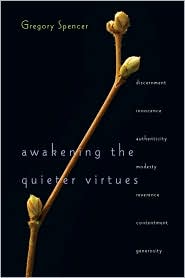
Book Review: awakening the quieter virtues


We often define our faith by a big list of things we should do, and things we shouldn't do. Most of the items on those list also fall into the category of obvious and important things we should do (like go to church, love our mother, behave respectfully) and, more explicitly, the Big Sins we should avoid (murder, lust, pornography, addictions, voting for a Democrat, and stealing).

Gregory Spencer has written Awakening the Quieter Virtues, a very helpful book calling our attention to the fact that more often it's the little things that really count, the quieter virtues that really make a difference. It's the unseen practices that mold us and shape us as Christ-followers, and that slowly change the world around us. Much like yeast working through the dough, the quieter virtues act from deep within us, not calling attention to themselves yet all the while forming us and assisting us as we seek to be like Christ.

Not only does he point out this often-overlooked point; Spencer spends the bulk of the book working through these quieter virtues, explaining what they may look like in our 21st-Century lives. He peppers his work with stories from his own life and the lives of his friends and students (he teaches at Westmont College). The book is not an esoteric description of spiritual disciplines unattainable by normal, non-spiritual folks. He proves that with a little effort, anybody can put these virtues into practice and slowly see their spirit drawn closer to the Spirit who gives life.

Certainly these are important virtues for our world today, and if the church were to put these into practice, we would begin to shine a brighter light into a dark world. Virtues Spencer explores include discernment, innocence, modesty, reverence, contentment, and generosity. Each virtue is paired with a spiritual discipline that is useful to form that virtue in the reader's heart. However, I must say again that Spencer is not working toward a pious, self-righteous unearthly spirituality. He labors to plant these virtues firmly into the soil of our postmodern lives.

This certainly isn't a theological tome, and the fact that Spencer teaches college students shows up in his writing. Some may be put off by his attempts to be catchy, but in the end I appreciated his efforts to contextualize this work, making sense of it for our time and place. It reads lighter than Nouwen or Merton, but to that end would be especially useful for people without much (if any) experience with the concept of spiritual disciplines.

Awakening the Quieter Virtues was a gift given to Covenant pastors at last year's Midwinter conference. I appreciate that people within our denomination are generous in their gifts, and thoughtful in the books they send out way.

Tuesday, October 18, 2011

This is Offensive

This was pointed out on a worship leader facebook group of which I'm a part. It's a brand-new album release. And it defines the word "hubris."

Some label out there has just released a CD entitled "Let's All Worship." It's the subtitle that is evil: "The Very Best Worship Songs of All Time."


Think about that for a second. The Very Best. Of all time.

Hmm. I doubt it. Especially when the 'old ones' include 'Shine, Jesus, Shine.' Let alone that 'Shine Jesus Shine' should never end up on any album with the title 'best' in it. That's as historic as they get.

Somehow I think Bach might have something to say about this. Or, say, Handel? Mozart? Tallis? Rutter? Or someone more 'modern,' like John Wesley or Fannie Crosby? How do they not rate on the list of "The Very Best Worship Songs of All Time" ? How is Messiah not on here? Or Vivaldi's Gloria? I enjoy Paul Baloche as much as the next person, but is he really one of the 25 best worship music composers OF ALL TIME? I highly doubt it.

Oh, and this. As a selling point, they mention their international flavor, with music from Australia to the UK to Ireland to the U.S. Yep. Truly international. Although. . .pretty white, too. Funny how nothing by any Mexican composer made it here. How do we know "The Heart of Worship" is definitively better than a song being sung in an underground Chinese church right now? Or something being sung under a tree in Africa? Or in the jungles of New Guinea? Being a Covenanter, I should point out no Swedish songs made the list either.

Seriously. This is offensive. (the fact that if you follow that link, the album shows up under a banner ad for a new Casting Crowns CD is offensive, too, but that's a different story for a different day).

Who sits in a room and comes up with this stuff? They ought to be smited.

Thursday, October 06, 2011

Friday, September 30, 2011

A Psalm for B of A, et. al.

I remember being a kid, and going with mom and dad to open up a bank account. I remember that little passport-like book they gave me, where we kept track of how much money was in my little account. From time to time I'd earn some cash and we'd go give it to the nice bank teller, who then stamped new numbers in my book, and off we'd go into the big bright world. I even remember getting notices of the tiny bit of interest I'd made over the last few months.

I learned that banks were trustworthy, that they were reputable, respectable organizations who cared about little people like me. I gained a worldview that said "Banks are good! Banks can be trusted! Banks are here to help!"

It's taken a lot of time for me to let that image go, and replace it with a much more realistic one. One that says "banks are evil and satanic and vile and despicable and untrustworthy and willing to walk all over the little people to maximize their profits on behalf of the wealthy and powerful."

Yes, we dropped out of that system when WaMu was sold off to Chase, and are now happy members of the local credit union, where they still know us by name and where they still give lollipops to our kids. And I'm looking forward to the day we take our daughters down there to open up a savings account.

In the meantime, based on the news of B of A's intent to steal money for their customers by charging a fee to use debit cards, I offer this (slightly out of context) Psalm to the fatcat bankers trying to gouge hardworking Americans just to pay for their vacations in Bermuda:  

They encourage each other in their evil plans,
they talk about hiding their snares; 
they say, 'Who will see it?" 
They plot injustice and say, 
"We have devised a perfect plan!" 
Surely the human mind and heart are cunning 

But God will shoot them with his arrows; 
they will suddenly be struck down. 
He will turn their own tongues against them and bring them to ruin; 
all who see them will shake their heads in scorn. 
Psalm 64:5-8 (TNIV)

Tuesday, September 20, 2011

Movie Review: Thunder Soul


Thunder Soul is the story of a reunion 30 years in the making. It's a story of music. It's a story of race. It's a story of culture and fashion, and a story of hopes and dreams. It's a story about the power of education.

In the late 60s and early 70s, funk was a powerful influence in music. The stage band of Kashmere High School in Houston, TX, came onto the scene bringing that funk with them. Playing far above the level most people would find believable, they won multiple national competitions, recorded any number of albums, toured Japan and Europe, and changed a generation at their school.

In 2008, they gathered again, putting on a reunion concert to honor Professor Conrad Johnson, the band director responsible for making it all happen. This film chronicles that reunion, but it also takes us back into a world of their youth, a world in the midst of war and fresh out of race riots, a world awash in afros and bell bottom jeans, a world of James Brown and Sly and the Family Stone. We learn the stories of kids growing up in the hood, kids heading down dark paths only to find their meaning in life through the mentorship of Johnson. We see how this band became a family to so many kids struggling to come of age in a difficult time.

We also see just what a difference music can make in the life of kids and the culture of a school. Unfortunately, we also see the dark side - the place where jealousy and pettiness on the part of administrators can eventually destroy that which is so good (and yes, I've seen that happen to good friends of mine).

Thunder Soul is a moving example of the power of mentors, of the need for arts in education, and of the ability for young people to do so much more than we usually think they can. It is full of great music and interesting characters; best of all, these are real people sharing their real lives, and not actors living out a feel-good script. It's well worth watching; in many ways the answer to last year's Waiting for Superman.

And, of course, not only is it worth watching; it's worth a listen, since it's really about the music these kids, now adults, create. Exciting, fun, full of pizzazz and humor and life - it's enough to make you smile, just a little more hopeful that there is still good in the world.

Thunder Soul opens September 23 in select theaters - check their website for a screening near you.

Monday, September 12, 2011

Leftover from Sunday

Toby Keith: "We'll always recognize when we see old glory flying, there's a lot of men dead, so we can sleep in peace at night when we lay down our heads."
( from the song Courtesy of the Red, White, and Blue)

 Vs.

Psalm 4: "In peace I will lie down and sleep, for you alone, O Lord, make me dwell in safety."

It's an either/or, not a both/and. And as Christians, we're called to live according to the gospel of Jesus, not the gospel of Toby.

Monday, September 05, 2011

Family Camp

Family Camp: where you can ride horses through the woods, swim in the lake, take long bike rides, jump off an inflatable iceberg, take a night trip down a waterslide lit by tiki torches, stand in a field and look at galaxies through telescopes, sleep in a train car, catch a large mouth bass, hang out with some downright nice people, sing some fun songs, listen to some good teaching, play with your kids, listen to the song of geese over the water, eat pancakes in the shadow of glorious Mt. Rainier, shoot off model cars with rocket engines, hang out by the beach, eat too much popcorn and cotton candy. . .and still not have time for every option available.

Friday, September 02, 2011

changes in the air

In a Bible study a few weeks ago, we talked about how people react to change. Specifically, that many people don't react well. Their status quo is threatened, so they push back. They fight. They belittle the other. Rather than receive the possibility of something new, they prefer to stay in their comfortable little world, and thus become bullies toward anybody who threatens their world. This goes a long way in explaining the Taliban and Muslim terrorists. It explains the passion and vitriol of certain young Calvinists who post on internet message boards. It explains so-called Christian extremists who go on shooting rampages. It explains kids on the schoolyard.

note: I know in some of those cases, it goes beyond simple self-protection. Some form of mental illness is often necessary before people go on shooting rampages. But that's beside the point for now.

I pointed out that this is more true of the rest of us than we'd like to admit. It's true of Christians in America, and it's true of people here in our own church. The root of the decades-old worship war isn't really about what kind of music is best-suited to praise God, it's really more a territorial battle over who gets their preference when it comes to music. Many in the church today are nervous, worried, and angst-ridden at all the 'change' in the church; they do their best to push back and return us to a more traditional Christianity in the name of restoring something good and holy; in reality, they just don't like it that some emerging trends in the church threaten their worldview, their sense of well-being (Brannon Howse over at Worldview Weekend is a great example). Change in practice, or questions to traditional theological (or social, or political) positions is taken as a threat (after all, if those people are right, it would force me to change my belief system, which would cause me to change my lifestyle, which would just make me uncomfortable).

So the question was asked, why are people grieving this change? What have we lost that is causing us to fight back, to feel all this tension and anger and worry?

Two articles came to mind.

First, there was the church in Olympia that was told by the state they couldn't hold their baptism at a local state park. A picnic and barbecue was okay, but not a baptism, because, according to the state's General Administration office, a baptism is a religious activity, and the state constitution doesn't allow for state property to be used for religious activities. (Side point A: actually, a picnic is a religious activity, too, since fellowship is a central core of Christian practice.) (Side point B: this article stuck out to me, since we do a baptism service at our local state park every year, we just don't get a permit).

The church, after looking at all their options, decided being good neighbors was important, so has chosen not to sue, even though it would seem they have a good case.

Then there was the article my friend Stan wrote for the Covenant News website, which talked about a recent court decision in New York forbidding schools from renting their facilities to churches during non-school seasons. The court decision said it is "reasonable for the board to fear that allowing schools to be converted into churches might foster an excessive government entanglement with religion that advances religion."

It's those words "fear" and "entanglement" that jumped out.

So this is what I pointed out in our Bible Study. The wind has shifted. Back in the day, being a Christian was respectable. Sometimes it was necessary, if you wanted to be part of the social and business societies in town (one could argue that that was unhealthy in its own way). Being a minister was respectable. The church held pride of place in society. And some of us still remember those days.

But things have changed. The church is being shoved aside. Christians are to be feared (just go read the comments section in this recent article about Mark Driscoll and Mars Hill Church. But put on your flak jacket first).

I know this isn't news to many of you. But for some who've been in the Church for a long time, who don't really pay attention to popular culture, all they sense is that something has changed, and it doesn't feel good. So some fight back, be it politically (see Dobson, James) or theologically (see MacArthur, John). Many others fight back in their local churches whenever and wherever the younger people try to make adjustments befitting the times (and no, I'm not saying every change those youngsters make is good). The landscape is littered with pastors who have made missional moves to better reach the world, only to be attacked by people more interested in maintaining a comfortable status quo.

It's a complicated situation, but we have to face the reality that, while the Church is eternal, the age of respect for the Church in the U.S. has passed us by. And we need to name it and grieve it, but then move on. God still has a work to be done in and through us. The playing field may have changed, but the Spirit is as powerful as ever.

Oh, and this. The discussion we were having was around the church in the 1st Century, the church in Jerusalem. God was doing an amazing new thing, but it was happening within the world of Judaism and synagogue. Most chose to reject this new movement, kicking these upstart Jesus-followers out of their world. And the church split from its historic Jewish roots, and the two have been uneasy with each other ever since. And, at the risk of sounding a little offensive, Judaism lost the chance to experience this amazing new Messianic wind. Imagine if rather than rejecting God's work, they had embraced it with open arms? History would be different.

God is still at work around us, but it looks different than before. Are we going to shut ourselves off to it, and lose the chance to be part of this Spirit Work? Or are we willing to be a little uncomfortable, to try some new things, to accept a different landscape, and to carry forth with God's mission? Are we going to keep fighting to keep things as they are, or, in fact, to push things back to 'the good old days'? Or are we willing to be like Peter, and realize the landscape has changed, and all that's left is to trust the Spirit and ride this train wherever it goes?

I'm no fan of those who ridicule the church; I'm not happy with court decisions marginalizing the church and Christianity. But it is what it is. At some point, we just have to stop worrying about all that, and instead look around to see what God is doing anyway, climbing on board and being part of his work. Because he's not going to be held up by court decisions or public opinion. He's just going to keep at his work of saving this world, whether we want to join him or not.

Friday, August 19, 2011

August 17

Clara, the youngest, will have many adventures and achievements in her coming years. But forever and always, when she looks back on her life, she will have this: August 17, 2011, the day her dad took her to her first Major League Baseball Game.


The trip was really in honor of Olivia's 11th birthday, so she should get most of the press here. But it was Clara's first-ever MLB game, so that added to the specialness of the day.

Right over the top of Olivia's head there is grandpa, my dad. And my brother there on the other side of him. I got to figuring we've been going to Mariners' games for at least 3 decades now, so it was all the more poignant for them to be part of Olivia and Clara's day.

Here's Safeco Field on a sunny Seattle evening:

Really, for all the bad press Seattle gets about weather and such, there's no prettier place when the sun decides to come out. And almost no better place to enjoy it than sitting in the bleachers at the ball park.

Uncle Michael decided to buy the kids dessert.
Cotton Candy.

Dippin' Dots

As to the game. . .as I said, my dad and I have been doing this for 30+ years. And in all that time, the one certainty is the M's will lose more often than they win. And this was a normal night in that regard.

We showed up in time to kick a family out of our front-row seats (out in the left field bleachers) just before somebody sang O Canada (we were playing Toronto, and I think there were more Canadians there than Americans) and the National Anthem. Watched the first inning. Went to find hot dogs and fries. Came back and it was already 4-0 Toronto. And that was pretty much it. A little exciting later on when the M's loaded the bases with 1 out (the last guy got on when Brandon Morrow beaned Caspar Wells in the face with a fastball), but then Ichiro grounded into a double play, and that was it. Typical Mariners baseball.

But then again, a bad night at the ballpark is better than a good night sitting at home watching movies on netflix, so it was worth it. And to spend time with dad and Michael, and to celebrate Olivia's birthday and to take Clara to her first-ever professional baseball game, that was all wonderful.

Thursday, August 11, 2011

Book Review: The Pastor


Ever pick up a book and realize it's written directly to, and about, you? Ever have a book that comes along at just the right moment, perfectly matching your situation, essentially changing your life?

I'd been meaning to get to Eugene Peterson's memoir The Pastor ever since it came out, but had a large pile of unread books I was working through. Then Ron came in and dropped a copy on my desk. He had no idea I was about to enter into a long summer of introspection and assessment. He had no idea I was going to need a friendly voice to sit with me as I sat and pondered my ministry and my life this summer. He just knew I probably needed to get to this book sooner rather than later.

And so Peterson has been a voice speaking into my life all summer, whether sitting in the quiet of my living room, or flying with me on the way into Chicago, or sitting beside the Skykomish River waiting to catch a fish. And his truly has been a helpful, and necessary, voice.

Peterson has written a lot of books during his storied career as pastor, writer, and professor; now that he has laid most of those titles aside, he has chosen to look back over the last decades and find the places God was working, using them as signposts to the rest of us, clues to the ways God might be working still. He points out quickly that Pastor has never been an easy title, and is probably more confusing now than ever. "North American culture does not offer congenial conditions in which to live vocationally as a pastor. Men and women who are pastors in America today find that they have entered into a way of life that is in ruins."

Thankfully, Peterson chose another way, a non-comformist way; or, as Peterson would probably say, God led him through this vocation to another way, a way of life in which he learned to live as Pastor to a specific people in a specific place over a long period of time.

I liken it to a long walk through a dark wood. There is beauty and terror along the way, with no clear path, no obvious trail. But God has left markers along the way to keep us on the path. Peterson has gone ahead of us, sometimes failing and sometimes succeeding, but he's now teaching us how to live in this forest. No quick plans to bring the forest to submission, no designs on fame or fortune; instead, an attentiveness to God's provision in the moment, and his people traveling with us.

One of the most helpful pieces throughout this book is Peterson's attempt at reclaiming the role of Pastor, a role this world can't seem to figure out. Whereas often the role of pastor is co-opted into CEO, therapist (my personal temptation), or simply village dimwit (Rev. Lovejoy, anyone?), Peterson works hard at drawing healthier, more vibrant pictures of what it means to represent Christ, to serve a people, to become part of a place and witness to what God is doing there. It certainly challenged me to consider why I'm in Lakebay, and what, in the end, God is calling me to do here.

So I need to thank Ron for dropping it on my desk, I need to thank Peterson for writing it. . .and now that I'm finished, I think I need to read it again. And again. And again.

Friday, August 05, 2011

hither and yon

Sometime back there in late June, my family left Lakebay for Colorado, and the Covenant's Feast and Annual Meeting. The end of that week, Olivia took off for Southern California and time with Nana and Tata, while Clara and I came back home.

A few weeks later Clara headed to Southern California to see family and friends. The next week I flew off to Chicago for four days of meetings and such. While I was gone, Olivia flew back to Seattle, where she stayed with Grandma and Grandpa for a couple days. Last week I flew home and picked up Olivia. She was back in her own room all of one day, because the next day I dropped her off at Cascades Camp in Yelm.

Monday I headed up into the mountains for 4 days of camping, fishing, train watching, and solitude. It was good. But this solitude thing is getting a little old.

So. . .tomorrow morning Olivia comes back from camp. Tomorrow evening Clara flies home. And tomorrow night, for the first time in over a month, our family will all be together, in our own home. And hopefully it will remain that way for a while.

Friday, July 22, 2011

Stuff of Note

Do you know Caspar Babypants? You should. Chris Ballew, singer and guitarist for that other band known as The President of the United States of America, heads off in a different direction and starts recording/performing children's music. Talk about a 180-degree turn.

But it works. It's got so much going for it. It's children's music that I, as an adult, still enjoy. Almost as much as my 6-year old loves it. It's the opposite of that Disneyfied, overproduced gunk that sells so much. No slick vocals, no overdubbed, auto-tuned harmonies, to attempts at sounding cool. Just fun, intelligent music. Lots of ukeleles, hooters, saws, and guitars. It's also the opposite of the Barney genre, where everything seems dumbed down and goofy. This is smart music. It catches you off guard. It actually surprises from time to time.

It's mostly original stuff, but there are covers along the way (3 Blind Mice, Frere Jacques). There are lots of songs about bugs and creepy things. And enough catchy little hooks to keep you (and your kids) singing along.

This is currently Clara's favorite:


______________________

Just got my copy of the 2nd edition of Mark Baker and Joel Green's Recovering the Scandal of the Cross. Mark was one of my profs in seminary, and this book was important in helping me understand the dynamics of the ongoing conversation on the Atonement. It ought to be popular among us Covenanters, because it fits well with P.P. Waldenstrom's challenge to the same thing so many years ago. Look for a review sometime soon.

_____________________

I just read where they've closed the Camp 6 Logging Museum at Pt. Defiance Park. One more victim of a bad economy and changing entertainment choices. As a kid I loved going over there and riding the train through the woods. A couple years ago I took our two daughters over and we rode it again, albeit with the diesel engine this time around. But apparently they don't have enough money to keep it running, and fewer and fewer people are coming out to visit. (Insert snarky comment about how people would rather play video games than get out and experience history.) They're looking for a buyer, if anybody's interested in a 1:1 scale model railroad.

Monday, July 18, 2011

Dan's Eye, Installment XVII

Just because some of you keep asking. . .

I went to the eye doc today. It was becoming apparent that the latest and greatest (and last and best hope) contact lens wasn't working. Vision-wise not so bad, but fit-wise, it kept migrating inward and downward, and thus was uncomfortable to wear. Eye doc took one look through the magnifying lens and agreed. So out goes this lens.

Which pretty much shattered any hope of working with a hard (RGP) lens, which would give the sharpest vision in this eye. So just for the fun of it, we're going to try a soft lens - a specialty, back-toric soft lens - once, and see if that works. If it does, I'll have decent (but not great) vision. If it doesn't, then we're going to have to look at glasses from here on out.

In the meantime, I'm back to being one-eyed for the next three weeks (just in time for a trip to Chicago and a camping trip - yeah!), and then we'll give the soft lens a shot.